

Commentary
As we close out another season of Strategic Europe, it is worth taking stock of the deep shifts underway.
Rym Momtaz
{
  "authors": [
    "Nicholas Karides"
  ],
  "type": "commentary",
  "blog": "Strategic Europe",
  "centerAffiliationAll": "",
  "centers": [
    "Carnegie Endowment for International Peace",
    "Carnegie Europe"
  ],
  "collections": [],
  "englishNewsletterAll": "",
  "nonEnglishNewsletterAll": "",
  "primaryCenter": "Carnegie Europe",
  "programAffiliation": "",
  "programs": [],
  "projects": [],
  "regions": [
    "Europe",
    "Eastern Europe"
  ],
  "topics": [
    "Foreign Policy",
    "EU"
  ]
}
Source: Getty
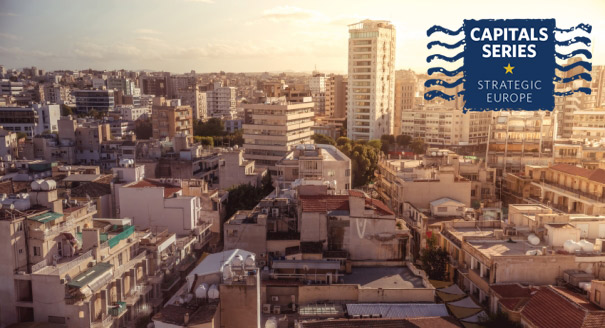
Cyprus could play a major geopolitical role in the Eastern Mediterranean. Yet for reasons both within and outside its control, Nicosia has yet to exploit this potential.
Strategic Europe continues its series devoted to explaining the foreign and security policy ambitions of the 28 EU member states. We have asked our contributors from each capital to give a candid assessment of their country’s perception of security and strategy, with a ranking on a scale from 0 (the laggards) to 5 (the ambitious). This week, the spotlight is on Cyprus.
*
A new term has recently entered the lexicon of Cypriot foreign policy. It was born out of necessity rather than ambition, and although it has brought some hope, it has also resulted in considerable controversy. It’s the new multidimensional foreign policy.

Cyprus’s accession to the European Union in 2004 had extinguished such changeable impulses by anchoring the small island state into the Western European political fold. Overnight, Cyprus became the EU’s farthest outpost in an increasingly turbulent Eastern Mediterranean.
However, EU membership did not serve as the catalyst it had been billed as in terms of ending the country’s division, which has been in place since Turkey invaded the northern part of the island in 1974. What is more, many Cypriots saw the union’s solidarity to be lacking during Europe’s recent economic crisis. As a result of these two factors, the EU’s gloss quickly wore off, and the specter of a more multidimensional realpolitik emerged.
Given the EU’s own lack of direction and diminishing clout, this may not be a bad thing. Cyprus’s shift has in some ways marked a coming of age for the country, an acknowledgment of what Nicosia needs to do to survive the bruising complexity of power politics within the EU.

Within two weeks, he was ignominiously forced to accept a €10 billion ($11 billion) bailout agreement from the EU and the International Monetary Fund in return for introducing austerity measures and reforms. Crucially, the bailout was accompanied by a so-called bail-in that involved an unprecedented write-off of deposits in an attempt to keep the island’s biggest bank afloat.
With the eurozone perceived as a punisher and not a savior, and with Moscow reeling when Russian depositors lost billions from Cypriot banks, Nicosia scrambled for allies. Its rusty instincts toward the Non-Aligned Movement began to kick in. Cyprus’s once record-high pro-European sentiment was eroded to inconceivable lows.
Two years on, the economy is still hurting, and resentment of the EU’s decisions remains. Yet substantive reforms are proceeding apace, and public finances are improving significantly. Surprisingly, Russian businesses stayed on in Cyprus, galvanizing relations between the two countries. This culminated in better repayment terms for an older €2.5 billion ($2.8 billion) Russian loan and the updating of an agreement that allows Russian warships to dock in the Cypriot port of Limassol.
Many in #Cyprus saw EU solidarity lacking during the euro crisis.Tweet This
The international media hyped up the military deal as a rebellious shift. The agreement’s renewal came at a time when Russian President Vladimir Putin was seeking to erode the EU’s stance on the Ukraine crisis and Nicosia had its own reservations about Western sanctions against Russia. The Cypriot government was at pains to explain that Russian privileges would in fact be no different from those already enjoyed in Cyprus by the U.S. Sixth Fleet or by the French and German navies.
Many Cypriots have argued that Cyprus was picked on, and that its approach has not been very different from the multidimensionalism consistently exercised by most other EU member states. Cyprus’s defenders claim that the country remains as aligned with the EU’s Common Foreign and Security Policy as all other member states. They add that Cypriot reservations on questions of national interest are in fact far fewer than those of states that pretend to occupy the European moral high ground.
Certainly, EU membership has enhanced Cyprus’s security and allowed for a sense of stability never enjoyed on the island before. Being a part of the EU has mitigated the chances of any future aggression by NATO member Turkey.
EU membership has not, however, brought closure to the endless rounds of UN-brokered talks for a settlement of the island’s division. A new round began in May 2015 after a lengthy pause. That is another last chance since the previous last chance—but one that does carry high expectations, despite the complexity of the issues to be resolved. For the moment, the only two drivers of the process and the expectations are, first, the close personal relationship between Anastasiades and the new moderate Turkish Cypriot leader Mustafa Akıncı and, second, both sides’ underlying sense of fatigue with the status quo.
Notwithstanding the improving climate between Cyprus’s Greek- and Turkish-speaking communities, Cyprus remains constrained by the stranglehold Ankara has on it. Since Greece is no longer the counterweight it once was, opposing Turkey’s own, often hostile, ambitions in the region requires adept diplomatic maneuvering around the five permanent members of the UN Security Council, which mandate the UN negotiations.
When in late 2014 a Turkish research vessel began menacingly crisscrossing Cyprus’s gas-rich exclusive economic zone, the Cypriot government expected the United States and the UK to step in. When they didn’t, Anastasiades was left bitterly exposed, particularly as U.S. Vice President Joe Biden had visited Nicosia in May of the same year, hailing a new partnership between Cyprus and the United States.
With the United States failing to reprimand Turkey and the UK remaining steadfastly aloof, Cyprus veered toward Russia. It was no coincidence that Anastasiades attended the Victory Day Parade in Moscow’s Red Square on May 9, 2015, one of only four EU leaders to do so.
#Cyprus has never really been allowed a regional role.Tweet This
Though blessed by geography, Cyprus has never really been allowed a regional role, partly because of its division. However, the current government has been keen to strengthen ties with countries in the region that have converging interests or common threats. The strained relations between Turkey and Egypt as well as Israel’s own strategic concerns have recently granted Cyprus a level of significance that the British had identified when the island was a colony.
Critically, however, to add substance to any ambitions, Cyprus needs to invest in human resources. The economic crisis has forced civil service cutbacks, and the foreign ministry and its diplomatic missions are suffering considerably. Local think tanks are few and are rarely listened to, let alone consulted.
Political parties are not hubs of foreign policy formulation. Their affiliation with their respective groups in the European Parliament has provided some stimulation, but Cypriot parties still lack the depth, the structures, and the will to adapt and to engage in meaningful research or constructive debate.
Cyprus’s stability has consistently proved pivotal for the big players in the Eastern Mediterranean on surveillance, antiterrorism, and humanitarian crisis management. However, for reasons both within and outside its control, Nicosia has yet to exploit this potential. Crucially, as a new UN process for Cyprus unfolds, it is clear that any convoluted political settlement could make the country’s unfulfilled ambitions potentially divisive.
Nicholas Karides is the director of Ampersand Public Affairs.
Nicholas Karides
Ampersand Public Affairs
Carnegie does not take institutional positions on public policy issues; the views represented herein are those of the author(s) and do not necessarily reflect the views of Carnegie, its staff, or its trustees.

As we close out another season of Strategic Europe, it is worth taking stock of the deep shifts underway.

Rym Momtaz
The EU had to compromise to adopt a twenty-first sanctions package against Russia, exposing growing cracks in the union’s resolve. Is this latest, weaker round worth it to keep pressure on Moscow?
Rym Momtaz, ed.

Trump is distracted and Ukraine wants Europe to step up. The continent’s leaders must find their voice and assert it in talks with Russia.

Alissa de Carbonnel

Mounting economic strain and battlefield losses will not necessarily make the Kremlin less dangerous. They could instead push Moscow toward a more aggressive hybrid campaign designed to test NATO’s Eastern flank, exploit allied hesitation, and fracture European resolve.

Maksym Beznosiuk

Over the past ten years, NATO has held almost as many summits as it did during the entirety of the Cold War. Are they still useful, or is it time to stop holding annual meetings?
Rym Momtaz, ed.