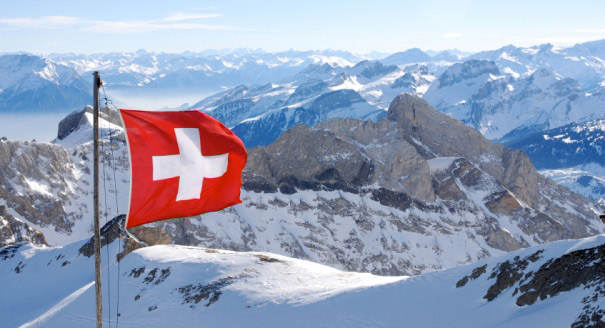
Swiss politicians these days receive many British visitors who want to know what it is like for a country to be European without having EU membership. At the same time, Dutch far-right politician Geert Wilders says the Netherlands should quit the EU and be like Switzerland. “Switzerland is the example,” he said on RTL television in May 2014, praising the country’s sovereignty, immigration policies, direct democracy, and economic prosperity. And Germany’s far-right, anti-Islam Pegida movement repeatedly singles out Switzerland in its manifesto as an example to follow.
These politicians and political parties argue that all will be better if their countries pull out of the EU. They are wrong. Switzerland is essentially as dependent on Brussels as EU countries are. In fact, the Alpine country is losing as much sovereignty and democratic impact as EU members. The problem is not Brussels. It is globalization.
As a nation with one of the world’s most open economies, Switzerland increasingly has to play by global rules. Those rules are not set in Bern. After fierce battles with the U.S. tax authorities in recent years, the Swiss have de facto given up their banking secrecy, which is enshrined in the country’s constitution. If they had not handed over thousands of bank files on American citizens, Swiss banking giants UBS and Credit Suisse would have lost their license to do business on Wall Street. Without this license, a bank cannot trade in dollars—in other words, it is dead.
#Switzerland is losing as much sovereignty as EU members.
Washington presented Bern with a clear-cut choice: Either play the global game and have the world’s biggest banks, or play the sovereign game and shield foreign bank clients in your country. You can no longer have it both ways—especially as a small country.
Switzerland once was a safe haven for dictators’ fortunes. No more. After heavy international pressure, particularly since the 9/11 terrorist attacks on the United States, Bern now clamps down on money launderers and scrutinizes politically exposed individuals. And after the recent U.S. crackdown on officials of football’s world governing body FIFA in Zurich, Swiss lawmakers will finally change a decades-old law that exempts sports associations from scrutiny.
Almost half of Switzerland’s imports come from Germany, Italy, or France. The Swiss said no to joining the European Economic Area in a referendum in 1992, but they need access to the EU’s internal market, which completely surrounds their country. So Bern has concluded many bilateral treaties with Brussels that require Switzerland to adhere to the basic rules governing the internal market—free movement of goods, people, capital, and services.
In February 2014, the Swiss voted in a referendum to impose restrictive quotas for foreigners wishing to live in Switzerland. The Swiss feel swamped, even if figures show that 85 percent of these foreigners are European citizens, mostly well-educated ones such as German engineers or French doctors, on whom the Swiss economy depends. To this day, Bern has not figured out how to square this vote with free access to the EU market, showing how important Brussels is even for EU outsiders.
Swiss lawmakers draft most legislation and regulations in such a way that Swiss companies have access to the EU’s internal market without facing two incompatible sets of rules. Just like Norway, which voted against EU membership in 1994, Switzerland more or less copies EU law into its national legislation without having any influence over its content. (The Norwegians call this the fax economy.)
When EU leaders in Brussels discuss banking regulations or provisions on the EU’s passport-free Schengen Area—rules that directly affect Switzerland, the Swiss president is absent. The Swiss ambassador doesn’t get farther than the press room.
The eurozone crisis is as costly for #Switzerland as for EU states.
The eurozone crisis is also as costly for Switzerland as for EU states. Investors have been selling euros and buying safer Swiss francs for several years now—ever since the start of the euro crisis. This made the franc and Swiss products so expensive that in 2011, the Swiss National Bank pegged the franc to the euro. The bank bought billions of euros to keep the exchange rate stable. In early 2015, the bank abruptly abandoned the peg, having amassed about $480 billion worth of foreign currency, equivalent to 70 percent of Switzerland’s GDP.
Because of this so-called Francogeddon, the Swiss stock market crashed, hedge funds took big losses, and prices shot up again. More than ever before, Swiss citizens flock over the border to neighboring EU countries to buy eggs, furniture, or wine for half the price. Many people would gladly pay a fine for buying more than the allowed quantities, because most of the time they are not caught. According to the journal Intereconomics, “seldom have the well-being of the Swiss economy in general and the success of Swiss monetary policy in particular been this dependent on the euro.”
Because the Swiss need to apply so many global rules and EU regulations, their self-rule is also compromised. Many Swiss citizens find their country’s system of direct democracy is not functioning as it used to. Voter turnout in general is below 50 percent, far lower than in most EU member states. Ten years ago, several villages around Geneva reported that turnout for a referendum had declined to 30–40 percent, with the extreme right-wing Swiss People’s Party ahead nearly everywhere.
A former village mayor conceded to me that Swiss locals had become rich by selling vineyards to multinational companies and by renting out houses to the new globalized middle class. Life was good, he said; the well-off immigrants Switzerland had managed to attract made other nationals green with envy. “But we’ve sold our souls and destroyed our social tissue,” he added. Another official complained that the government was ignoring the Swiss refusal to join the EU: “It doesn’t matter how we vote. Every year, we get more EU regulation via the back door.”
So those who claim that certain EU member states should leave the union and be like Switzerland are deceiving the electorate. Switzerland has the same problem as EU countries: a considerable loss of sovereignty. The cause is not Brussels, but globalization. Quitting the EU is therefore a false remedy, and it is time those fantasists up north realized that.
Caroline de Gruyter is the Vienna correspondent for NRC Handelsblad and the author of the recently published Zwitserlevens. She was previously based in Brussels and Geneva.