

Commentary
Judy Dempsey
{
  "authors": [
    "Judy Dempsey"
  ],
  "type": "commentary",
  "blog": "Strategic Europe",
  "centerAffiliationAll": "",
  "centers": [
    "Carnegie Endowment for International Peace",
    "Carnegie Europe",
    "Carnegie Russia Eurasia Center"
  ],
  "collections": [
    "Europe’s Eastern Neighborhood",
    "EU Integration and Enlargement"
  ],
  "englishNewsletterAll": "",
  "nonEnglishNewsletterAll": "",
  "primaryCenter": "Carnegie Europe",
  "programAffiliation": "",
  "programs": [],
  "projects": [],
  "regions": [
    "Europe",
    "Eastern Europe",
    "Western Europe"
  ],
  "topics": [
    "Foreign Policy",
    "EU"
  ]
}
Source: Getty
The European Union is strategically and politically ill prepared to make a difference at the regional or global level.
Each week over the past seven months, Carnegie Europe has been posting a letter from one of the 28 EU capitals. All the authors were given the same brief: to assess the level of foreign policy ambition of their country.
The assessments were fascinating but also depressing. It was argued that Germany, which is discovering foreign policy under Chancellor Angela Merkel, has a high level of ambition. So too have other big countries such as France, Italy, and Poland, according to those letters’ authors. But Britain’s ambitions and strategic culture are in fast decline.
Maybe, this has something to do with the size of the countries’ populations (see chart). But this is not entirely convincing. Look at Denmark’s role when it comes to Copenhagen’s robust defense and security policy, or Ireland’s as the country relishes peace with Northern Ireland.
Indeed, if there is any common thread running through the series, it is this: with few exceptions, European governments do not think or act strategically. And since they do neither, how then can they have the ambition to shape foreign policy, especially on the EU level?
Another conclusion is that instead of the EU forging a common strategic outlook, the union has achieved the opposite. Ambition, if it exists at all, is inward looking and based on the national level, on narrow interests, on short-term goals. Ambition seems to have little to do with projecting a strong EU—even though this is precisely what the union should be doing.
Throughout the series, foreign policy ambition was not defined. And that is the essential weakness of most of Europe’s governments. They shy away from ambition because it means defining and taking risks and providing the means to see those risks through.

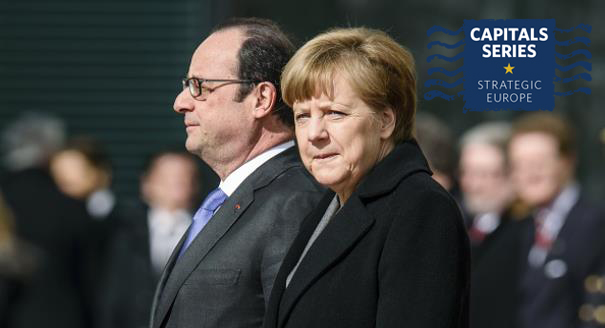
So far, Merkel and French President François Hollande have taken risks, in each case linked to a particular kind of ambition. Merkel is Europe’s negotiator with Russian President Vladimir Putin and has the unenviable task of overseeing the ever-fragile Minsk accord she concluded with Russia and Ukraine in February 2015 to stop the fighting in eastern Ukraine.
Hollande, meanwhile, has used France’s military and political influence in the Sahel to prevent Mali from breaking up and lurching into civil war. Merkel and Hollande each had their reasons to act. But the big question is whether they have a long-term foreign policy strategy and ambition to deal with Russia and the Sahel respectively. I’m not so sure.
Foreign policy, after all, is about projecting interests and values but also influence, which all need strategic underpinning. In the case of the EU, it is increasingly difficult for member states to go it alone, as Berlin and Paris have discovered when dealing with Russia or Mali. The issues have become much more complex and numerous.
Consider the case of Europe’s policy toward the Mediterranean refugee crisis. This was hardly an issue in most of the letters in the series, with the exception of those from Italy, Malta, and Greece.
Yet even though this is one of the most pressing problems facing the continent, member states prefer to pass the buck instead of giving the EU a major role in setting a strong refugee and asylum policy both for Europe and for the region from which the refugees are fleeing.
Related to the issue of migration is an extraordinary lack of interest in the self-proclaimed Islamic State and the serious security and social challenges that the militants pose for Europe.
Somehow, despite the January 2015 shooting at the offices of the French newspaper Charlie Hebdo and other terrorist attacks in Europe, the impression from reading all the letters was that Europe is living in a comfort zone—as if the continent were insulated from the turmoil in its Eastern and Southern neighborhoods. One can only hope and assume that Europe’s intelligence agencies see things differently and have increased their cooperation.
Another issue that got short shrift in the series was the Transatlantic Trade and Investment Partnership, or TTIP. Most authors agreed that their governments supported the trade agreement currently being negotiated. But not once did the contributions discuss the strategic and political implications of such a deal between Europe and the United States succeeding or failing.
In fact, the dearth of public discourse about TTIP has been disgraceful, despite the fact that it is a major foreign policy issue that has the potential to build a genuinely new transatlantic relationship. On that point, little attention was paid to defense issues—let alone to the role of the United States as Europe’s security guarantor.
The same could be said of the complete disinterest in the Middle East. China got some mention in terms of trade opportunities but not what kind of role the country will play in European and global politics in the coming years.
There were other omissions. But that is not the point. The point is that the series exposed how most countries neither see the relevance of Europe nor want to make Europe relevant. As long as this perception continues, Europe will slip further into decline—unless EU leaders embrace real, strategic foreign policy ambition for the continent.
*
Strategic Europe will be offline for two weeks starting on Monday, August 10. We hope you have enjoyed reading our analysis so far this year and look forward to welcoming you back on Monday, August 24. In the meantime, we invite you to take a look at our collection of summer reading recommendations. Have a great summer!

Nonresident Senior Fellow, Carnegie Europe
Judy Dempsey is a nonresident senior fellow at Carnegie Europe
Recent Work
Judy Dempsey
Judy Dempsey
Carnegie does not take institutional positions on public policy issues; the views represented herein are those of the author(s) and do not necessarily reflect the views of Carnegie, its staff, or its trustees.

With its public finances in shambles, the far right polling at 35 percent ahead of the 2027 presidential election, and a growing protest movement, is France’s crisis a threat to the EU’s geopolitical awakening?

Rym Momtaz, ed.

Ahead of a tough winter for Ukraine, Donald Trump’s swing back toward Russia bodes ill. But instead of panicking, Kyiv’s European allies are focusing on action.
Rym Momtaz

While the EU and European governments are embracing the much-lauded middle-power moment, this entails three difficult conundrums.

Richard Youngs

Much has been said of the changes Brussels is trying to make to the EU enlargement process. Here’s why gradual integration might—or might not—be the answer.

Dimitar Bechev

The European Commissioner for Trade is headed to China. But after President Xi’s bridge-building visit to Washington, can a more isolated EU overcome Beijing’s stranglehold on critical raw materials? Who will blink first?
Rym Momtaz, ed.