

Commentary
Judy Dempsey
{
  "authors": [
    "Judy Dempsey"
  ],
  "type": "commentary",
  "blog": "Strategic Europe",
  "centerAffiliationAll": "",
  "centers": [
    "Carnegie Endowment for International Peace",
    "Carnegie Europe"
  ],
  "collections": [
    "Europe’s Eastern Neighborhood"
  ],
  "englishNewsletterAll": "",
  "nonEnglishNewsletterAll": "",
  "primaryCenter": "Carnegie Europe",
  "programAffiliation": "",
  "programs": [],
  "projects": [],
  "regions": [
    "Europe",
    "Eastern Europe",
    "Ukraine"
  ],
  "topics": [
    "Democracy",
    "EU",
    "Civil Society"
  ]
}
Source: Getty
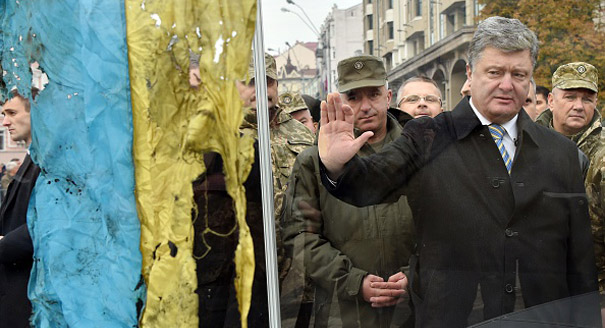
Ukraine’s civil society and young generation are determined to make the ongoing reforms to the country’s state institutions irreversible.
Ukraine is undergoing profound change aimed at ridding the country of the insidious and pervasive power of its oligarchs.
For decades, the ubiquitous presence of the oligarchs throughout Ukraine’s economy, media, parliament, ministries, civil service, and local government prevented the modernization and democratization of the EU’s Eastern neighbor.
Helped by successive leaders who either had no political will to confront them or were too beholden to them, the oligarchs dug deep into the fibers of the state and society. They established a system based on corruption, bribery, and intimidation that purposefully degraded the state institutions and undermined the sense of national identity. Such a system left Ukraine completely exposed to interference from Russia, which regarded Ukraine as part of its sphere of influence.
Now, for the first time since its independence in 1991, Ukraine is embarking on an extraordinarily difficult and complex transformation that touches almost every aspect of society. And for the first time, civil society and young people are driving the reforms. They were the backbone of the Maidan protest movement that toppled former president Viktor Yanukovych in February 2014.
Today, these activists are determined to dig up—not bury—Ukraine’s deep state. To do that, they are going to need a maximum of support from the European Union and EU governments to help Ukraine build a modern, democratic state.
Despite Europe’s other problems, especially the refugee crisis, this is not the time for the EU to waver over Ukraine. The success or failure of Ukraine’s ambitious reform program will have a profound impact on the stability of the country, of other post-Soviet states, and of the EU. Needless to say, success is not in the interests of the Kremlin. Russian President Vladimir Putin fears the contagion of democracy and it would affect his rule.
As it is, reformers are under immense pressure from Ukraine’s public and from the country’s international donors to deliver.
#Ukraine's reformers are under immense pressure from the public to deliver.Tweet This
In a series of fascinating meetings I attended in Kiev on October 15–17 with politicians, civil society activists, academics, diplomats, and people implementing the reforms, there was a real sense of urgency to show results.
Young ministerial officials, legislators, and activists warned that the Ukrainian public, which is shouldering very high energy prices plus a fall in living standards, is tired and could be vulnerable to populists who want to derail the reforms. The activists were also critical of the media, particularly television, which is still largely financed by the oligarchs, who are ambiguous—to say the least—about reforms.
As for international donors and individual EU governments, they complain that the reforms are too slow and that not enough is being done to combat corruption or curb the powers of the oligarchs.
But a look at legislation recently passed by the Rada, or parliament, shows how the deep state is being dug up. Public officials have to declare all their assets, and such information is now available electronically. Political party financing must now be transparent and will be paid out of the state budget and not by oligarchs, each of whom had his or her own corps of obedient legislators.
The reform of the police is making strides, too. Indeed, that is the one big visible change that ordinary citizens can see and experience.
The police apparatus, long renowned and reviled for its corruption, has been replaced by a new force of young men and women. The majority of them are graduates, according to Anastasia Leukhina, Ukraine’s law enforcement training and community policing coordinator. But just imagine the training, time, money, and human resources needed to build an entirely new police force. “It is about making the reforms sustainable,” Leukhina said.
It is also about making the reforms permanent. Hanna Hopko is the head of the parliament’s foreign affairs committee and a leading member of the EuroOptimists, a cross-party group of legislators. These young graduates, who took part in the 2004 Orange Revolution and last year’s Dignity Revolution, exude an energy and commitment that underpin the reforms. They are determined to change Ukraine.
Besides writing and pushing through legislation designed to make the political system transparent and accountable, they know that Ukraine has to implement those laws that erode the influence of the oligarchs—and down to the grass roots of society. “This is about making the reforms irreversible,” Hopko said.
These legislators believe there is still energy in Ukrainian society to support the reforms. “People now know they can influence the process,” said Vladyslav Golub, another EuroOptimist and member of the Rada’s committee on judicial policy and justice. “The conspiracy of silence, the conspiracy of corruption is being replaced by volunteers, by young people who support this revolution of values.”
Other reformers are more circumspect. Dmytro Kotlyar, an anticorruption expert and a former deputy minister of justice, worries that the new anticorruption institutions that have been or are being set up will require sustained enforcement, which is weak.
These institutions will also require support at the highest level—meaning from President Petro Poroshenko, who can choose the country’s general prosecutor. Anticorruption campaigners have criticized Poroshenko, an oligarch himself, for his caution over such appointments precisely because this post carries investigative powers that challenge the oligarchs and the balance of political power.
The EU has a role to play in supporting #Ukraine's anticorruption measures.Tweet This
EU governments and institutions also have a role to play in supporting these anticorruption measures. Young Ukrainian legislators and civil activists said they want the EU to freeze bank accounts and seize assets illegally obtained by the oligarchs.
In short, for those who risked their lives in 2014 on Kiev’s Maidan, or Independence Square, it’s about digging up the deep state. Having come this far, Kotlyar believes “it is impossible to go back now.”

Nonresident Senior Fellow, Carnegie Europe
Dempsey is a nonresident senior fellow at Carnegie Europe
Recent Work
Judy Dempsey
Judy Dempsey
Carnegie does not take institutional positions on public policy issues; the views represented herein are those of the author(s) and do not necessarily reflect the views of Carnegie, its staff, or its trustees.
The war in Iran proves the United States is now a destabilizing actor for Europe and the Arab Gulf. From protect their economies and energy supplies to safeguarding their territorial integrity, both regions have much to gain from forming a new kind of partnership together.

Rym Momtaz

French President Emmanuel Macron has unveiled his country’s new nuclear doctrine. Are the changes he has made enough to reassure France’s European partners in the current geopolitical context?
Rym Momtaz, ed.
European reactions to the war in Iran have lost sight of wider political dynamics. The EU must position itself for the next phase of the crisis without giving up on its principles.

Richard Youngs
Europe isn’t as weak in the new geopolitics of power as many would believe. But to leverage its assets and claim a sphere of influence, Brussels must stop undercutting itself.

Dimitar Bechev

Europe’s reaction to the war in Iran has been disunited and meek, a far cry from its previously leading role in diplomacy with Tehran. To avoid being condemned to the sidelines while escalation continues, Brussels needs to stand up for international law.

Pierre Vimont