

Commentary
Judy Dempsey
{
  "authors": [
    "Judy Dempsey"
  ],
  "type": "commentary",
  "blog": "Strategic Europe",
  "centerAffiliationAll": "",
  "centers": [
    "Carnegie Endowment for International Peace",
    "Carnegie Europe"
  ],
  "collections": [],
  "englishNewsletterAll": "",
  "nonEnglishNewsletterAll": "",
  "primaryCenter": "Carnegie Europe",
  "programAffiliation": "",
  "programs": [],
  "projects": [],
  "regions": [
    "Middle East",
    "Europe",
    "Western Europe"
  ],
  "topics": [
    "EU",
    "Migration",
    "Foreign Policy"
  ]
}
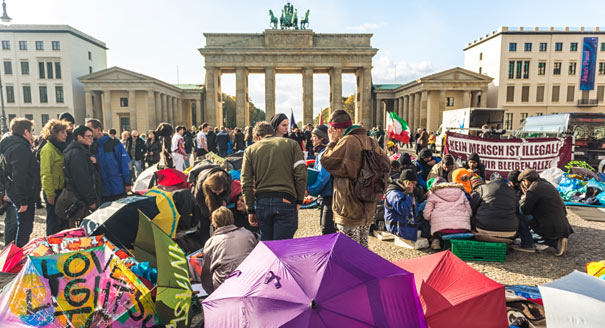
Source: Getty
The German chancellor is not only trying to rescue refugees. She is also trying to rescue the European Union from self-denial and self-destruction.
First, the good news. Greece has relocated 30 asylum seekers to Luxembourg. Thirty—and to one of the EU’s richest countries. This was the first such transfer from Greece after EU leaders agreed in October that refugees should be distributed within the EU away from those countries that are completely overwhelmed by the crisis.
“Thirty in the face of thousands who have fled their homes in Syria and Iraq is a drop in the ocean,” said Greek Prime Minister Alexis Tsipras. “We hope that this [transfer] becomes a stream, and then a river of humanity and shared responsibility, because these are the principles upon which the European Union was built,” he went on.
European Parliament President Martin Schulz, speaking in Athens, added that only eight of the EU’s 28 member states were participating in the relocation scheme.
Now, the bad news. Unless Angela Merkel, the German chancellor, can convince other countries to open their doors, the EU’s policy toward the refugees will cause irreparable damage to the bloc. The immediate damage is obvious. Most of the 28 member states have turned their backs on solidarity, values, and principles—the three blocks that are supposed to give the EU some degree of cohesion.
Merkel and the leaders of Sweden, Greece, and Austria now see that solidarity is an empty word. Most governments are not prepared to support each other in providing safety and shelter to the estimated 1 million people trying to reach Europe as they flee the wars in Syria and Iraq.
How Europe can have problems in providing roofs for such a number defies explanation for the people of Lebanon, Jordan, and Turkey. These three countries together have taken in almost 4 million Syrian refugees. In Lebanon, the conditions in which the refugees are living are now so appalling that human rights organizations have reported how girls, some as young as twelve, are being married off because their parents cannot afford to look after them. There are also millions of refugee children who have no access to any kind of schooling.
Merkel and the local authorities across Germany deserve praise and support for getting refugee children into schools as quickly as possible. This is not only about integrating them. It is also about giving them stability.
Most EU member states have turned their backs on solidarity and values.Tweet This
Values, too, have been discarded. Most EU member states are not extending protection and basic human rights to the refugees—a promise, by the way, that they signed up to in the 1951 refugee convention. As for principles, such as preserving the Schengen area of open borders across most of the EU, these have also been broken as countries, particularly Hungary, have built fences to keep refugees out.
The erosion of solidarity, values, and principles has had the effect of exposing the EU’s lack of confidence and identity. If the EU as a bloc had a culture of confidence, it could surely overcome this reluctance to accept refugees. If the EU had a shared culture of identity based on tolerance and openness, most countries would not feel threatened by refugees, as many of them do.
Confidence and a strong sense of identity are the two qualities that Merkel is now showing. For the moment, the majority of Germans support her despite the bickering from within her own conservative bloc and, particularly, from the Bavarian-based Christian Social Union party.
Seehofer and the CDU know full well there is no alternative to #Merkel.Tweet This
Horst Seehofer, the party’s leader, has been publicly criticizing Merkel’s open-door policy toward the refugees, even threatening the stability of Germany’s governing coalition. Yet Seehofer and Merkel’s own Christian Democratic Union party know full well there is no alternative to Merkel. Nor is there any going back on the refugee policy.
More importantly, they know how Merkel has kept the EU together over the euro crisis and over Russia’s March 2014 annexation of Crimea and invasion of the Donbas region in eastern Ukraine.
So far, Merkel has tried to keep the EU together over the refugee crisis as well. But Europe’s weaknesses are now out in the open. Until now, most EU governments have been in self-denial about what the refugee crisis really means. It is an inevitable aspect of globalization and the enormous power of social media that fences and walls mean little for refugees escaping war. EU leaders cannot seek refuge behind these barriers.

Nonresident Senior Fellow, Carnegie Europe
Judy Dempsey is a nonresident senior fellow at Carnegie Europe
Recent Work
Judy Dempsey
Judy Dempsey
Carnegie does not take institutional positions on public policy issues; the views represented herein are those of the author(s) and do not necessarily reflect the views of Carnegie, its staff, or its trustees.

A summer of escalation in the Black Sea has hurt Ukraine economically and is exacerbating world food security. A truce is needed—as is a broader reframing of Europe’s Ukraine strategy.

Thomas de Waal

Are Germany’s economic, industrial, and political struggles becoming a liability for the EU’s ability to rise to the geopolitical moment?

Rym Momtaz, ed.

European Commission President Ursula von der Leyen is about to give her annual address on the state of the EU. Here’s what she won’t—but should—say.
Rym Momtaz

The aftermath of the Ceuta crisis shows Europe has drawn the wrong lessons. Rather than doubling down on failed migration policies, the EU needs to address the underlying roots of such episodes.

Richard Youngs

An overwhelming victory by a far-right-wing party in a small state in eastern Germany will have major repercussions for Chancellor Friedrich Merz’s coalition.
Judy Dempsey