

Commentary
Marc Pierini
{
  "authors": [
    "Marc Pierini"
  ],
  "type": "commentary",
  "blog": "Strategic Europe",
  "centerAffiliationAll": "",
  "centers": [
    "Carnegie Endowment for International Peace",
    "Carnegie Europe"
  ],
  "collections": [
    "Europe’s Southern Neighborhood",
    "Arab Awakening"
  ],
  "englishNewsletterAll": "",
  "nonEnglishNewsletterAll": "",
  "primaryCenter": "Carnegie Europe",
  "programAffiliation": "",
  "programs": [],
  "projects": [],
  "regions": [
    "Middle East",
    "North Africa",
    "Tunisia",
    "Southern, Eastern, and Western Africa"
  ],
  "topics": [
    "Political Reform",
    "EU"
  ]
}
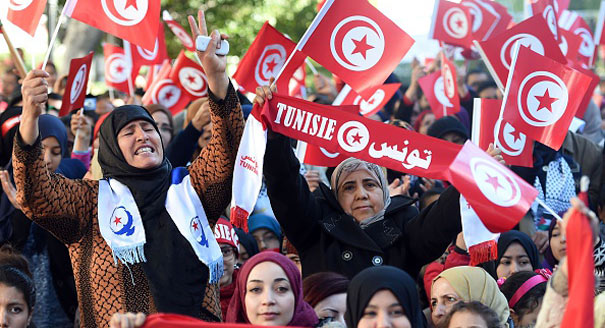
Source: Getty
As the country with the only peaceful Arab revolution, Tunisia has made remarkable progress since 2011. But major challenges remain.
January 14 marks the fifth anniversary of the Tunisian revolution, the first movement of the Arab Spring and the trigger for many other popular uprisings in Egypt, Libya, and Syria in particular. Tunisia has achieved a lot since 2011, but frustrations and dangers still loom large. All the more reason for the EU to be committed to the country.
In the last five years, Tunisia has witnessed remarkable accomplishments: the country’s police state was eliminated, democratic elections were held, a new constitution was crafted based on compromise between opposing views, freedom of expression was restored, new forms of dialogue were introduced, and, above all, the entire process was conducted in a peaceful manner.
The democratic infrastructure of the country is now almost complete, which, by historical standards, is a very swift transformation. Naturally, practicing democracy on a daily basis is infinitely more complicated than voting on new laws and setting up institutions. The “new game of democracy,” as one of my Tunisian interlocutors described the process, is a long-term one. Right now, the democratic hardware is in place, the software is not.
Here lies the Tunisian quandary. While the revolution’s achievements are admirable—and admired in the Western world—the country is facing urgent challenges on both at home and abroad.
Inside Tunisia, those who triggered the revolution—the youth and those excluded from prosperity—have not seen much improvement. On the contrary, tourism receipts have plummeted, local and foreign investment has dropped drastically, and foreign donors haven’t found ways to channel fast-disbursing assistance. Despair among the young—almost half of the country’s unemployed are young graduates—can be fertile ground for extremist forces.
Externally, Tunisia is prone to the adverse consequences of the uncertain situation in Algeria and, more immediately, the potential spillover effects of the chaos in Libya and the swift progress of the self-proclaimed Islamic State in that country.
On the political side, Tunisia is in theory safely governed by the solid parliamentary majority of the current coalition between liberal forces and the country’s Islamist party. However, beyond the reassuring official narrative of the coalition members lie worrying trends and massively different societal projects. The liberal side of this improbable coalition, the Nidaa Tounes party, is slowly crumbling, with one resignation after another, to the point that its Islamist partner, Ennahdha, is now the largest party in the parliament.
Ennahdha, for its part, is playing a long game, patiently waiting for local elections, in principle later in 2016, to consolidate its position and reinforce its dominance at the national level while bringing progress to citizens at the local level. This strategy is comparable to that of Turkey’s Islamist Justice and Development Party (AKP) over the past twenty years, in an inverted sequence.
On the external front, Tunisia is witnessing a strange phenomenon: it is probably the Arab country gathering the strongest support from its Western partners, but its citizens cannot see the effects of these good words. Promises and pledges abound, with aid in return for reforms, but donor organizations and the government are (gently) blaming each other for change not materializing fast enough.
Donors and the government both have good explanations for the lack of progress, but they cannot wait much longer to deliver the positive effects of their mutual commitments. Since the tragic terrorist attacks in Sousse and Tunis in 2015, an effective mechanism has been put in place to reinforce security cooperation. The same is urgently needed on the economic and social fronts.
Those in the business of international cooperation know the difficulties of swiftly channeling financial resources and applying them to produce structural reforms and quick deliverables for citizens. Clearing bottlenecks and bringing hope to citizens are urgent and mutual tasks.
One precaution is needed, though: ordinary citizens and the young need to quickly feel the difference. They won’t if international support is made up only of macrofinancial assistance and large infrastructure projects such as ports and highways. Citizens should be involved in tangible, new initiatives. Possibilities are endless: a tablet for each elementary school child across the country, accompanied by proper teaching, would give parents a sense that everybody can share in modernity; and a nationwide plan to address Tunisia’s immense environmental challenges (water shortages and desertification in rural areas, selective waste collection in urban areas) would help mobilize volunteers and distribute income.
Overall, Tunisia’s financial challenge is not huge for Western powers: some €6–9 billion ($7–10 billion) over the next five years, accompanied by a clearinghouse mechanism, would go a great length to boost the country’s forces with a mix of budget support and concrete, people-oriented projects. This would be a sound investment from the Western community in the Tunisian revolution before the regional environment becomes more chaotic.

Senior Fellow, Carnegie Europe
Marc Pierini is a senior fellow at Carnegie Europe, where his research focuses on developments in the Middle East and Turkey from a European perspective.
Recent Work
Marc Pierini
Marc Pierini
Carnegie does not take institutional positions on public policy issues; the views represented herein are those of the author(s) and do not necessarily reflect the views of Carnegie, its staff, or its trustees.

When the U.S.-Iran memorandum of understanding was announced, the UK, France, Germany, and Italy declared their readiness to help demine the Strait of Hormuz and lift nuclear sanctions on Tehran. But does Europe need new tools to recover a diplomatic role?

Rym Momtaz, ed.
The Franco-German relationship is on the rocks again. But unlike previous moments of tension, the epochal changes on the world stage require that both step up investment in their bilateral ties.
Rym Momtaz
The EU is putting together a new security strategy to meet today’s myriad challenges. But for any proposal to be effective, the union needs to grapple with its identity and ambitions.

Pierre Vimont

The EU’s new migration policy is not suited to today’s realities. With climate change increasingly becoming a driver of displacement, Europe needs to rethink its deterrence-focused approach.

Shana Tabak
The battle over free speech has taken center stage since U.S. Vice President JD Vance accused Europe of censorship. From travel bans to social media regulation, especially around the Israel-Palestine conflict, are liberal democratic governments weaponizing free speech?
Rym Momtaz, ed.