

Commentary
Judy Dempsey
{
  "authors": [
    "Judy Dempsey"
  ],
  "type": "commentary",
  "blog": "Strategic Europe",
  "centerAffiliationAll": "",
  "centers": [
    "Carnegie Endowment for International Peace",
    "Carnegie Europe"
  ],
  "collections": [
    "Europe’s Southern Neighborhood"
  ],
  "englishNewsletterAll": "",
  "nonEnglishNewsletterAll": "",
  "primaryCenter": "Carnegie Europe",
  "programAffiliation": "",
  "programs": [],
  "projects": [],
  "regions": [
    "Europe",
    "Western Europe"
  ],
  "topics": [
    "EU",
    "Migration"
  ]
}
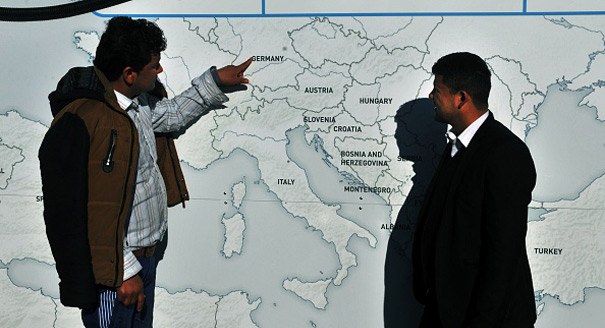
Source: Getty
The EU and the German chancellor are becoming increasingly powerless as individual countries adopt their own policies to deal with Europe’s refugee and migrant crisis.
When Chancellor Angela Merkel announced in fall 2015 that Germany would adopt an open-door policy toward refugees fleeing the war in Syria, she didn’t inform her Christian Democratic Union party or her coalition partners. Nor did she inform the European Commission, the EU’s executive, or her neighbors—except her Austrian counterpart, Chancellor Werner Faymann.
Austria, along with Germany and Sweden, has been taking in an unprecedented number of refugees since 2014. But now, with no end in sight to the war in Syria and with the rise of populism in Austria, Vienna has had enough. Austria has introduced border controls and limits on the number of refugees allowed into the country. That was a blow to the EU and to Merkel. Member states are going their own way.
So far, there has been little progress. More than 110,000 people have arrived in Greece and Italy in the first two months of 2016 alone. That is in addition to the 1 million asylum seekers who entered the EU in 2015, most of whom ended up in Germany.
Austria’s decision to impose limits hasn’t stemmed the flow of refugees and migrants either. The country’s border has been only half closed. Refugees can still make their way to Germany.
The result is that the strain on Greece and other Western Balkan countries has become intolerable. There are over 12,000 migrants stranded in Greece, a country that is simply unable to cope financially, politically, or socially with the influx. To make matters worse for Greece, its neighbor Macedonia has closed its border. Other countries in the region have built fences on their frontiers because EU member states cannot agree on a common refugee and asylum policy.
Above all, many of these countries now blame Merkel for her open-door policy. Because she will not impose any limits on those entering Germany, it is to Germany that most of the refugees and migrants are heading. And as the majority of refugees make their way across the Western Balkan route, the ability of the under-resourced countries in the region to cope has reached breaking point—which in turn has added more misery for those seeking safety and shelter.
To alleviate some of the pressure, ministers from Austria and nine Balkan countries met in Vienna on February 24 to discuss ways to control the region’s borders and check the identities of people seeking refuge. The aim was to make it as difficult as possible for those reaching Greece to leave the country.
Astonishingly, Greece was not invited to the meeting. Greek Prime Minister Alexis Tsipras was furious, and rightly so. “Greece will no longer agree to any deal if the burdens and responsibilities are not shared proportionally,” he told the Greek parliament. “We will not allow our country to turn into a warehouse of souls.”
The Vienna meeting showed the helplessness of the EU in its attempts to persuade member states to share the burden of refugees. Indeed, the EU’s future ability to implement any kind of burden sharing was dealt another blow.
On the same day as the Vienna meeting, Hungarian Prime Minister Viktor Orbán announced he would hold a referendum on the European Commission’s plans to introduce quotas for relocating migrants throughout the EU. Hungary was the first EU member to build a high razor-wire fence along its border to prevent any refugees from entering the country. Since then, Hungary and other EU states have refused to implement the commission’s burden-sharing measures. Several countries have introduced border controls that are undermining the EU’s Schengen system of passport-free travel.
“Nobody has asked the European people so far whether they support, accept, or reject the mandatory migrant quotas,” Orbán said. “The government is responding to public sentiment now: we Hungarians think introducing resettlement quotas for migrants without the backing of the people equals an abuse of power,” he added.
It wouldn’t be surprising if Orbán’s decision to hold a referendum were copied by Poland, the Czech Republic, and Slovakia, whose leaders want little or nothing to do with the refugees. If Hungarians vote to oppose burden sharing, it will further weaken the EU’s ability to forge any kind of common policy to cope with the refugee crisis.
Merkel, in the meantime, is still betting on Turkey’s cooperation. But it would be naive if she and Jean-Claude Juncker, the European Commission president, and Donald Tusk, the president of the European Council, which brings together EU leaders, believed a partial solution to the refugee crisis could be found at an EU summit with Turkish President Recep Tayyip Erdoğan in early March.
What all this means is that it falls to Merkel to make a decision on how to move forward in the refugee crisis. Were she to impose limits on the number of refugees and migrants entering Germany, this could relieve the pressure on the Western Balkans and Greece. Were the EU to really step up its efforts to help Lebanon, Turkey, and Jordan take care of the refugees, this could make a difference too.
But ultimately, the refugee crisis will abate only once the war in Syria ends. Of that, there is no sign. Unless there is a major change of heart among all 28 EU member states toward sharing the burden, the EU will further unravel, and as Carnegie Europe’s Stefan Lehne suggested in a recent article, it could become “an ever-looser union.” The EU is already heading in that direction.

Nonresident Senior Fellow, Carnegie Europe
Dempsey is a nonresident senior fellow at Carnegie Europe
Recent Work
Judy Dempsey
Judy Dempsey
Carnegie does not take institutional positions on public policy issues; the views represented herein are those of the author(s) and do not necessarily reflect the views of Carnegie, its staff, or its trustees.
Donald Trump has repeatedly bashed NATO and European allies, threatening to annex Canada and Greenland and deploring their lack of enthusiasm for his war of choice in Iran. Is this latest round of abuse the final straw?

Rym Momtaz, ed.
Donald Trump’s repudiation of NATO goes against the Make America Great Again vision of a U.S.-centered foreign policy. If the goal is to preserve the alliance by boosting Europe’s commitments, leaning into France’s vision is the most America First way forward.
Rym Momtaz
Hungarians head to the polls on April 12 for an election of national and European consequence. Three different outcomes are on the cards, each with their own implications for the EU.
Zsuzsanna Szelényi
The far right failed to win big in France’s municipal elections. But that’s not good news for the country’s left wing, which remained disunited while the broader right consolidated its momentum ahead of the 2027 presidential race.
Catherine Fieschi
Donald Trump has demanded that European allies send ships to the Strait of Hormuz while his war of choice in Iran rages on. He has constantly berated NATO while the alliance’s secretary-general has emphatically supported him.
Rym Momtaz, ed.