

Commentary
Judy Dempsey
{
  "authors": [
    "Judy Dempsey"
  ],
  "type": "commentary",
  "blog": "Strategic Europe",
  "centerAffiliationAll": "",
  "centers": [
    "Carnegie Endowment for International Peace",
    "Carnegie Europe"
  ],
  "collections": [],
  "englishNewsletterAll": "",
  "nonEnglishNewsletterAll": "",
  "primaryCenter": "Carnegie Europe",
  "programAffiliation": "",
  "programs": [],
  "projects": [],
  "regions": [
    "Europe",
    "Western Europe",
    "Germany"
  ],
  "topics": [
    "EU"
  ]
}
Source: Getty
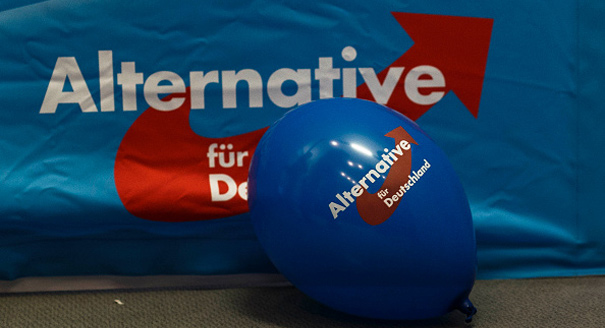
Big electoral gains by a populist, xenophobic movement opposed to Angela Merkel’s refugee policy have shaken Germany’s established party system.
The outcome of elections in three German regions on March 13 was a big protest vote against Chancellor Angela Merkel’s open-door policy toward refugees.
The contests revealed an electorate torn between defending her refugee policy and staunchly opposing this kind of immigration. For the first time, the results in the regions of Baden-Württemberg, Rhineland-Palatinate, and Saxony-Anhalt showed voters flocking to the Alternative for Germany (AfD), a nationalist, Euroskeptic, and xenophobic party.
Similar parties and leaders across Europe might feel vindicated that their attitude toward the refugees—keeping them out—is now gaining traction in Germany. That would be a mistaken assumption. Neither Merkel nor the leader of her coalition partner, the Social Democrats’ Sigmar Gabriel, has ever played the populist card. Nor will they do so after these election results.
Before now, populist or xenophobic parties in Germany rarely won more than 5 percent of the vote. The success of the AfD changed that, at least for the moment. The party received 15.1 percent of the vote in Baden-Württemberg, overtaking the Social Democrats, and 12.6 percent in Rhineland-Palatinate. In the eastern region of Saxony-Anhalt, the AfD captured 24.2 percent of the vote, becoming the second-largest party. It pushed into third place The Left, a movement created out of the former East German Communist party.
The AfD’s big success in this part of eastern Germany confirmed a trend that is antiforeign and anti-Islam. Over the past year, there have been many arson attacks on refugee hostels in the country’s eastern regions. Local politicians in the east have finally acknowledged that there is a serious problem when it comes to racism.
Yet if there is any solace for the established parties after March 13, it is that all three incumbent premiers were reelected. The Greens won a stunning victory in Baden-Württemberg, while Merkel’s Christian Democrats lost 12 percentage points, taking their vote share down to 27.0 percent. That’s a staggering blow for a party that for decades has been entrenched in this prosperous region.
What was also interesting about the result in Baden-Württemberg is that Winfried Kretschmann, the region’s highly popular Green premier, had openly supported Merkel’s refugee policy—and the party’s share of the vote increased by 6.1 points to 30.3 percent. Support for the Social Democrats was cut almost in half, falling to a mere 12.7 percent.
The miserable results for the CDU and the Social Democrats were due not only to the popularity of the Greens. According to infratest dimap, an independent polling institute, the AfD in Baden-Württemberg sucked 190,000 voters away from the Christian Democrats and 90,000 from the Social Democrats.
In Rhineland-Palatinate, the Social Democrats hung onto power largely because of the immense popularity of their premier, Malu Dreyer. Her victory dampened any speculation about the political ambitions of her CDU contender, Julia Klöckner, who had distanced herself from Merkel’s policies in the hope she could unseat Dreyer.
Across in Saxony-Anhalt, the Christian Democrats’ Reiner Haseloff managed to hold onto his job too. But Haseloff has the same dilemma as the other premiers: they are all going to have difficulties in forming simple coalitions with just one other party in the regional legislatures. The AfD’s victory ensures weeks of horse-trading.
One thing is certain: no premier will contemplate building a coalition with the AfD. But nor can any of the winners afford to ignore the outcome of these elections, which amounted to a warning for Merkel’s coalition at the national level.
No doubt the AfD will exploit its victories and will do everything to maintain its momentum when another round of regional elections takes place in September 2016 in Berlin, Mecklenburg-Vorpommern, and Lower Saxony. The AfD’s leader, Frauke Petry, went further. Speaking after the election results on March 13, she said her party was on the winning straight, particularly in view of the 2017 federal election.
No doubt too, in the aftermath of the latest results, CDU officials may start piling on the pressure for Merkel to change course by putting a cap on the number of refugees and migrants arriving in Germany.
But it is highly unlikely that Merkel will change course. The decisions by Austria and the Western Balkan countries to effectively close their borders to migrants trapped in Greece has bestowed a favor on Merkel. That has given her some breathing space, despite the election results. But it might not be enough for traditional conservatives to return to the CDU.

Nonresident Senior Fellow, Carnegie Europe
Dempsey is a nonresident senior fellow at Carnegie Europe
Recent Work
Judy Dempsey
Judy Dempsey
Carnegie does not take institutional positions on public policy issues; the views represented herein are those of the author(s) and do not necessarily reflect the views of Carnegie, its staff, or its trustees.
Europe isn’t as weak in the new geopolitics of power as many would believe. But to leverage its assets and claim a sphere of influence, Brussels must stop undercutting itself.

Dimitar Bechev

Europe’s reaction to the war in Iran has been disunited and meek, a far cry from its previously leading role in diplomacy with Tehran. To avoid being condemned to the sidelines while escalation continues, Brussels needs to stand up for international law.

Pierre Vimont
France and Germany’s failure to agree on the Future Combat Air System (FCAS) raises questions about European defense. Amid industrial rivalries and competing strategic cultures, what does the future of European military industrial projects look like?

Rym Momtaz, ed.
France has stopped clinging to notions of being a great power and is embracing the middle power moment. But Emmanuel Macron has his work cut out if he is to secure his country’s global standing before his term in office ends.
Rym Momtaz
Integrating AI into the workplace will increase job insecurity, fundamentally reshaping labor markets. To anticipate and manage this transition, the EU must build public trust, provide training infrastructures, and establish social protections.
Amanda Coakley