

Commentary
The EU can impose sanctions but struggles to enforce them without the United States. With Washington increasingly disinterested in backing European interests, the bloc must now fend for itself.
Nicu Popescu, Tiago Antunes
{
  "authors": [
    "Daniel Keohane"
  ],
  "type": "commentary",
  "blog": "Strategic Europe",
  "centerAffiliationAll": "",
  "centers": [
    "Carnegie Endowment for International Peace",
    "Carnegie Europe"
  ],
  "collections": [
    "Brexit and UK Politics"
  ],
  "englishNewsletterAll": "",
  "nonEnglishNewsletterAll": "",
  "primaryCenter": "Carnegie Europe",
  "programAffiliation": "",
  "programs": [],
  "projects": [],
  "regions": [
    "Europe",
    "Western Europe",
    "United Kingdom"
  ],
  "topics": [
    "EU",
    "Security",
    "Military"
  ]
}
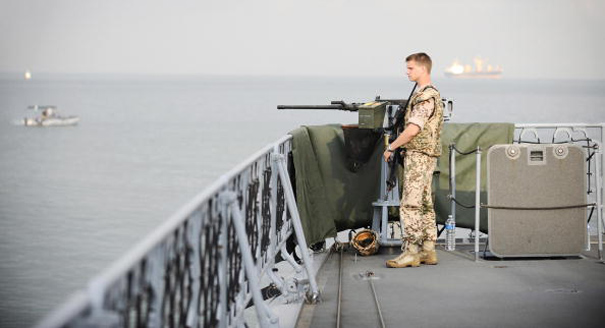
Source: Getty
In part because the UK is not a member of the eurozone or the Schengen Area, leading on defense policy would increase London’s overall political influence in the EU.
The risks for UK and European security of a Brexit—a British exit from the EU—have become a central theme in the campaign for the British EU referendum to be held on June 23. British Prime Minister David Cameron told an audience in London on May 9 that “whenever we turn our back on Europe, sooner or later we come to regret it. . . . Can we be so sure that peace and stability on our continent are assured beyond any shadow of doubt? Is that a risk worth taking?”
Cameron strongly emphasized that cooperation with other European governments is essential for coping with the myriad of security challenges that Britain and Europe face. He cited a number of concrete examples of useful EU security policies, such as sharing intelligence for countering terrorists or placing economic sanctions on Iran and Russia. He also highlighted how EU cooperation “does not undermine NATO, it is a vital reinforcement to it.”
In contrast, his only mention of EU defense policy was to confirm that London would veto “any suggestion of an EU army” (like NATO, the EU makes defense policy decisions by intergovernmental consensus). No doubt the main reason for this sparing reference was to retort scare stories run last week by some British newspapers that Germany is plotting to create an EU army.
It is no secret that some senior German politicians are rhetorically committed to the long-term aim of a European army (as are some Belgian, Italian, and Spanish politicians—but few from other countries). Since her appointment as German defense minister in late 2013, Ursula von der Leyen has regularly said that she hopes for a European army someday. Considered a conventional position in Berlin, especially among those politicians who support the idea of a federal EU, this notion is toxic in the British EU debate.
This is a shame. Not because an EU army is a good idea—and an idea that London can block only if the UK remains in the EU—but because emotional claims about a Euromartial fantasy conceal a much more important point: an effective EU defense policy is in the British interest.
There are four reasons for this. First, if the British people choose to stay in the EU on June 23, acting through the union will remain a strategic option for the UK. True, EU military operations so far have not been as full-bodied as those of NATO or the UN. But some have been very effective, such as the missions in the Democratic Republic of the Congo in 2003, in Bosnia and Herzegovina since 2004, in Chad during 2008–2009, and on the waters off Somalia to counter pirates since 2008 (which is run from a British military headquarters).
This matters because the United States will not always put out Europe’s fires, meaning NATO will not always act. Indeed, this was a major part of the strategic logic behind the 1998 Anglo-French defense agreement reached at Saint-Malo, which begat the EU’s defense policy. That agreement stated that the EU “must have the capacity for autonomous action, backed up by credible military forces, the means to decide to use them, and a readiness to do so, in order to respond to international crises.”
Even if eighteen years later the EU has not yet proved as robust as NATO (let alone anything akin to a European army), and even though it would always be preferable to act with the United States, wouldn’t it be in the British interest to keep that strategic option?
Second, the UK—alongside France—is a deutsche mark of European defense, meaning Britain should lead EU military efforts. For example, the bilateral cooperation emerging from the 2010 Anglo-French Lancaster House treaties should set the standard for EU military cooperation. Moreover, because the UK is not a member of the eurozone or the Schengen passport-free travel area, leading on defense policy would increase London’s overall political influence in the EU.
Third, the UK could continue to ensure that the EU and NATO work better together. Stunted by more than a decade of Cypriot-Turkish disputes, European security today badly needs the two Brussels-based organizations to work more closely together.
To tackle terrorism or the migration crisis, the EU and NATO can connect everything from internal policing and intelligence networks to external military operations. Both bodies are conducting operations to combat people smuggling in the Mediterranean—NATO in the Aegean, the EU on the waters off Libya. To counter Russian hybrid belligerence, they are also trying to better combine their various efforts, from economic sanctions to territorial defense and cyberdefense.
Fourth, the EU is seeking to use its single market rules to open up protected European defense procurement—long a British goal. For too long, too much of the combined defense spending of the EU’s 28 member states, around €180 billion ($205 billion) a year, has been wasted on national-preferential procurement. In addition, in large part due to British prodding, the European Commission recently agreed in principle that some of its vast civil scientific research projects should have military applications, to supplement feeble national defense research spending (less than 2 percent of member states’ combined defense expenditure is on research and technology).
In 2008, ten years after the Anglo-French Saint-Malo agreement, a senior official gave speeches within days of each other in Paris and London, both of which contained the same core message: “Europe needs, the United States needs, NATO needs, the democratic world needs – a stronger, more capable European defense capacity . . . because . . . NATO cannot be everywhere.” That official was Victoria Nuland, then U.S. president George W. Bush’s ambassador to NATO.
Given the security challenges Europe faces now, those words hold truer today than they did then. Whisper it, but an effective EU defense policy is in British, European, and Western interests.
Daniel Keohane is a senior researcher at the Center for Security Studies at ETH Zürich.
Daniel Keohane
Carnegie does not take institutional positions on public policy issues; the views represented herein are those of the author(s) and do not necessarily reflect the views of Carnegie, its staff, or its trustees.

The EU can impose sanctions but struggles to enforce them without the United States. With Washington increasingly disinterested in backing European interests, the bloc must now fend for itself.


Nicu Popescu, Tiago Antunes

Russia is testing the waters of NATO’s mutual defense clause. What do strikes in Romanian territorial waters mean for the alliance’s posture toward Moscow?

Dimitar Bechev

With its public finances in shambles, the far right polling at 35 percent ahead of the 2027 presidential election, and a growing protest movement, is France’s crisis a threat to the EU’s geopolitical awakening?

Rym Momtaz, ed.

Ahead of a tough winter for Ukraine, Donald Trump’s swing back toward Russia bodes ill. But instead of panicking, Kyiv’s European allies are focusing on action.
Rym Momtaz

While the EU and European governments are embracing the much-lauded middle-power moment, this entails three difficult conundrums.

Richard Youngs