

Commentary
The EU can impose sanctions but struggles to enforce them without the United States. With Washington increasingly disinterested in backing European interests, the bloc must now fend for itself.
Nicu Popescu, Tiago Antunes
{
  "authors": [
    "Daniel Keohane"
  ],
  "type": "commentary",
  "blog": "Strategic Europe",
  "centerAffiliationAll": "",
  "centers": [
    "Carnegie Endowment for International Peace",
    "Carnegie Europe"
  ],
  "collections": [],
  "englishNewsletterAll": "",
  "nonEnglishNewsletterAll": "",
  "primaryCenter": "Carnegie Europe",
  "programAffiliation": "",
  "programs": [],
  "projects": [],
  "regions": [
    "Europe",
    "Western Europe",
    "France",
    "Germany"
  ],
  "topics": [
    "Security",
    "Military",
    "EU"
  ]
}
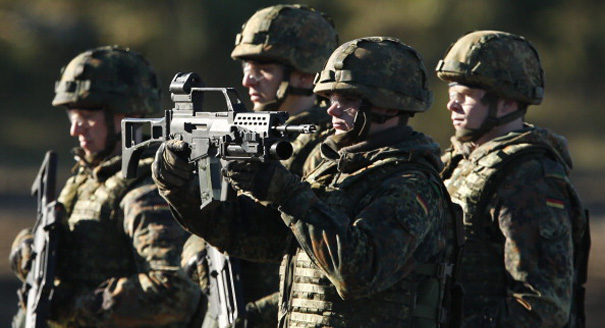
Source: Getty
Both Paris and Berlin are keen to boost the EU’s military role in the world. But their different strategic cultures may hinder the creation of a stronger EU defense.
Shortly after the British vote to leave the European Union on June 23, the French and German foreign ministers produced a joint statement reaffirming their countries’ strong commitment to the EU. Among other things, they called for a “European Security Compact” to beef up the EU’s contribution to international security, including with military means, as well as to improve the union’s ability to tackle internal security threats such as terrorism.
However, even though France and Germany agree on much on paper, differences in their respective strategic cultures may hinder the progress and effectiveness of their proposals, especially on EU defense.
Internal security has taken on more importance with the terrorist attacks in France and Germany in late July. Even though the local specificities of the threat, the types of attacks, and the reactions have been different in the two countries, there will likely be renewed determination in Berlin and Paris to further develop European policing, judicial, and intelligence cooperation.
Similarly, on defense policy both France and Germany are keen to boost the EU’s military role in the world. Speaking while presenting the new German white paper on defense on July 13, Ursula von der Leyen, the German defense minister, said that Germany and France would lead talks with other EU members to assess their appetite for closer defense cooperation. She said that the UK had “paralysed” progress on these issues in the past, but now the rest of the EU should move forward.
Politicians in France and Germany have long lent strong vocal support to deeper European defense cooperation. Even before EU defense policy was formally launched in 1999, the two countries agreed to create a joint brigade in 1987, which formed the basis for the ambitiously named Eurocorps, established in 1992. (Nine countries currently participate in this Strasbourg-based formation.)
France and Germany have also consistently called for the EU to have its own military command and control structures, most notoriously during the fallout from the Iraq War that began in 2003, when Berlin and Paris said they wanted to create a de facto EU military headquarters. In their June 2016 European security compact, the French and German foreign ministers called for the EU to develop “a permanent civil-military chain of command.”
Up to now, the UK has blocked such measures (each EU member has a veto over defense policy) for fear that creating such institutions would undermine NATO, for example by duplicating SHAPE, the alliance’s military headquarters through which multinational operations are run. As von der Leyen underlined, following the British decision to exit the EU, there seems to be no real reason why long-held Franco-German proposals cannot be implemented.
And yet, while they agree on much on paper, there are some major differences in strategic culture between these two EU heavyweights. For one, France, which is a nuclear-armed permanent member of the UN Security Council, has a special sense of responsibility for global security. The French defense minister, Jean-Yves Le Drian, recently proposed that the EU should send military ships to ensure open waterways in the territorially disputed South China Sea. Germany, in contrast, is not yet in the habit of initiating international military operations anywhere, let alone in East Asia.
For another, Berlin is still more reluctant than Paris to deploy robust military force. True, Germany beefed up its support to the coalition against the self-styled Islamic State following the November 2015 terrorist attacks in Paris. Plus Berlin is increasing its defense spending and wants to boost its military contribution to international security. But Germany will act only in coalition with others. France, by contrast, is not only prepared to bomb the Islamic State, it will also act unilaterally if needed—consider the French military interventions in Mali and the Central African Republic in 2013–2014.
Moreover, Berlin and Paris do not necessarily agree on the end goal of EU defense policy. The new German defense white paper says that EU members should aim to create a “European Security and Defence Union.” Many German politicians understand this to mean the creation of a common European army in the long term.
Although it is not entirely clear who would command such an army—EU governments or the Brussels-based institutions—this idea has tremendous appeal in Germany for a host of historical and political reasons. An EU army would be the ultimate expression of European political unity. In other words, EU defense is primarily an integration project for some in Berlin.
The French are more interested in a stronger EU defense policy than a symbolic integration project (albeit one that has its own political value for some in Paris as well as in Berlin). The French perceive acting militarily through the EU as an important option for those times the United States does not want to intervene in crises in and around Europe. This was the main strategic rationale behind the 1998 Franco-British Saint-Malo agreement, which begat EU defense policy—which has since consistently failed to realize its potential.
Indeed, despite the ever-intensifying security challenges they face, EU members have progressively lost interest in the union’s defense policy in recent years. As a result, the French do not assume that their EU partners will always rush to support their military operations. They haven’t in Africa. But if acting through the EU could help ensure more military support from other EU members, that would generally be preferable to acting alone.
Because of their different strategic cultures, therefore, France and Germany may struggle to develop a stronger EU defense more than their joint proposals would suggest. If anything, it currently seems easier for Berlin and Paris to agree on the central strategic importance of NATO for their defense.
At the NATO summit in Warsaw on July 8–9, French President François Hollande said that “a European defense separate from NATO would make no sense.” The new German defense white paper says that “only together with the United States can Europe effectively defend itself against the threats of the 21st century and guarantee a credible form of deterrence. . . . NATO remains the anchor and main framework of action for German security and defence policy.”
Whatever may result from their joint initiatives on EU defense, neither France nor Germany wishes to undermine NATO, which they both want to retain as the primary military guarantor of European security.
Daniel Keohane is a senior researcher at the Center for Security Studies at ETH Zürich.
Daniel Keohane

The EU can impose sanctions but struggles to enforce them without the United States. With Washington increasingly disinterested in backing European interests, the bloc must now fend for itself.


Nicu Popescu, Tiago Antunes

Russia is testing the waters of NATO’s mutual defense clause. What do strikes in Romanian territorial waters mean for the alliance’s posture toward Moscow?

Dimitar Bechev

With its public finances in shambles, the far right polling at 35 percent ahead of the 2027 presidential election, and a growing protest movement, is France’s crisis a threat to the EU’s geopolitical awakening?

Rym Momtaz, ed.

Ahead of a tough winter for Ukraine, Donald Trump’s swing back toward Russia bodes ill. But instead of panicking, Kyiv’s European allies are focusing on action.
Rym Momtaz

While the EU and European governments are embracing the much-lauded middle-power moment, this entails three difficult conundrums.

Richard Youngs