

Commentary
The domestic impacts of how long it is taking to end the war in Ukraine have pushed the French electorate to the political extremes and compromised the country’s diplomatic capacity.
Rym Momtaz
{
  "authors": [
    "Daniel Keohane"
  ],
  "type": "commentary",
  "blog": "Strategic Europe",
  "centerAffiliationAll": "",
  "centers": [
    "Carnegie Endowment for International Peace",
    "Carnegie Europe"
  ],
  "collections": [
    "EU Integration and Enlargement",
    "Brexit and UK Politics"
  ],
  "englishNewsletterAll": "",
  "nonEnglishNewsletterAll": "",
  "primaryCenter": "Carnegie Europe",
  "programAffiliation": "",
  "programs": [],
  "projects": [],
  "regions": [
    "Europe",
    "Western Europe"
  ],
  "topics": [
    "EU",
    "Security",
    "Military"
  ]
}
Source: Getty
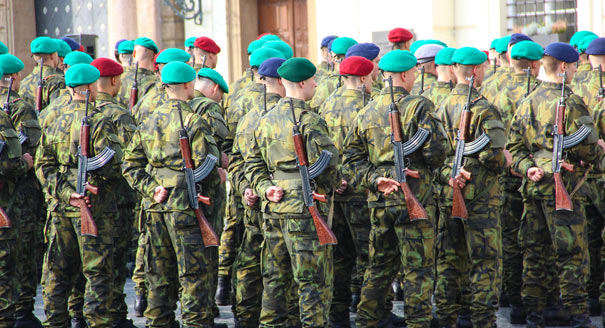
The post-Brexit cacophony may generate enough political momentum to keep defense high on the EU agenda. But an EU army won’t appear anytime soon.
Since Britain voted on June 23 to leave the EU, it seems everyone has an idea for strengthening European defense. The cacophony of calls in the last month alone has included an Italian proposal for a “Schengen of defense,” a reference to the EU’s passport-free travel zone; a Visegrád Four appeal from the Czech Republic, Hungary, Poland, and Slovakia for a “European army”; and a Weimar triangle declaration from France, Germany, and Poland on the need for more effective EU security and defense policies.
Ahead of an informal summit of EU heads of state and government (minus the UK) in Bratislava on September 16, the French and German defense ministers have prepared a paper containing a number of concrete ideas for deeper military cooperation—building on an earlier post-Brexit initiative by their foreign ministers for a “European Security Compact.”
Not to be outdone, EU leaders in Brussels have also joined the chorus. Federica Mogherini, the EU foreign policy chief, has said that she will produce a security and defense plan by the end of 2016, a follow-on document to her broader global strategy for EU foreign and security policies, which was published in June.
There is political opportunism at play here. For one, following the British decision to leave the EU, the other 27 EU governments are keen to display some unity. They also want to show that the union remains relevant for their citizens, especially for their security. Moreover, it is easier to agree on some aspirational ideas for EU defense on paper, which may take years to implement, than to find effective solutions for more pressing internal political challenges, such as managing migrant flows or stimulating stronger economic growth across the eurozone.
For another, although it is hardly fair to blame the UK alone for the union’s disappointing military performance, EU defense cheerleaders have seized on Brexit as a golden chance to relaunch the policy. Given the substantial differences between the remaining 27 regarding their strategic cultures, security priorities, and attitudes to the use of military force—most notably between France and Germany—skeptics could be forgiven for thinking that EU defense will continue to promise lots but deliver little.
The skeptics, however, may be misjudging the combination of the post-Brexit political mood and an increasing awareness among EU governments that they sometimes need to fend for themselves.
EU governments want NATO—meaning the United States—to continue to deter Russian aggression in Eastern Europe. But the migrant crisis has resulted in the EU sending military ships to Mediterranean waters to tackle people smuggling. As Jean-Claude Juncker, the European Commission president, said in his State of the Union address to the European Parliament on September 14, “Europe can no longer afford to piggy-back on the military might of others or let France alone defend its honour in Mali.”
This emerging strategic necessity might help explain why the British defense secretary said recently that after its departure, the UK could still contribute to EU operations in the Western Balkans, the Mediterranean, and the Indian Ocean.
In addition, as much as the notion agitates parts of the British press, whatever emerges from the current discord will not result in an EU army for the foreseeable future. True, some politicians such as Juncker have previously declared their support for this aspiration. But an aspiration it will remain. No European government wants to cede sovereignty over its national armed forces, and an EU army is a proposal that any member state could veto. As Mogherini explained following an informal meeting of EU foreign ministers on September 2, “we . . . all agree . . . that the European army is not something that is going to happen anytime soon . . . fifty, sixty, a hundred years from now, who knows?”
More interesting is to look beyond the misleading catch-all phrase of a European army or clunky Euro-jargon like European defense union or Schengen of defense. The merits of the concrete proposals made by France and Germany together, and by Italy alone, deserve closer consideration.
It has long been a cliché that Europeans need much more bang for their defense buck. The 28 EU member states collectively spent some €200 billion ($225 billion) on defense in 2015, but much is wasted. For example, there are nineteen different types of armored infantry fighting vehicles across the EU, while the United States has one. Berlin and Paris have sensibly proposed that more of the costs of military logistics, medical assistance, and satellite reconnaissance should be shared.
Italy has supplemented those Franco-German capability ideas, suggesting European tax breaks and financing for joint procurement programs. Rome has also provided an elegant political way forward for European defense. The Italians suggest that the six founding members of the EU could work together to develop a multinational force initially outside the EU structures, similar to how today’s Schengen zone started as an agreement between five governments.
The Italians stress that this is not about creating a European army, and that the resultant force could operate under NATO or UN auspices as well as the EU’s. This approach would eventually be open to others and could become the basis for a more formal endeavor via EU mechanisms (as Schengen did)—if other EU governments agreed. The forbidden love of this approach is that the UK could also participate in such a project if it wanted to, like the way Norway and Switzerland participate in Schengen even though they are not members of the EU.
The post-Brexit cacophony may generate enough political momentum to keep defense high on the EU agenda. Plus, the remaining 27 EU governments can no longer blame the UK for any lack of progress.
There are worries in London and Washington that some proposals on the EU table, such as an EU military headquarters, might undermine NATO. But if Brexit inspires EU governments to better spend their defense budgets and deepen their military cooperation, NATO will benefit too, as 21 countries will remain members of both the union and the alliance.
Only time will tell if EU governments deliver on defense. If they don’t, never will so many write so much about so little.
Daniel Keohane is a senior researcher at the Center for Security Studies at ETH Zürich.
Daniel Keohane
Carnegie does not take institutional positions on public policy issues; the views represented herein are those of the author(s) and do not necessarily reflect the views of Carnegie, its staff, or its trustees.

The domestic impacts of how long it is taking to end the war in Ukraine have pushed the French electorate to the political extremes and compromised the country’s diplomatic capacity.

Rym Momtaz

Before the next wave of EU enlargement takes place, the union needs to grapple with thorny questions of how power is distributed among its members.


Emil Sondaj Hansen, Ditte Brasso Sørensen

A summer of escalation in the Black Sea has hurt Ukraine economically and is exacerbating world food security. A truce is needed—as is a broader reframing of Europe’s Ukraine strategy.

Thomas de Waal

Are Germany’s economic, industrial, and political struggles becoming a liability for the EU’s ability to rise to the geopolitical moment?
Rym Momtaz, ed.

European Commission President Ursula von der Leyen is about to give her annual address on the state of the EU. Here’s what she won’t—but should—say.
Rym Momtaz