

Commentary
Judy Dempsey
{
  "authors": [
    "Judy Dempsey"
  ],
  "type": "commentary",
  "blog": "Strategic Europe",
  "centerAffiliationAll": "",
  "centers": [
    "Carnegie Endowment for International Peace",
    "Carnegie Europe"
  ],
  "collections": [
    "EU Integration and Enlargement"
  ],
  "englishNewsletterAll": "",
  "nonEnglishNewsletterAll": "",
  "primaryCenter": "Carnegie Europe",
  "programAffiliation": "",
  "programs": [],
  "projects": [],
  "regions": [
    "Europe",
    "Eastern Europe"
  ],
  "topics": [
    "Democracy",
    "EU"
  ]
}
Source: Getty
Only a major shift by the EU and international donors will salvage the Western Balkans from rampant corruption, growing authoritarianism, and instability.
A meeting of international donors, foundations, and multilateral funders opened in the Serbian capital Belgrade on September 21 amid growing concern from young grassroots and philanthropic organizations that the Western Balkans are drifting backward. And in a dangerous way.
It is a backwardness characterized by growing corruption, increasing intimidation of the media, and political elites across the region who pay lip service to reform.
With the EU now focused on ensuring security, controlling its external borders, and stemming the flow of migrants reaching Europe, the union is paying little attention to the negative trends taking place in its immediate backyard. The emerging message from the Balkan Donors Forum, spearheaded by the European Fund for the Balkans and the Open Society Foundations, was that donors and NGOs need to rethink their role in this part of Europe.*
The decision by Britain in June 2016 to quit the EU has dealt a blow to reformers in the Western Balkan countries of Albania, Bosnia and Herzegovina, Kosovo, Macedonia, Montenegro, and Serbia. For reformers and those who support the region joining the EU, Brexit will mean a weaker Europe. Brexit also robs the EU of a strong advocate of further enlargement.
With this shift by the EU away from integration and enlargement toward security issues, there was a sense among the participants attending the Belgrade conference that as long as the Western Balkans are stable, that’s enough for EU governments—even if it means neglecting to strengthen the region’s highly fragile democratic institutions.
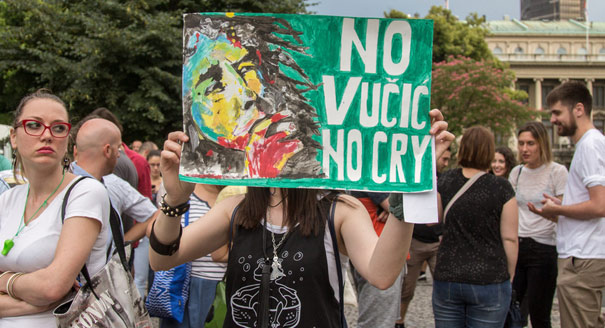
This is a big mistake. The region is far from stable, as demonstrations against corruption, abuses of power, and clientelism that have taken place in major cities in recent months confirm.
Yet the protests have not led to changes that would make the elites more accountable. On the contrary. In an internal report presented at the conference to donors and other stakeholders, former Macedonian diplomat Nikola Dimitrov argued that the EU has opted for short-term measures instead of a long-term strategy that would complete the political and economic transformation of the region.
“Finishing the job in the Western Balkans has become a side-show at best,” he wrote. “With the current reactive mood of Europe, if there is any concern left for the region in Brussels, it is about its short-term stability . . . as opposed to democratic reforms.”
This emphasis on short-term stability suits most of the leaders in the Western Balkans. Calling them the “Balkan Strongmen”—a reference to the region’s presidents in the 1990s, when the former Yugoslavia, engulfed in civil war, was led by Slobodan Milošević in Serbia, Franjo Tuđman in Croatia, and Radovan Karadžić in Republika Srpska, part of Bosnia and Herzegovina—Dimitrov wrote that today’s leaders also suit the EU. “The perceived need for strong leaders dealing with the situation has enhanced the tendency of horse-trading of fundamental European values for geopolitical interests and stability.”
More worryingly, “the increasingly authoritarian Balkan strongmen still talk pro-EU talks but they more and more emulate the Russian or Turkish model,” Dimitrov added.
The EU is not alone in compromising its values in the Western Balkans in ways that perpetuate the status quo. Young activists at the Belgrade conference complained that the plethora of international donors need to understand how the changes taking place in the EU are having a negative impact on the entire democratization process in the Western Balkans.
“There’s too much kowtowing to the status quo by donors and nongovernmental organizations,” said Damir Arsenijević, an activist and professor in critical theory and literature at the University of Tuzla in Bosnia and Herzegovina.
His view, shared by others at the conference, was that precisely because the EU was taking its eye off democratization in the Western Balkans, focusing instead on stability and security, NGOs should be far more assertive in speaking out against corruption and the erosion of accountability. Failing that, the Balkan strongmen can continue to act with impunity, as they have done particularly in Macedonia.
The European Commission, the EU’s executive, knows exactly what is happening in the Western Balkans. Its regular enlargement strategy and country reports pull no punches about the region’s deteriorating rule of law, nepotism, and crackdown on the media.
But Brussels is a long way from the situation on the ground in this part of Europe. That is where NGOs should be the eyes and ears of what’s going on and should speak out. However, the Western Balkan strongmen are resorting to tactics used by Vladimir Putin, the Russian president. In these leaders’ view, NGOs are foreign agents and traitors that need to be reined in.
Serbian Prime Minister Aleksandar Vučić, so much liked by Brussels because of his cooperative and conciliatory approach toward resolving the relationship between Serbia and its former province Kosovo, is no exception to this trend. “Serbia is now among the countries globally to have suffered the largest declines regarding freedom of the press in 2015,” wrote Dimitrov. And as for Vučić using pro-EU rhetoric with his EU interlocutors, “so much of it is lip service. There is so little transparency. The pro-EU talk is not matched by reforms at home,” said Biljana Dakić Đorđević, executive director of Trag, a philanthropic organization based in Serbia.
The seeds of change—and discontent—are being sown.
* I was invited to speak at the forum. I wish to thank the organizers for their hospitality.

Nonresident Senior Fellow, Carnegie Europe
Judy Dempsey is a nonresident senior fellow at Carnegie Europe
Recent Work
Judy Dempsey
Judy Dempsey
Carnegie does not take institutional positions on public policy issues; the views represented herein are those of the author(s) and do not necessarily reflect the views of Carnegie, its staff, or its trustees.
As we close out another season of Strategic Europe, it is worth taking stock of the deep shifts underway.

Rym Momtaz
The EU had to compromise to adopt a twenty-first sanctions package against Russia, exposing growing cracks in the union’s resolve. Is this latest, weaker round worth it to keep pressure on Moscow?
Rym Momtaz, ed.

Trump is distracted and Ukraine wants Europe to step up. The continent’s leaders must find their voice and assert it in talks with Russia.

Alissa de Carbonnel

Mounting economic strain and battlefield losses will not necessarily make the Kremlin less dangerous. They could instead push Moscow toward a more aggressive hybrid campaign designed to test NATO’s Eastern flank, exploit allied hesitation, and fracture European resolve.

Maksym Beznosiuk

Over the past ten years, NATO has held almost as many summits as it did during the entirety of the Cold War. Are they still useful, or is it time to stop holding annual meetings?
Rym Momtaz, ed.