

Commentary
Are Germany’s economic, industrial, and political struggles becoming a liability for the EU’s ability to rise to the geopolitical moment?
Rym Momtaz, ed.
{
  "authors": [
    "Andrew A. Michta"
  ],
  "type": "commentary",
  "blog": "Strategic Europe",
  "centerAffiliationAll": "",
  "centers": [
    "Carnegie Endowment for International Peace",
    "Carnegie Europe"
  ],
  "collections": [],
  "englishNewsletterAll": "",
  "nonEnglishNewsletterAll": "",
  "primaryCenter": "Carnegie Europe",
  "programAffiliation": "",
  "programs": [],
  "projects": [],
  "regions": [
    "Europe",
    "Western Europe"
  ],
  "topics": [
    "EU",
    "Security",
    "Military"
  ]
}
Source: Getty
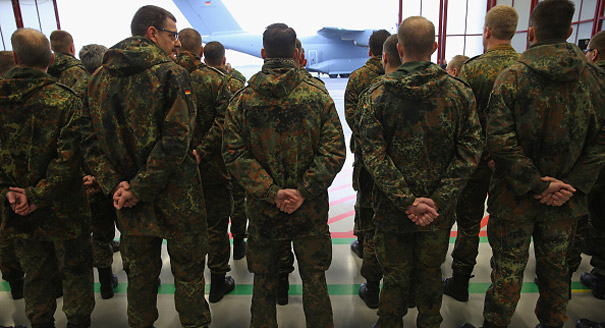
Calls for the creation of a new EU military headquarters ignore the more important issues of defense spending, coordination, and the need to strengthen NATO.
In September 2016, Europe’s leaders declared their intent to revisit the idea of forging closer military ties, including the creation of a new military headquarters. From the get-go, the new announcement was met with a voluminous stream of editorializing, from proponents and skeptics alike. Yet the latest calls miss the point, as they fail to address Europe’s pressing security challenges.
Those in favor of the current round of “getting European defense right”—to quote one interlocutor of mine—argued that this time would be different. After Britain’s vote to leave the EU, and with the UK no longer blocking the concept, the continent would finally coalesce around the idea of common defense, with the EU rising to the task and delivering at least a foundational skeleton of joint defense. The declaration also evoked the usual dose of skepticism that another round of debate over European defense would generate a lot of meetings, position papers, and ultimately no change—a feeling of “been there, done that.”
The question of whether European governments can deliver real defense capabilities (I remain skeptical) is overshadowed by the larger issue of what this says about where views on defense in Europe’s capitals seem to be. The recent proposal’s focus on creating EU defense institutions instead of shoring up transatlantic security is potentially bad news for both Europe and the United States, because rather than reconsolidating resources in NATO, it may in fact further divide Europe along national security optics. If the idea of greater EU defense capabilities is to move forward, it will inevitably draw on the strained capabilities of the NATO alliance, as defense spending and capabilities are a zero-sum game. Not surprisingly, perhaps, Russia’s President Vladimir Putin seems to be a fan of the idea given his determination to put more daylight between Europe and the United States when it comes to transatlantic security.
More importantly, European common defense, while presented as an attempt to mount a serious response to Europe’s deteriorating security situation, is maybe more than anything a reflection of the shifting power dynamic in the EU after the Brexit vote. The reemergence of the idea of EU defense suggests that there is a disconnect between the real requirements of fielding more capabilities to buttress Europe’s security, on the one hand, and the almost instinctive institutional response by the EU’s political class, on the other.
Discussing how to create more infrastructure in Europe or how to tweak the institutions doesn’t move the debate forward. This approach also raises the key question of how serious European governments are about making their defense effort mesh with that of the United States. That question is especially relevant today when America’s footprint in Europe has shrunk significantly and when the rapidly changing security landscape in Asia and the deepening crisis in the Middle East call on the United States to devote more resources to those theaters.
Perhaps even more significantly, talk in Europe of a new headquarters and new European defense structures is arguably the last thing the U.S. Congress and the American public need to hear (assuming the American people pay enough attention to what goes on in Europe). In a U.S. presidential election year in which the theme of “America first” has resonated with a large segment of the electorate, Congress may simply decide that the time has come to rethink the fundamentals of what the United States provides in terms of transatlantic security.
The proposal to reopen the debate on European defense also suffers from poor timing. Europe has effectively demilitarized over the past decade, and the notion of crafting another institutional adaptation in place of shoring up NATO speaks volumes about how disconnected internal EU debates on security have become from the realities on the ground. State-on-state conflict has returned to Europe’s periphery, borders are being redrawn by force, refugees and migrants are flowing into Europe at unprecedented levels, and the norm-based order is increasingly displaced by Russia’s geostrategic assertiveness along Europe’s periphery. In that context, the idea of creating a new European headquarters cannot but seem far removed from the real needs the transatlantic security community faces.
NATO has its share of flaws and needs to be reformed to meet the security threats of today and tomorrow, from a renewed emphasis on traditional territorial defense through counterterrorism to cybersecurity. But NATO is worth preserving and reinvigorating because it offers the most effective and time-tested link between the defense capabilities of the United States and Europe. EU leaders should stop wasting their time, energy, and, most importantly, money on another iteration of an EU security idea when the core transatlantic alliance needs bolstering. To insist otherwise is to run the risk that the U.S. public will take the Europeans at their word and begin distancing itself from the alliance.
In the end, calling for the creation of a new military headquarters and for the EU to get serious about forging military ties ensures that Europeans will again sidestep the issues of spending more on defense, improving coordination, and strengthening NATO. The new European defense initiative sends the disturbingly familiar message that the EU’s leaders are poised for another round of talking institutional change in place of addressing hard-power dilemmas.
Andrew A. Michta is the dean of the College of International and Security Studies at the George C. Marshall European Center for Security Studies. Views expressed here are his own.

Andrew A. Michta
Carnegie does not take institutional positions on public policy issues; the views represented herein are those of the author(s) and do not necessarily reflect the views of Carnegie, its staff, or its trustees.

Are Germany’s economic, industrial, and political struggles becoming a liability for the EU’s ability to rise to the geopolitical moment?

Rym Momtaz, ed.

European Commission President Ursula von der Leyen is about to give her annual address on the state of the EU. Here’s what she won’t—but should—say.
Rym Momtaz

The aftermath of the Ceuta crisis shows Europe has drawn the wrong lessons. Rather than doubling down on failed migration policies, the EU needs to address the underlying roots of such episodes.

Richard Youngs

An overwhelming victory by a far-right-wing party in a small state in eastern Germany will have major repercussions for Chancellor Friedrich Merz’s coalition.

Judy Dempsey

Canadian Prime Minister Mark Carney has twice inspired praise for standing up to U.S. President Donald Trump: at the 2026 World Economic Forum in Davos and on Canada-U.S. trade negotiations. Is Carney showing a third way better than the EU has in dealing with the Trump administration?
Rym Momtaz, ed.