

Commentary
Judy Dempsey
{
  "authors": [
    "Judy Dempsey"
  ],
  "type": "commentary",
  "blog": "Strategic Europe",
  "centerAffiliationAll": "",
  "centers": [
    "Carnegie Endowment for International Peace",
    "Carnegie Europe"
  ],
  "collections": [],
  "englishNewsletterAll": "",
  "nonEnglishNewsletterAll": "",
  "primaryCenter": "Carnegie Europe",
  "programAffiliation": "",
  "programs": [],
  "projects": [],
  "regions": [
    "Europe",
    "Western Europe"
  ],
  "topics": [
    "EU",
    "Democracy"
  ]
}
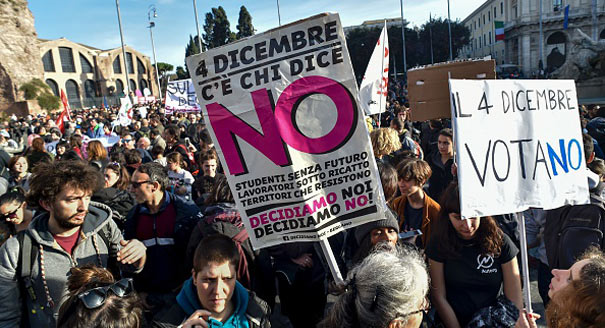
Source: Getty
Italy’s political and economic crisis is unsettling the foundations of the European Union and its single currency.
As if it hadn’t already suffered enough setbacks over the past year, the European Union has been dealt yet another political and economic blow, this time by Italy. But this crisis is different from many previous emergencies. It affects a core member of the EU in a way that touches the fundaments on which the union stands.
Prime Minister Matteo Renzi’s plans to streamline Italy’s political system were overwhelmingly rejected by voters in a referendum on December 4. His defeat by far-right, far-left, and Euroskeptic movements—but also by some pro-Europeans—ensures that no politician will try again to implement reforms for the foreseeable future. After losing the vote, Renzi said he would resign.
All eyes are now on Sergio Mattarella. The Italian president’s job is to maintain stability, especially in times of crisis. He may want Renzi to remain in office for a few more months if that is politically possible.
The alternative—an early general election—haunts Mattarella and Renzi’s supporters. The anti-establishment Five Star Movement led by Beppe Grillo and anti-immigration, anti-euro parties that include the Northern League and the Brothers of Italy are waiting in the wings.
Even though these parties and movements disagree with each other on many issues, the prospect of a motley group of populists gaining power in Italy might be enough of a temptation for them to band together. And don’t forget Silvio Berlusconi, the former prime minister, who had supported Renzi’s reforms only to turn against the young premier.
If Italians succumbed to these anti-EU parties in a general election, it would undermine the very foundations of the European Union. This is not an exaggeration, because the political uncertainty in Italy is different from other crises affecting the EU.
It differs from the Greek financial crisis, which nearly drove Greece out of the eurozone. Greece’s economy is small and the country’s political role and stature in the EU fairly insignificant. Even so, the other eurozone countries were not prepared to push Greece out of the single currency. The psychological and political costs outweighed the huge bailouts that Athens has received to rescue its banks in return for making sweeping structural reforms.
Even Britain’s June 2016 decision to leave the EU, which could still be the beginning of the unraveling of the union, is fundamentally different from the crisis engulfing Italy, because of what Italy represents. The country is one of the founding members of the EU. It is the third-largest economy among the eurozone’s nineteen countries. And it is the world’s eighth-largest economy, calculated by nominal GDP.
For decades, Italy was a passionate supporter of a strong and more integrated EU. It was a founding member of the eurozone. It is a core EU country, which is why its current crisis affects the credibility of the euro and of the EU itself.
Italy’s failure to introduce long-overdue reforms to the labor market and the banking system has now come home to roost. Unemployment is 11.5 percent of the labor force, compared with 4 percent in Germany. Youth unemployment is a staggering 36 percent, against just under 7 percent in Germany.
Ulrich Grillo, president of the Federation of German Industry, pulled no punches in his short statement reacting to Renzi’s defeat. “German industry dreads the consequences of the result. With it, the risks of new political instability increase for economic development, for financial markets, and for the currency union,” Grillo said.
No matter what Mattarella chooses to do, Italy’s government will have to tackle immediately the country’s third-largest bank, Monte dei Paschi di Siena. It is in urgent need of recapitalization. Renzi had tried to woo investors to rescue it. That was conditional on him winning the referendum. “Some will see the result [of the referendum] as proof that Italy is incapable of reform, and may pull back,” the Economist argued.
Renzi, or whoever succeeds him, will be in no strong position to rescue the bank. Under new EU rules, state losses have to be borne by investors, who in this case also include small savers. Also, keeping the bank afloat either by nationalizing it or by pouring money into it would mean breaking the EU’s budget rules—specifically, that a country’s budget deficit must not exceed 3 percent of its GDP. Italy’s budget deficit is currently 2.6 percent of GDP. Yet France and Germany have broken that rule and gotten away with it. The EU may make an exception for Italy too.
The banking crisis is just one symptom of Italy’s political and economic decline, which Renzi had hoped to reverse. That decline is being seized on by anti-EU, anti-globalization, anti-immigration, and anti-establishment movements—as in neighboring France. But Beppe Grillo, Berlusconi, and France’s far-right National Front Leader Marine Le Pen have never articulated any solutions to the deep economic, political, and social problems facing their countries—except to oppose the status quo and everything it represents.
Europe’s populists have now homed in on the EU’s core. In Italy, boosted by having defeated Renzi, their next stop is gaining power—unless pro-Europeans can emulate what voters in Austria did on December 4. They rallied around a lackluster elderly gentleman to stop a far-right candidate from becoming the country’s next president. “[The result] showed you can win elections in Europe with pro-European views,” Tessa Szyszkowitz, the UK correspondent for Austrian news magazine profil, told Carnegie Europe.
As the Netherlands, France, and Germany prepare to go to the polls in 2017, the electoral campaigns will show whether the leaders of Europe’s core countries are willing to defend what their predecessors founded nearly sixty years ago.

Nonresident Senior Fellow, Carnegie Europe
Judy Dempsey is a nonresident senior fellow at Carnegie Europe
Recent Work
Judy Dempsey
Judy Dempsey
Carnegie does not take institutional positions on public policy issues; the views represented herein are those of the author(s) and do not necessarily reflect the views of Carnegie, its staff, or its trustees.

Ahead of a tough winter for Ukraine, Donald Trump’s swing back toward Russia bodes ill. But instead of panicking, Kyiv’s European allies are focusing on action.

Rym Momtaz

While the EU and European governments are embracing the much-lauded middle-power moment, this entails three difficult conundrums.

Richard Youngs

Much has been said of the changes Brussels is trying to make to the EU enlargement process. Here’s why gradual integration might—or might not—be the answer.

Dimitar Bechev

The European Commissioner for Trade is headed to China. But after President Xi’s bridge-building visit to Washington, can a more isolated EU overcome Beijing’s stranglehold on critical raw materials? Who will blink first?
Rym Momtaz, ed.

The domestic impacts of how long it is taking to end the war in Ukraine have pushed the French electorate to the political extremes and compromised the country’s diplomatic capacity.
Rym Momtaz