

Commentary
The aftermath of the Ceuta crisis shows Europe has drawn the wrong lessons. Rather than doubling down on failed migration policies, the EU needs to address the underlying roots of such episodes.
Richard Youngs
{
  "authors": [
    "Andrew A. Michta"
  ],
  "type": "commentary",
  "blog": "Strategic Europe",
  "centerAffiliationAll": "",
  "centers": [
    "Carnegie Endowment for International Peace",
    "Carnegie Europe"
  ],
  "collections": [],
  "englishNewsletterAll": "",
  "nonEnglishNewsletterAll": "",
  "primaryCenter": "Carnegie Europe",
  "programAffiliation": "",
  "programs": [],
  "projects": [],
  "regions": [
    "Europe",
    "Western Europe"
  ],
  "topics": [
    "Security",
    "Military"
  ]
}
Source: Getty
Never in the past quarter century has the European project been more challenged, and never has there been a more urgent need for new ideas on the future of the EU.
The state of European security may dramatically worsen in 2017 if the worrying trends of 2016 continue. Observers should watch for four big and consistent problems.
The first area in which Europe still flounders is its response to security threats. It is reasonable to assume that jihadist terrorism in Europe will continue to increase, as the self-proclaimed Islamic State has singled out the United Kingdom, France, and especially Germany as its preferred European targets. But governments’ current pattern of relying on intelligence services, police, and interior ministries to tackle the problem will be insufficient.
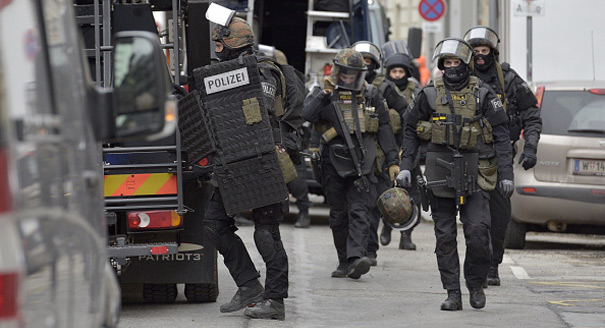
Bringing the military into the fight against Islamic terrorism at home should be an urgent priority for European governments in 2017, especially as the continued inflow of immigrants from the Middle East and North Africa has increased the risk of attacks across the continent. Militaries are necessary not just to augment the manpower of civilian police forces when the threat level is heightened and to reassure the public in a crisis. Governments also need to leverage militaries’ organizational, planning, and communications capabilities and provide armor and weapons that local police may lack.
Assigning an added internal security function to the military would be a significant change, and it would not be an easy task. But despite potential legal obstacles to such a move as well as the differences between civilian law enforcement and military culture, the increased effectiveness of Europe’s counterterrorism operations that would result warrants the effort. As the threat of Islamic terrorism rises, governments would be remiss not to maximize the resources available to counter it.
A key problem is that even if capitals agreed on such cooperation, Europe’s militaries have for the most part been starved of resources and not structured to exercise a greater counterterrorist role. Although in Europe counterterrorism tasks have not traditionally been allocated to defense ministries, today the civilian vs. military division makes ever less sense considering the interconnection between military operations in the Middle East, growing jihadist recruitment in Europe, and the increasingly urgent problem of how to deal with Islamic State fighters returning to Europe.
Europe’s second security weakness is the chronic problem of insufficient defense spending by most European states, except for a handful of NATO members, and the attendant dearth of real and exercised military capabilities. Governments need to address this shortcoming to reverse the ongoing deterioration of security along Europe’s Eastern and Southern peripheries, with a focus on strengthening NATO.
The imperative to increase defense spending to the target of 2 percent of GDP on which allies have agreed is not merely a question of political symbolism. It is equally important for the future of Europe’s militaries as well as for the continent’s relations with the United States as the administration of President-elect Donald Trump takes office. Without a defense spending boost, all talk about NATO solidarity and deterrence capabilities rings hollow.
The third aspect to watch is the migration issue, which European governments have yet to deal with effectively, at the level of either policy or implementation. No other factor defined the fracturing of the European consensus in 2016 as much as the continuing strain of massive immigration from the Middle East and North Africa. The inability of Europe’s leaders to broker a consensus on what they need to do about immigration will continue to accelerate the current trend of individual states adopting their own solutions, putting more daylight between EU member states. And the EU will be worse off for it.
Finally, Europe’s crisis of leadership is likely to worsen in 2017, underscored by a deepening divide between traditional elites, on the one hand, and nationalist and populist parties, on the other. With key elections coming up this year in the Netherlands, France, and Germany, the fragmentation of the political scene in Western Europe is likely to quicken, while a popular backlash from citizens over failed immigration policies will shrink the available space for compromise. In addition, countries on Europe’s Eastern flank will see greater political confrontation between nationalist, center-right, and right-wing parties and liberal, center-left, and left-wing ones against the backdrop of an ever-faster regionalization of Europe.
Whether Europe ultimately splits into a Carolingian core and a Visegrád-cum-Baltic periphery or emerges from the 2017 electoral cycle with a consensus on a larger shared future is still unclear. But never in the past quarter century have the ideas underpinning the European project been challenged to this extent, and never has there been a more urgent need for new ideas on the future of the EU.
These four areas, which need urgent attention if Europe is to turn the corner on security, are by no means a complete list. But they should be a start, because they are common enough across Europe to lay the foundations for governmental and societal buy-in. As Europe enters 2017, watchful waiting continues. But for how long?
Andrew A. Michta is the dean of the College of International and Security Studies at the George C. Marshall European Center for Security Studies. Views expressed here are his own.

Andrew A. Michta
Carnegie does not take institutional positions on public policy issues; the views represented herein are those of the author(s) and do not necessarily reflect the views of Carnegie, its staff, or its trustees.

The aftermath of the Ceuta crisis shows Europe has drawn the wrong lessons. Rather than doubling down on failed migration policies, the EU needs to address the underlying roots of such episodes.

Richard Youngs

An overwhelming victory by a far-right-wing party in a small state in eastern Germany will have major repercussions for Chancellor Friedrich Merz’s coalition.

Judy Dempsey

Canadian Prime Minister Mark Carney has twice inspired praise for standing up to U.S. President Donald Trump: at the 2026 World Economic Forum in Davos and on Canada-U.S. trade negotiations. Is Carney showing a third way better than the EU has in dealing with the Trump administration?

Rym Momtaz, ed.

The EU’s responses to two recent incidents expose the gulf between European perceptions and capabilities. Unless the union can bridge that gap, it will never become a real geostrategic power.
Rym Momtaz

In supporting Europe’s far-right, MAGA and Russia both want the same thing: a weaker EU. Europe must defend itself without abandoning the openness these forces exploit.

Armida van Rij