

Commentary
As we close out another season of Strategic Europe, it is worth taking stock of the deep shifts underway.
Rym Momtaz
{
  "authors": [
    "John R. Deni"
  ],
  "type": "commentary",
  "blog": "Strategic Europe",
  "centerAffiliationAll": "",
  "centers": [
    "Carnegie Endowment for International Peace",
    "Carnegie Europe"
  ],
  "collections": [
    "Transatlantic Cooperation"
  ],
  "englishNewsletterAll": "",
  "nonEnglishNewsletterAll": "",
  "primaryCenter": "Carnegie Endowment for International Peace",
  "programAffiliation": "",
  "programs": [],
  "projects": [],
  "regions": [
    "North America",
    "United States",
    "Russia"
  ],
  "topics": [
    "Foreign Policy",
    "Security"
  ]
}
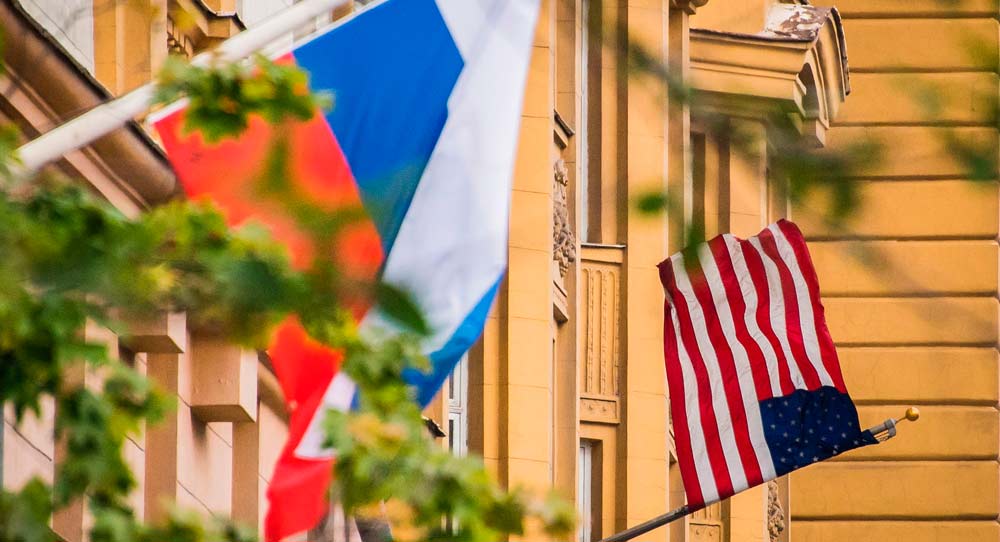
Source: Getty
The West must be more tolerant of Russia’s rhetorical hyperbole to guard against both the most dangerous and the most likely challenges emanating from Moscow.
On July 30, Russia’s President Vladimir Putin announced that he would cap the number of U.S. diplomatic and technical staff in Russia at 455 and force an overall cut of roughly 755 employees. Press accounts portrayed this as a reaction to the U.S. Congress’s decision to increase economic sanctions on Russia, although it also appears directly related to the December 2016 decision by the administration of then U.S. president Barack Obama to expel 35 Russian embassy employees.
As the West has learned, Russia’s reactions—often overreactions—to diplomatic, economic, and military policy decisions by the United States and its allies are inevitable. However, Western oversensitivity to Moscow’s reactions is not. The West needs to increase its tolerance of Russia’s rhetorical hyperbole, diplomatic drama, and escalatory overreactions in response to even the most demonstrably defensive moves by the United States and its NATO allies.
The Kremlin’s decision to force a cut in U.S. diplomatic and technical personnel and seize two facilities used by U.S. staff has been characterized as Moscow’s “most aggressive move against Washington since the final years of the Cold War” and a “heightening [of] tensions between Washington and Moscow.”
In fact, the move represents a relatively predictable decision by Putin, who must maintain his strongman image in Russia as the 2018 presidential election approaches. Moreover, the United States will be left to determine who will be released from the roughly 1,200 employees across four U.S. diplomatic posts in Russia, and it’s likely that many of the reductions will fall on Russian nationals employed by the United States.
Nonetheless, Putin’s foreign ministry termed the latest round of U.S. sanctions evidence of “the extreme aggressiveness of the United States when it comes to international affairs” and a reaction to a “series of hostile steps by Washington.” From a more objective perspective, this is utter nonsense and especially ironic coming from a country that has systematically attempted to intimidate or outright invade several of its neighbors.
The Kremlin’s reaction to the sanctions is similar to its response to NATO’s enhanced forward presence initiative. Through this effort, NATO has strengthened its deterrent posture across Eastern Europe by stationing one multinational battle group—about 1,000 troops—on a rotational basis in each of the Baltic states and Poland.
In response, Russia announced it would form two new divisions—about 10,000 troops each—in its Western Military District and one new division in its Southern Military District. Furthermore, pro-Kremlin and Russian state-funded media campaigns sought to characterize the Baltic states as paranoid, argued that the enhanced forward presence deployments were unwelcome for local citizens in the host countries, and portrayed NATO actions as ineffective or overly aggressive.
These sorts of Russian overreactions to even the mildest policy moves by the alliance have become nearly routine. In 2015, Russian-directed media characterized the establishment of 40-person exercise coordination teams in several Eastern European NATO allies as part of a plan to “creep toward Russian borders.” Russian officials termed the initiative “absurd” and portrayed the small, unarmed teams as evidence of the alliance’s aggressive posturing.
Russian overreaction appears to be part of a carefully crafted disinformation operation designed to achieve domestic as well as international effects. Domestically, overreaction to Western policies is necessary to silence critics on Putin’s political right flank who might accuse him of insufficiently safeguarding Russian national interests. Geography and history have combined to create domestic political incentives for Russian politicians to characterize the West in adversarial terms. Such rhetoric has the added benefit of distracting Russians from the economic malaise that has afflicted their country for the last two years or more.
Internationally, Russia’s overreaction appears designed to stoke Western anxiety toward escalation and conflict, and it is here that Western security faces the greatest risks. What the West should fear most as it continues to refine its approach toward Russia is not the overblown Russian reactions themselves but rather the indecision, vacillation, and immobility that comes with hypersensitivity toward Moscow’s opinion.
The West’s array of diplomatic, economic, and military policies must evolve to achieve the most sustainable, effective, and efficient deterrence and assurance possible. The United States may consider forward stationing armored units in Germany or Poland in the near future. In addition, it’s not clear that multinational battle groups are the best way to counter the most likely Russian operations aimed at the West—especially those that fall short of the threshold for NATO to invoke its Article 5 mutual-defense clause, such as unattributable cyberattacks on critical infrastructure, fomenting of ethnic or religious discontent, or media manipulation.
However, given Russia’s domestic political incentive structure, it is almost impossible to conceive of Moscow reacting to even the slightest modification of Western policies in anything but the most adversarial tones. With this virtual guarantee of a Russian overreaction, it may seem as if the West will continue to face a no-win situation. On the one hand, the West could try to avoid any action that risks upsetting Moscow, thereby fundamentally undermining Western deterrence and assurance measures. On the other hand, the West could take action to adapt and augment its policies to date, thereby engendering escalation and a security dilemma.
In fact, the West has another option: to increase its tolerance for the shrill pitch of Moscow’s disproportionality while trying to avoid excessively offensive measures. NATO’s stationing of hundreds of thousands of troops in Poland and the Baltic states might be a legitimate cause for concern in Moscow. But it’s impossible for four multinational battle groups—even when combined with a prospective U.S. armored brigade based in Poland—to form the vanguard of a Western invasion of Russian territory.
Reducing Western sensitivity to Russian overreaction will enable the West to more effectively refine its posture and policies. Such refinement is necessary to ensure Western security is safeguarded against not only the most dangerous challenges emanating from Moscow but also the most likely ones. Alternatively, maintaining hypersensitivity toward Moscow’s reactions effectively handcuffs the West.
John R. Deni is a research professor of security studies at the Strategic Studies Institute of the U.S. Army War College and an adjunct professor at the American University’s School of International Service. The views expressed are those of the author and do not necessarily reflect the official policies or positions of the U.S. Department of the Army, the U.S. Department of Defense, or the U.S. government.

John R. Deni
Atlantic Council
John R. Deni is a research professor at the U.S. Army War College’s Strategic Studies Institute, a nonresident senior fellow at the Atlantic Council, and an associate fellow at the NATO Defense College. He is the author of NATO and Article 5. The views expressed are his own.
Carnegie does not take institutional positions on public policy issues; the views represented herein are those of the author(s) and do not necessarily reflect the views of Carnegie, its staff, or its trustees.

As we close out another season of Strategic Europe, it is worth taking stock of the deep shifts underway.

Rym Momtaz
The EU had to compromise to adopt a twenty-first sanctions package against Russia, exposing growing cracks in the union’s resolve. Is this latest, weaker round worth it to keep pressure on Moscow?
Rym Momtaz, ed.

Trump is distracted and Ukraine wants Europe to step up. The continent’s leaders must find their voice and assert it in talks with Russia.

Alissa de Carbonnel

Mounting economic strain and battlefield losses will not necessarily make the Kremlin less dangerous. They could instead push Moscow toward a more aggressive hybrid campaign designed to test NATO’s Eastern flank, exploit allied hesitation, and fracture European resolve.

Maksym Beznosiuk

Over the past ten years, NATO has held almost as many summits as it did during the entirety of the Cold War. Are they still useful, or is it time to stop holding annual meetings?
Rym Momtaz, ed.