

Commentary
Judy Dempsey
{
  "authors": [
    "Judy Dempsey"
  ],
  "type": "commentary",
  "blog": "Strategic Europe",
  "centerAffiliationAll": "",
  "centers": [
    "Carnegie Endowment for International Peace",
    "Carnegie Europe"
  ],
  "collections": [
    "EU Integration and Enlargement"
  ],
  "englishNewsletterAll": "",
  "nonEnglishNewsletterAll": "",
  "primaryCenter": "Carnegie Europe",
  "programAffiliation": "",
  "programs": [],
  "projects": [],
  "regions": [
    "Europe",
    "Eastern Europe"
  ],
  "topics": [
    "EU",
    "Democracy",
    "Political Reform"
  ]
}
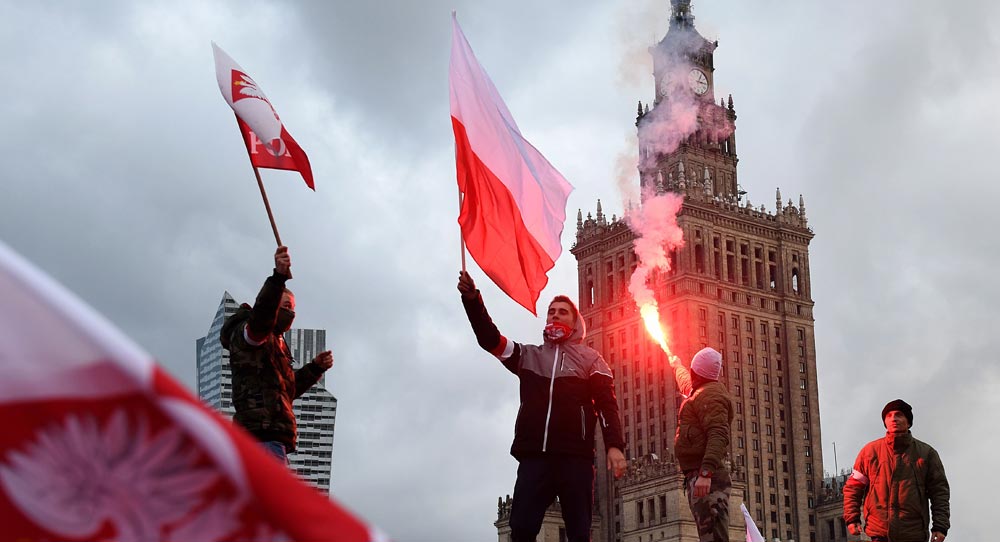
Source: Getty
The Polish government pours a lot of scorn on the EU, but Warsaw can ill afford to turn its back on what the West stands for.
History matters. Memory matters. Independence is treasured, particularly in Poland.
Each year, young and old turn out in Warsaw on November 11. It’s a date indelibly marked in the Polish calendar. In 1918, the country regained its independence after being partitioned by Austria, Prussia, and Russia—first in 1772, then in 1793, and then once more in 1795. After the final partition, Poland ceased to exist.
Its regained independence in the twentieth century was short lived. During World War II, Poland was occupied by Nazi Germany, only to be followed by the Soviet occupation that was to last until 1989. No wonder that November 11 matters for the collective consciousness of a nation that rejoined Europe in 2004 as a member of the European Union.
Poland is back in Europe, but the governing Law and Justice party’s relationship with Brussels is ambiguous at best, confrontational at worst. At issue is how the Law and Justice government perceive the rule of law and the separation of powers. This, in some ways, is the backdrop to the recent demonstrations in Warsaw on November 11.
They took a nasty turn. Depending on the estimates, between fifty- and sixty-thousand people, many with families, had gathered in the capital, down from last year’s turnout of ninety thousand.
The occasion was hijacked by about one thousand neo-Nazis, who each year have used Poland’s Independence Day events to promote their own slogans. Some of the placards had supremacist themes that included, “white Europe of brotherly nations,” “Europe will be white or deserted,” and “pure blood, clear minds.” Some demonstrators had flags with Celtic crosses, which is a white supremacist symbol. The parallels with far-right movements in the United States are eerily similar.
According to eye-witness accounts, a group of women were beaten, or kicked, or called “whores.” Refugees were cursed. Because Independence Day has increasingly attracted these far-right groups—not only from inside Poland but from other countries, too—fewer people attend the celebrations, out of fear.
Piotr Stasiński, deputy editor in chief of Gazeta Wyborcza, Poland’s leading liberal newspaper, in an interview to the independent TVN24 news channel, described the atmosphere and the slogans used by the far-right groups. Stasiński didn’t pull his punches. He quoted the language of these groups directly.
For that interview, Stanisław Karczewski, the speaker of the Senate, said he would file a complaint with the public prosecutors against Stasinski’s “vulgar words” used on television.
And here is the nub of the issue.
Under Polish law, neo-Nazi, fascist, or communist symbols are not allowed. Yet in previous demonstrations, the government had failed to open proceedings against those who wave such symbols. This has had three consequences. First, it puts off ordinary people from attending the November 11 celebrations because of the nasty language and the violence. Second, by not prosecuting the far-right groups, these demonstrators can disrupt events with a certain impunity. And third, Polish society is becoming more polarized between those who are increasingly skeptical about European values and those who want to defend or uphold the values of decency and tolerance. The center ground seems to be closing in.
Poland’s conservative-nationalist government at first tried to play down the far-right element in response to the November 11 events—in contrast to President Andrzej Duda, who said there was no place in Poland for xenopohobia and anti-Semitism. Following protests from the American Jewish Committee in Warsaw and the Israeli foreign ministry (whose spokesman, Emmanuel Nahshon said that “history teaches us that expressions of racist hate must be dealt with swiftly and decisively,”) the government changed its tune. Outside criticism clearly matters.
The foreign ministry condemned the racist and anti-Semitic slogans. It stated that the demonstration was “a great celebration of Poles, different in their views, but united around the common values of freedom and loyalty to an independent homeland.”
Still, the Polish government and legislators also claimed that the media reporting was taken out of context and that journalists like Stasiński should not describe openly what he saw and what he heard. But reporting about these far-right movements and their condemnation by governments is needed more than ever given the impact of social media. It’s also about ensuring that the Independence Day celebrations are just that: a celebration of Poland and its place in Europe.

Nonresident Senior Fellow, Carnegie Europe
Judy Dempsey is a nonresident senior fellow at Carnegie Europe
Recent Work
Judy Dempsey
Judy Dempsey
Carnegie does not take institutional positions on public policy issues; the views represented herein are those of the author(s) and do not necessarily reflect the views of Carnegie, its staff, or its trustees.

Ahead of a tough winter for Ukraine, Donald Trump’s swing back toward Russia bodes ill. But instead of panicking, Kyiv’s European allies are focusing on action.

Rym Momtaz

While the EU and European governments are embracing the much-lauded middle-power moment, this entails three difficult conundrums.

Richard Youngs

Much has been said of the changes Brussels is trying to make to the EU enlargement process. Here’s why gradual integration might—or might not—be the answer.

Dimitar Bechev

The European Commissioner for Trade is headed to China. But after President Xi’s bridge-building visit to Washington, can a more isolated EU overcome Beijing’s stranglehold on critical raw materials? Who will blink first?
Rym Momtaz, ed.

The domestic impacts of how long it is taking to end the war in Ukraine have pushed the French electorate to the political extremes and compromised the country’s diplomatic capacity.
Rym Momtaz