

Commentary
- +11
Cornelius Adebahr, Dan Baer, Rosa Balfour, …
{
  "authors": [
    "Erik Brattberg"
  ],
  "type": "commentary",
  "blog": "Strategic Europe",
  "centerAffiliationAll": "",
  "centers": [
    "Carnegie Endowment for International Peace",
    "Carnegie Europe",
    "Carnegie Russia Eurasia Center"
  ],
  "collections": [
    "Transatlantic Cooperation"
  ],
  "englishNewsletterAll": "",
  "nonEnglishNewsletterAll": "",
  "primaryCenter": "Carnegie Endowment for International Peace",
  "programAffiliation": "",
  "programs": [],
  "projects": [],
  "regions": [
    "North America",
    "United States",
    "Western Europe",
    "Europe"
  ],
  "topics": [
    "Security",
    "Foreign Policy",
    "EU"
  ]
}
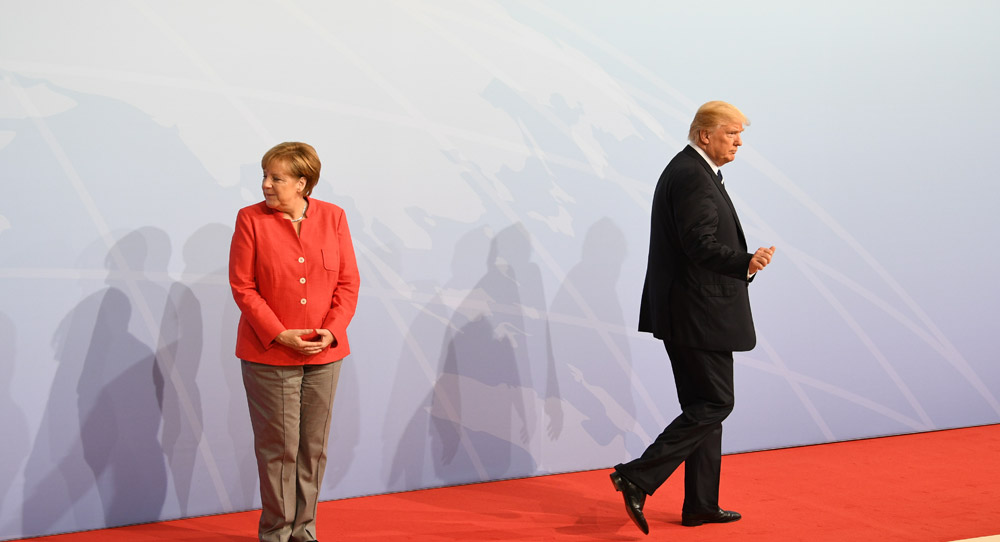
Source: Getty
European capitals are about to face several major foreign policy battles with Washington over the coming months, which could undermine an already fragile transatlantic relationship.
Conventional wisdom was that after Germany’s election, Angela Merkel would reemerge to fix the European project together with her French counterpart, Emmanuel Macron. The German chancellor would continue to protect the liberal international order from U.S. President Donald Trump’s erratic leadership.
She still can. But the dynamics in Europe have changed. President Macron’s recent speech at the Sorbonne staked out an ambitious EU reform agenda. This risks leaving Berlin—preoccupied with domestic politics—to play catch up.
Macron needs Merkel more than ever to realize his agenda. The French president’s focus is on making Europe strong, competitive, ambitious, and able to deal with the immense global challenges stemming from China and the United States. But this has ramifications for the transatlantic relationship.
Here’s why.
European capitals are about to face several major foreign policy battles with Washington over coming months, which could undermine an already fragile transatlantic relationship.
First is Afghanistan. The Trump administration is preparing for a troop surge in the country. Although the U.S. president was initially against the idea of greater military commitment in the region, he has been convinced otherwise by his military advisors. When announcing his plans in August, President Trump made clear that he also expects NATO contributions.
NATO Secretary-General Jens Stoltenberg, who recently met with Afghan officials during a visit to Kabul, said that Europe has an interest in stabilizing Afghanistan and pledged to help. However, the public appetite in Europe to step up its contribution to the effort is lukewarm at best.
In Germany, where government coalition talks are about to begin, Merkel’s (likely) new allies—the Green Party and the pro-business Free Democrats—are skeptical about signing up to such an effort in Afghanistan. Given that Trump views such contributions as part of transatlantic burden sharing, a failure to provide additional European troops could intensify the defense spending debate.
Second is Iran. Washington is currently gearing up toward a decision on whether or not to jettison the 2015 nuclear deal.
During his speech at the 72nd session of the United Nations General Assembly, Trump referred to the nuclear agreement as an “embarrassment to the United States.” The most impending issue is whether the U.S. president will recertify Iran’s compliance with the Joint Comprehensive Plan of Action (JCPOA), a decision he needs to make by October 15.
A failure to recertify the deal could pave the way not only for bilateral U.S. sanctions, but also could potentially force the UN Security Council to reinstate the multilateral sanctions lifted under the agreement. This would put European allies in a terrible pickle, essentially having to choose between defying the United States or the United Nations. However, even if the White House does not walk away from the deal this time, pressure on European allies to renegotiate it would nevertheless mount.
Germany, which like the rest of Europe wants to preserve the current agreement and is willing to fight tooth and nail to do so, knows that a transatlantic clash over Iran may be inevitable. If so, this could easily overshadow the fallout from Trump’s decision to withdraw from the Paris climate agreement. What is more, U.S. reasoning for the Iraq invasion in 2003 divided the West, taking the relationship years to recover. The fallout between Europe and the United States over Iran should not be underestimated.
Third is North Korea. The United States is inching closer toward a confrontation with the Kim regime. At the September United Nations General Assembly, Trump threatened to “totally destroy” North Korea if it continues to develop nuclear weapons and ballistic missiles. While a direct military confrontation is not imminent, the harsh rhetoric from Trump and North Korean leader Kim Jong-un increases the risk of incidents and accidents, significantly impacting upon global security.
Merkel and other European leaders have been critical of Trump’s rhetoric, yet at the same time they support tougher sanctions against Pyongyang. While apparently nearly half of Americans support military action against North Korea to end its nuclear program, the reaction from Europe if military action was to go ahead would be extremely negative. While the security threat to Europe is not as great as it is to the United States, it is not negligible. North Korean missiles could eventually reach the other side of the Atlantic, not to mention what would happen to South Korea.
Merkel’s offer to help resolve the crisis is unlikely to pan out. The fact is that despite Europe’s efforts and position, it is, unlike the United States, not perceived as a strategic player in the Asia-Pacific and therefore has limited leverage and influence.
As if the above were not enough to test transatlantic ties, other issues are emerging: how to deal with post-ISIS Syria; how new U.S.-Russia sanctions could affect European energy companies and the Minsk Process in Ukraine; and the potential for a trade war between the U.S. and Europe.
The bottom line is that the transatlantic relationship will be severely tested in coming months.
The Merkel-Macron duo has potential to strengthen Europe which until now has been ambling from crisis to crisis (the transatlantic relationship has almost become a muddling through affair, as well.) But the potential clash Europe faces with the United States over external issues such as Iran, Afghanistan, North Korea, and the Middle East, demand immediate attention and forward thinking, whether that be initiated by Berlin, Paris, or Washington. One thing is certain, however, traditional transatlanticism is in flux. It’s time to ask hard questions about its future direction.
Erik Brattberg kicks off a new, monthly slot for Strategic Europe. It will feature the view from the United States and all the permutations for transatlanticism and the West.

Former Director, Europe Program, Fellow
Erik Brattberg was director of the Europe Program and a fellow at the Carnegie Endowment for International Peace in Washington. He is an expert on European politics and security and transatlantic relations.
Recent Work


Cornelius Adebahr, Dan Baer, Rosa Balfour, …

Erik Brattberg, Philippe Le Corre, Paul Stronski, …
Carnegie does not take institutional positions on public policy issues; the views represented herein are those of the author(s) and do not necessarily reflect the views of Carnegie, its staff, or its trustees.

Ahead of a tough winter for Ukraine, Donald Trump’s swing back toward Russia bodes ill. But instead of panicking, Kyiv’s European allies are focusing on action.

Rym Momtaz

While the EU and European governments are embracing the much-lauded middle-power moment, this entails three difficult conundrums.

Richard Youngs

Much has been said of the changes Brussels is trying to make to the EU enlargement process. Here’s why gradual integration might—or might not—be the answer.

Dimitar Bechev

The European Commissioner for Trade is headed to China. But after President Xi’s bridge-building visit to Washington, can a more isolated EU overcome Beijing’s stranglehold on critical raw materials? Who will blink first?
Rym Momtaz, ed.

The domestic impacts of how long it is taking to end the war in Ukraine have pushed the French electorate to the political extremes and compromised the country’s diplomatic capacity.
Rym Momtaz