

Q&A
Alejandro Martin Rodriguez, Sarah Yerkes
{
  "authors": [
    "Sarah Yerkes"
  ],
  "type": "commentary",
  "blog": "Strategic Europe",
  "centerAffiliationAll": "",
  "centers": [
    "Carnegie Endowment for International Peace",
    "Carnegie Europe"
  ],
  "collections": [
    "Europe’s Southern Neighborhood"
  ],
  "englishNewsletterAll": "",
  "nonEnglishNewsletterAll": "",
  "primaryCenter": "Carnegie Endowment for International Peace",
  "programAffiliation": "",
  "programs": [],
  "projects": [
    "Tunisia Monitor"
  ],
  "regions": [
    "North Africa",
    "Tunisia",
    "Middle East",
    "Southern, Eastern, and Western Africa"
  ],
  "topics": [
    "Political Reform",
    "EU",
    "Security",
    "Democracy"
  ]
}
Source: Getty
The “democratization of corruption” is putting Tunisia’s transition at risk, affecting every level of the country’s economic, political, and security systems.
Since the 2010-2011 revolution that ousted Tunisian President Zine el Abidine Ben Ali, the European Union has shown a clear commitment to supporting the consolidation of country’s democratic transition.
The EU has provided Tunisia with approximately €3.5 billion in a combination of grants and loans since 2011. After establishing a “Privileged Partnership” between the EU and Tunisia in 2012, the EU has strengthened relationships with the Tunisian government and civil society across a range of issues, including security, economic, and political reform.
EU officials recognize that it is “in the EU’s strategic interest to have a strong, democratic, and stable Tunisia as its neighbor.” The EU is Tunisia’s main trading partner, responsible for 75 percent of its exports and 63 percent of its overall trade.
That, combined with geographic proximity (Tunisia is only about 150 kilometers from Sicily) and historical legacy, makes the EU Tunisia’s most important international partner. Furthermore, as many EU member states have themselves undergone democratic transitions, they are well-placed to support Tunisia’s process by sharing best practices and lessons learned.
However, the country’s transition is not complete. Despite a growing divide between the Tunisian people and their government, there is one issue on which everyone can agree: the need to fight corruption.
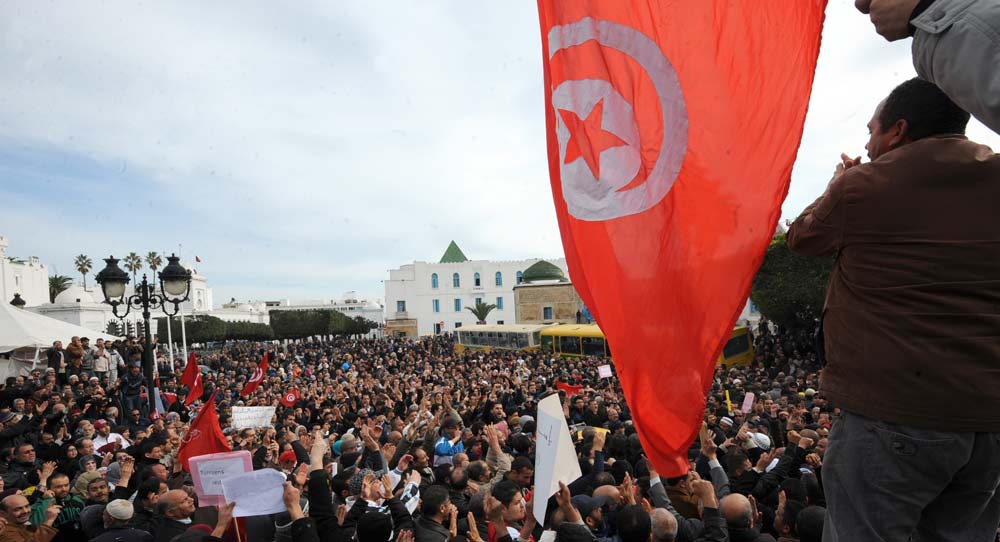
When Tunisians took to the streets in 2010-2011, they were motivated in large part by their anger and frustration at Ben Ali and his wife Leila’s massive corruption. In response, the post-revolutionary government established a series of independent commissions to investigate corruption and recover stolen assets. It incorporated economic crimes into the country’s transitional justice process, enacted several laws aimed at fighting corruption, and created good governance cells within every public institution.
Yet nearly seven years after the Jasmine Revolution, Tunisians perceive higher levels of corruption today than under the kleptocracy of Ben Ali.
As Marwan Muasher and I note in our recent paper, rather than eliminating corruption, the removal of the Ben Ali regime facilitated its decentralization. By dismantling the mafia-like system that oversaw corruption under the former regime, paradoxically, more Tunisians gained access to the tools and the spoils of corruption. Today, the “democratization of corruption” threatens Tunisia’s democratic transition at every level.
Corruption’s most obvious impact is on economic growth. A World Bank study estimated that in the decade before the revolution, Tunisia lost on average an amount equivalent to about 2 percent of its GDP per year due to corruption. Today, the country and its people continue to pay a high price for corruption. The head of Tunisia’s National Anticorruption Authority, Chawki Tabib, recently stated that the state loses on average 2 billion dinars (approximately €800 million) a year due to corruption-related transactions and the poor governance of public procurements. In a corrupt economy, every economic transaction has a corruption tax—an amount of money that is being siphoned away from the state. High levels of corruption also deter much-needed private sector investment, undermining the trust of potential foreign and domestic investors and creating unnecessary risks for firms.
Politically, corruption can have a negative impact on a country’s image abroad. But more importantly, it significantly erodes the trust between citizens and their government.
Corruption also contributes to the decline of public services. In a 2015 study by the Tunisian Association of Public Auditors, 70 percent of Tunisians said they believe that corruption is a means of facilitating daily transactions. This demonstrates how deeply embedded the norm of corruption has become within Tunisian society and how difficult it is to implement effective anticorruption strategies within the bureaucracy.
But most dangerously, corruption provides opportunities for drug and weapons smugglers as well as human traffickers and can assist the spread of terrorism. According to official estimates, the informal economy makes up about half of the Tunisian economy. While many who partake in the informal economy do so to gain access to lawful goods (such as oil and foodstuffs), others take advantage of porous borders and corrupt customs officials to bring drugs, guns, and people across the border between Tunisia and Libya.
Corrupt governments also provide fodder for extremist recruiters and chip away at public trust. While numerous factors can push individuals to join a terrorist group, a corrupt system provides a clear opportunity for terrorists to exploit the anger and frustration that comes along with corruption. Furthermore, funding and training for Tunisia’s border security services—a major priority of the international community—will be undermined by continued corruption at the borders. As one Tunisian security analyst told me, “as long as there are corrupt customs officials working with the smugglers, border fences are useless.”
The EU has several mechanisms through which it can assist Tunisia in the fight against corruption. Support for Tunisia since the revolution has focused primarily on economic recovery and security sector reform—both areas that are crucial in the fight against corruption. The EU-Tunisia Youth Partnership, announced in 2016 by President Beji Caid Essebsi and High Representative Federica Mogherini, can also help get at a key driver of frustration and disengagement: underemployment, especially among young people. Additionally, the EU’s strong relationship with Tunisian civil society, particularly through regular tripartite dialogues with EU and Tunisian officials, can help bridge the divide between civil society and the government on corruption and other issues.
Specifically, there are several steps the EU and member states can take to help Tunisia combat corruption:
Such measures could help complete Tunisia’s complex transition.

Acting Co-Director and Senior Fellow, Middle East Program
Sarah Yerkes is acting co-director and a senior fellow in Carnegie’s Middle East Program, where her research focuses on Tunisia’s political, economic, and security developments as well as state-society relations in the Middle East and North Africa.
Recent Work

Alejandro Martin Rodriguez, Sarah Yerkes
Sarah Yerkes
Carnegie does not take institutional positions on public policy issues; the views represented herein are those of the author(s) and do not necessarily reflect the views of Carnegie, its staff, or its trustees.

The EU’s responses to two recent incidents expose the gulf between European perceptions and capabilities. Unless the union can bridge that gap, it will never become a real geostrategic power.

Rym Momtaz

In supporting Europe’s far-right, MAGA and Russia both want the same thing: a weaker EU. Europe must defend itself without abandoning the openness these forces exploit.

Armida van Rij

As we close out another season of Strategic Europe, it is worth taking stock of the deep shifts underway.
Rym Momtaz
The EU had to compromise to adopt a twenty-first sanctions package against Russia, exposing growing cracks in the union’s resolve. Is this latest, weaker round worth it to keep pressure on Moscow?
Rym Momtaz, ed.

Trump is distracted and Ukraine wants Europe to step up. The continent’s leaders must find their voice and assert it in talks with Russia.

Alissa de Carbonnel