

Commentary
Before the next wave of EU enlargement takes place, the union needs to grapple with thorny questions of how power is distributed among its members.
Emil Sondaj Hansen, Ditte Brasso Sørensen
{
  "authors": [
    "Daniel Keohane"
  ],
  "type": "commentary",
  "blog": "Strategic Europe",
  "centerAffiliationAll": "",
  "centers": [
    "Carnegie Endowment for International Peace",
    "Carnegie Europe"
  ],
  "collections": [
    "Brexit and UK Politics"
  ],
  "englishNewsletterAll": "",
  "nonEnglishNewsletterAll": "",
  "primaryCenter": "Carnegie Endowment for International Peace",
  "programAffiliation": "",
  "programs": [],
  "projects": [],
  "regions": [
    "Western Europe",
    "United Kingdom",
    "France",
    "Europe"
  ],
  "topics": [
    "Security",
    "Military",
    "Foreign Policy",
    "EU"
  ]
}
Source: Getty
Europe needs more military cooperation between London and Paris. Yet the prospects for significant joint action in the future appear slim.
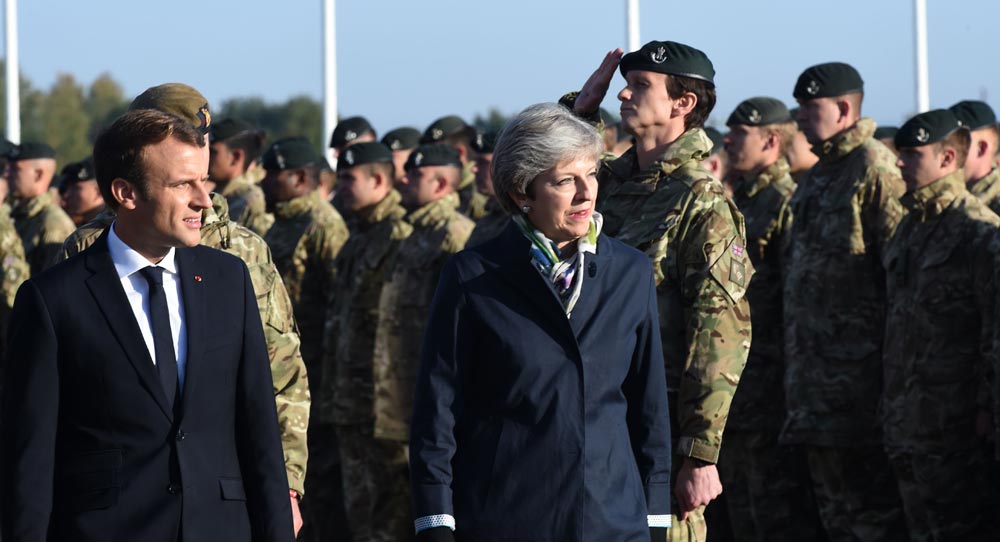
French President Emmanuel Macron and British Prime Minister Theresa May will discuss their defense relationship, among other things, at a bilateral summit on January 18. Franco-British collaboration is vital for European defense. This is not only because they are the two leading European military powers at NATO, but also because they have the most ambitious bilateral military relationship of any European countries, based on the 2010 Lancaster House treaties.
When Britain and France agree—and act together—it usually leads to significant results. It was their 1998 St. Malo accord, for instance, that brought about the EU’s defense policy in 1999. When they disagree, and work against each other, it hampers cooperation through the EU and NATO. Consider how Anglo-French disagreements over Iraq in 2003 hampered EU-NATO cooperation for some years afterward.
May and Macron will likely discuss the UK’s military cooperation with the EU following Brexit next year. A UK government paper in September 2017 clarified that London would like to keep a close relationship with the EU on foreign and defense policies, including potentially contributing to EU military operations. Macron would also like the UK to join in his European Intervention Initiative, an effort to improve European capacity to carry out military interventions abroad when needed—without the help of the United States.
However, regardless of the warm words that may emerge from the summit, the prospects for significant joint action in the future seem slim. This is not only because of Brexit, although a former UK National Security Adviser, Lord Peter Ricketts, has warned that it “will change the context and create the risk of the two countries drifting apart.” It is also because they have two different strategic visions framing their foreign and defense policies, namely “strategic autonomy” for France and “Global Britain” for the UK.
In his Sorbonne speech in September 2017, Macron asserted, “In the area of defense, our aim needs to be ensuring Europe’s autonomous operating capabilities, in complement to NATO.” The UK foreign secretary, Boris Johnson, told an Australian audience in July 2017 that “we have the chance now as we leave the arrangements of the European Union to become even more global, and when I say more global I do not mean for a minute that we will become less European.”
Both these strategic visions have deep historical roots and domestic political appeal. But the quotes from Macron and Johnson betray the core ambiguities of these two alluring visions.
Beyond a limited level of military operations, France cannot expect to act autonomously from the United States in the future—if needed—without the help of other Europeans. Moreover, not many other Europeans seem interested in developing the will, let alone the capability, to act autonomously. The German foreign minister, Sigmar Gabriel, recently told Spiegel: “We are pleased that Donald Trump and the U.S. have affirmed Article 5, but we should not test that trust too much. At the same time, Europe could not defend itself without the U.S., even if European structures were strengthened.”
This political reality also explains why a new French defense strategic review, published since Marcon’s Sorbonne speech, suggests that not all aspects of his European Intervention Initiative have to be carried out through the EU (and would ideally involve the UK). As Bruno Tertrais, from the Foundation for Strategic Research in Paris, has put it: “France has an ambiguous discourse on Europe. While the French complain that they are doing Europe’s dirty work, they appreciate the speed and sovereignty of acting alone. This tension is inherent in French security culture.”
The UK’s dilemma is that cannot afford to become more global at the expense of becoming less European. Despite Brexit, preserving European security should remain the first priority for British defense policy (after protecting national territory). As May has said many times, the UK is leaving the EU but it is not leaving Europe.
A £20 billion hole in the defense budget complicates the UK’s already challenging strategic choices. The UK government plans to carry out another defense review (its last one was published only in late 2015), and the British media is awash with reports of portending cuts to a wide array of capabilities, from amphibious landing logistics to warships to army personnel. No one doubts that the UK should retain its global outlook, but it will be difficult to maintain a global presence in the future because of growing government budgetary pressures.
Furthermore, the UK’s desire to be a global military player will depend on close cooperation with allies in Europe and beyond, especially the United States. But more cuts to British defense capabilities would make the UK a less useful partner for the United States worldwide. Michael Graydon, the former chief of the UK air staff, recently said that British defense capability cuts (both previous and future) are already damaging the UK’s influence with the United States: “Despite polite words from Washington, we are simply not listened to in the same way we once were.”
For all their differences, France and the UK share vital strategic interests in Europe and beyond. Unlike other Europeans, they are both nuclear-armed permanent members of the UN Security Council, with a special sense of responsibility for global security. They remain the most capable European military powers, and are therefore essential contributors to European security, whether defending NATO territory in the East or countering terrorists to the south of Europe.
The good news is that France has deployed soldiers to the UK-led NATO battalion in Estonia, and the UK is expected to announce at the summit that it will send helicopters to support French-led counter-terrorism operations across the Sahel. This is what Europe needs: more joint Franco-British deployments to protect European security, not just bilateral summit declarations.
Daniel Keohane is a senior researcher at the Center for Security Studies at ETH Zürich.
Daniel Keohane
Carnegie does not take institutional positions on public policy issues; the views represented herein are those of the author(s) and do not necessarily reflect the views of Carnegie, its staff, or its trustees.

Before the next wave of EU enlargement takes place, the union needs to grapple with thorny questions of how power is distributed among its members.


Emil Sondaj Hansen, Ditte Brasso Sørensen

A summer of escalation in the Black Sea has hurt Ukraine economically and is exacerbating world food security. A truce is needed—as is a broader reframing of Europe’s Ukraine strategy.

Thomas de Waal

Are Germany’s economic, industrial, and political struggles becoming a liability for the EU’s ability to rise to the geopolitical moment?

Rym Momtaz, ed.

European Commission President Ursula von der Leyen is about to give her annual address on the state of the EU. Here’s what she won’t—but should—say.
Rym Momtaz

The aftermath of the Ceuta crisis shows Europe has drawn the wrong lessons. Rather than doubling down on failed migration policies, the EU needs to address the underlying roots of such episodes.

Richard Youngs