

Commentary
Peter Kellner
{
  "authors": [
    "Peter Kellner"
  ],
  "type": "commentary",
  "blog": "Strategic Europe",
  "centerAffiliationAll": "",
  "centers": [
    "Carnegie Endowment for International Peace",
    "Carnegie Europe",
    "Carnegie Russia Eurasia Center"
  ],
  "collections": [
    "EU Integration and Enlargement",
    "Brexit and UK Politics"
  ],
  "englishNewsletterAll": "",
  "nonEnglishNewsletterAll": "",
  "primaryCenter": "Carnegie Europe",
  "programAffiliation": "",
  "programs": [],
  "projects": [],
  "regions": [
    "Europe",
    "Western Europe",
    "United Kingdom"
  ],
  "topics": [
    "EU",
    "Political Reform"
  ]
}
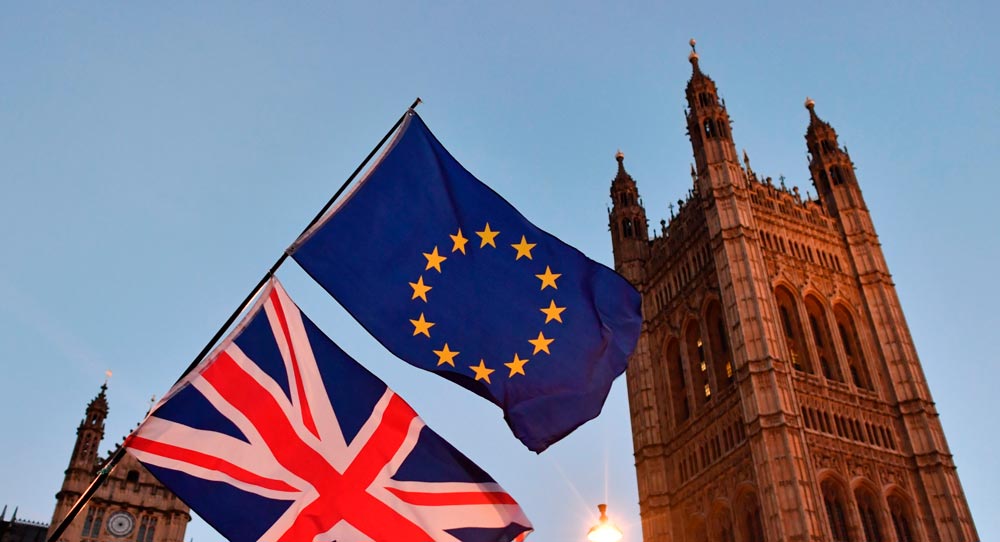
Source: Getty
Theresa May’s government most likely will limp on, but enough Conservatives will side with other parties to insist on a second EU referendum.
One question about British politics in 2018 dwarfs all others. By the end of the year, will the UK be heading irrevocably toward Brexit—or will parliament and Britain’s voters have the chance to think again?
Spoiler alert: this blog will give no firm answer. What I can do is sketch out the circumstances that might lead to the UK staying in the European Union after all.
The first point to make is that the UK parliament is unlikely to abandon Brexit without another public vote. Technically, the June 2016 referendum was advisory. Parliament would be within its constitutional rights to overturn it. Politically, however, that is a nonstarter. Even those of us who wish the 2016 referendum had never happened—and, indeed, prefer representative democracy to referendums in all circumstances—acknowledge that the only way to secure public legitimacy for a Brexit U-turn is for the public to decide the issue once again.
There are two ways a new public vote could come about. One is a fresh general election, in which one or more parties campaign to stop Brexit; if a majority of newly elected MPs have told their constituents that they oppose Brexit, they will have a mandate to reverse the referendum.
The second way would be for parliament to call a second referendum. It would say, in effect: “the position is different from what it was in June 2016. We have a clearer idea of what Brexit would mean. Some of the things said by both sides almost two years ago have turned out not to be true. It is right and proper for voters to think again and decide the matter.” The point was put rather well by a prominent politician five years ago: “If a democracy cannot change its mind, it ceases to be a democracy.” The author of that remark was David Davis—then a backbench MP, but now the UK’s chief Brexit negotiator.
Which is more likely? I would put money, though not much, on a referendum rather than a fresh general election. Here’s why. Until 2010, the decision to call an election was down to the prime minister alone. It became standard practice for the prime minister to consult the cabinet—but there was no need to consult parliament. Since 2011, the power to call an early election has been vested in parliament, not the prime minister. (Last year, Theresa May allowed a record seven weeks between announcing her wish to call an election and polling day itself. This is because she needed to allow time for MPs to debate and vote on the matter.)
So an early election requires the consent of a majority of MPs. It is hard to imagine the circumstances in which this would be granted. The context for such a decision would be a breakdown in the Brexit negotiations in Brussels or a punitive deal that most MPs dislike. Theresa May’s authority would be gravely weakened. The Conservatives would probably have slumped in the polls. An early election might well see Jeremy Corbyn becoming prime minister at the head of a Labour government. This prospect will not appeal to Tory MPs, whatever their views of Europe—nor would it appeal to the Democratic Unionist (DUP) parliamentarians from Northern Ireland, whose votes Mrs. May needs to sustain her majority in the House of Commons. The DUP MPs hate Corbyn with a vengeance, regarding him as an ally of the IRA during the troubles from 1969 to 1999.
More likely is that the current government will limp on, but enough Conservative MPs will side with parliamentarians from other parties to insist on a new referendum. This would deny Corbyn the early chance to become prime minister, and also give the Conservatives some hope of recovering the support of the electorate.
What, though, are prospects of reaching the point where the only way forward would be a fresh public vote of some kind? I doubt the issue will arise if the UK concludes a deal with the EU that looks fairly sensible on both sides. Under this scenario, such tricky matters as the Irish border, the future role of the European Court of Justice in British life, and the relationship of the UK to the single market and customs union would all have been settled. If that is what happens, then Brexit is all but certain to go ahead in March next year.
A fresh public vote will happen if and only if two things occur: first, the Brexit negotiations would have to fail or produce an outcome that is plainly bad for Britain; second, a significant number of people who voted Leave in 2016 would have to react to this outcome by changing their minds.
Recent polls suggest a small amount of “buyer’s remorse.” The latest YouGov survey for The Times finds that slightly more people think they were wrong to vote to leave the EU (46 percent) than think they were right (42 percent.) YouGov has produced a run of figures since September showing similar results.
This suggests a statistically significant shift in the public mood, from the 52 to 48 percent referendum result to leave the EU—but only a small shift. The dial would have to move a lot further for MPs to feel public pressure to call another vote. (Two other recent polls, by BMG Research and ComRes have produced bigger leads for Remain; but these look like outliers to me, rather than firm evidence of a big shift in public attitudes.)
All in all, the saga of British politics in 2018 looks like becoming an infernal triangle, with the negotiations, the public mood, and the decisions of MPs interacting with each other. The outcome of each is hard to predict and the way they interact even more so.

Former Nonresident Scholar, Carnegie Europe
Kellner was a nonresident scholar at Carnegie Europe, where his research focused on Brexit, populism, and electoral democracy.
Recent Work
Peter Kellner
Peter Kellner
Carnegie does not take institutional positions on public policy issues; the views represented herein are those of the author(s) and do not necessarily reflect the views of Carnegie, its staff, or its trustees.

Are Germany’s economic, industrial, and political struggles becoming a liability for the EU’s ability to rise to the geopolitical moment?

Rym Momtaz, ed.

European Commission President Ursula von der Leyen is about to give her annual address on the state of the EU. Here’s what she won’t—but should—say.
Rym Momtaz

The aftermath of the Ceuta crisis shows Europe has drawn the wrong lessons. Rather than doubling down on failed migration policies, the EU needs to address the underlying roots of such episodes.

Richard Youngs

An overwhelming victory by a far-right-wing party in a small state in eastern Germany will have major repercussions for Chancellor Friedrich Merz’s coalition.

Judy Dempsey

Canadian Prime Minister Mark Carney has twice inspired praise for standing up to U.S. President Donald Trump: at the 2026 World Economic Forum in Davos and on Canada-U.S. trade negotiations. Is Carney showing a third way better than the EU has in dealing with the Trump administration?
Rym Momtaz, ed.