

Commentary
Peter Kellner
{
  "authors": [
    "Peter Kellner"
  ],
  "type": "commentary",
  "blog": "Strategic Europe",
  "centerAffiliationAll": "",
  "centers": [
    "Carnegie Endowment for International Peace",
    "Carnegie Europe"
  ],
  "collections": [
    "EU Integration and Enlargement",
    "Brexit and UK Politics"
  ],
  "englishNewsletterAll": "",
  "nonEnglishNewsletterAll": "",
  "primaryCenter": "Carnegie Europe",
  "programAffiliation": "",
  "programs": [],
  "projects": [],
  "regions": [
    "Europe",
    "Western Europe",
    "United Kingdom"
  ],
  "topics": [
    "EU",
    "Political Reform"
  ]
}
Source: Getty
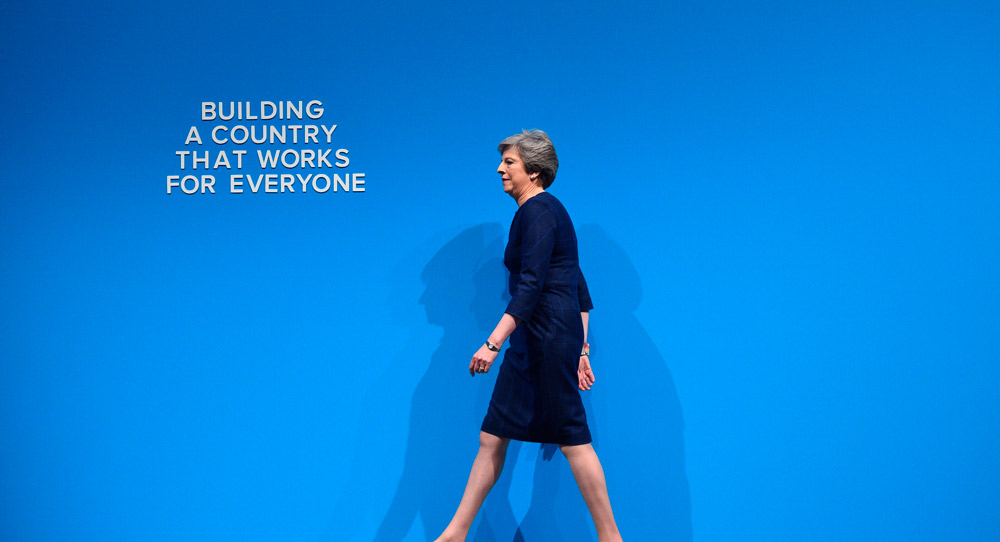
Theresa May cannot make the hard choices on Brexit until she decides what the Tory party is fundamentally about: tradition or enterprise. Either way, she is bound to put her government in peril.
There are two ways to view the crisis currently engulfing Theresa May’s government, but both lead to the same conclusion: that it will not be solved quickly, and possibly not at all. Its latest manifestation came last week. Two days of ministerial meetings were supposed to thrash out the United Kingdom’s approach to the Brexit negotiations with the rest of the EU. They failed to do so. The deep differences among cabinet ministers remain.
The first way to view the crisis is legal. The European Union is the product of treaties, directives, and regulations. John Adams, one of the architects of the American revolution, would have approved. In seeking to differentiate the infant United States from Britain—with its monarchy, empire, and unwritten constitution—he called for “a government of laws and not of men.”
These rival cultures are evident in the Brexit negotiations. Michel Barnier, the EU’s chief negotiator, points to the legal realities of what can and cannot be done. David Davis, the UK’s Brexit secretary, regards the rules as irritants to be sidestepped or adjusted. To him, everything is amenable to a political deal.
It is as if the two sides cannot agree on how to add two and two. Barnier says “they make four;” Davis says: “let’s talk about it.” Barnier invokes the laws of arithmetic; Davis sees room for compromise. Barnier refuses to budge; Davis regards that refusal as no more than a negotiating tactic. No wonder Barnier now says that he has “some problems understanding the UK’s position” and that the current talks may break down.
If there is to be a transition agreement within the next few weeks, let alone a long-term deal, the fudge must end. Formal agreements will need legal precision. Precision will require hard choices. For example, the prime minister says that she wants the UK to leave the customs union, and keep the Irish border open, and avoid the erection of trade barriers between Northern Ireland and the rest of the UK. The trouble is, there is no way to craft a formal agreement that achieves all three objectives. One of them must be abandoned. The UK must either stay in the customs union, or revive border controls on the island or Ireland, or erect trade barriers in the Irish Sea between different parts of the UK.
EU negotiators are reported to suggest that Northern Ireland remain in the customs union. This implies trade barriers in the Irish Sea—something that would be complete anathema to Northern Ireland’s Democratic Unionist Party, whose support the Conservatives need at Westminster to sustain their majority in Parliament. Theresa May is likely to reject this—but has yet to propose an alternative because her ministers cannot agree on what hard choice they should take in order to convert vague aspiration into clear legal language.
If the differences inside Britain’s cabinet were essentially tactical, then some kind of agreement might be worked out that kept the cabinet—and Conservative MPs more generally—together. Difficult decisions could be sold to the party, if they could be presented as the best, or least bad, route to a common long-term objective.
The trouble is that there is no such underlying consensus. This brings us to the second way to view the current crisis: through the prism of history. The Conservative Party is the democratic world’s longest-living and most successful political party. Created in its (relatively) modern form after the Great Reform Act of 1832, it has been in office for most of the past 186 years. Its periods in opposition have normally been quite short. On only three occasions has it been in the wilderness for a decade or more: in the middle of the nineteenth century, near the start of the twentieth century, and, more recently, following the party’s crushing defeat in 1997.
Each time, the party paid the price of division—and the character of the division was fundamentally the same: leading Conservatives could not agree whether their party was at root a party of enterprise and Europe, or one of nation and tradition. In the 1840s, the battle was over the import of corn, then mainly from Europe. Should Britain abandon tariffs so that people could enjoy cheaper bread—or maintain the tariffs to protect landowners and agricultural jobs?
At the start of the twentieth century, the party divided over tariff reform, with the supporters of free trade at odds with those who wanted to give preference to imports from the empire over those from other countries, above all, Europe. At the end of the twentieth century, as today, the dispute was over the UK’s relationship to the EU.
Indeed, the essential truth about the 186-year history of the Conservative Party can be reduced to a single sentence: when the impulses of nation and enterprise have found common ground, it has been virtually invincible; but when those two impulses have been at odds, it has been unelectable.
Today, the schism is as deep as ever. Theresa May has deferred the moment when she must decide what she wants from the Brexit negotiations because she is reluctant to take sides in the dispute about her party’s fundamental purpose. When she is finally forced to choose, she is bound to offend a significant group of Tory MPs and put her government in peril. Be prepared for a bumpy ride.

Former Nonresident Scholar, Carnegie Europe
Kellner was a nonresident scholar at Carnegie Europe, where his research focused on Brexit, populism, and electoral democracy.
Recent Work
Peter Kellner
Peter Kellner
Carnegie does not take institutional positions on public policy issues; the views represented herein are those of the author(s) and do not necessarily reflect the views of Carnegie, its staff, or its trustees.

Are Germany’s economic, industrial, and political struggles becoming a liability for the EU’s ability to rise to the geopolitical moment?

Rym Momtaz, ed.

European Commission President Ursula von der Leyen is about to give her annual address on the state of the EU. Here’s what she won’t—but should—say.
Rym Momtaz

The aftermath of the Ceuta crisis shows Europe has drawn the wrong lessons. Rather than doubling down on failed migration policies, the EU needs to address the underlying roots of such episodes.

Richard Youngs
An overwhelming victory by a far-right-wing party in a small state in eastern Germany will have major repercussions for Chancellor Friedrich Merz’s coalition.

Judy Dempsey

Canadian Prime Minister Mark Carney has twice inspired praise for standing up to U.S. President Donald Trump: at the 2026 World Economic Forum in Davos and on Canada-U.S. trade negotiations. Is Carney showing a third way better than the EU has in dealing with the Trump administration?
Rym Momtaz, ed.