

Commentary
Peter Kellner
{
  "authors": [
    "Peter Kellner"
  ],
  "type": "commentary",
  "blog": "Strategic Europe",
  "centerAffiliationAll": "",
  "centers": [
    "Carnegie Endowment for International Peace",
    "Carnegie Europe"
  ],
  "collections": [
    "EU Integration and Enlargement",
    "Brexit and UK Politics"
  ],
  "englishNewsletterAll": "",
  "nonEnglishNewsletterAll": "",
  "primaryCenter": "Carnegie Europe",
  "programAffiliation": "",
  "programs": [],
  "projects": [],
  "regions": [
    "Europe",
    "Western Europe",
    "United Kingdom"
  ],
  "topics": [
    "EU"
  ]
}
Source: Getty
Brexiteers want to conclude a deal—almost any deal—to leave the EU. Their fear is that if the negotiations drag on, Brexit may not happen.
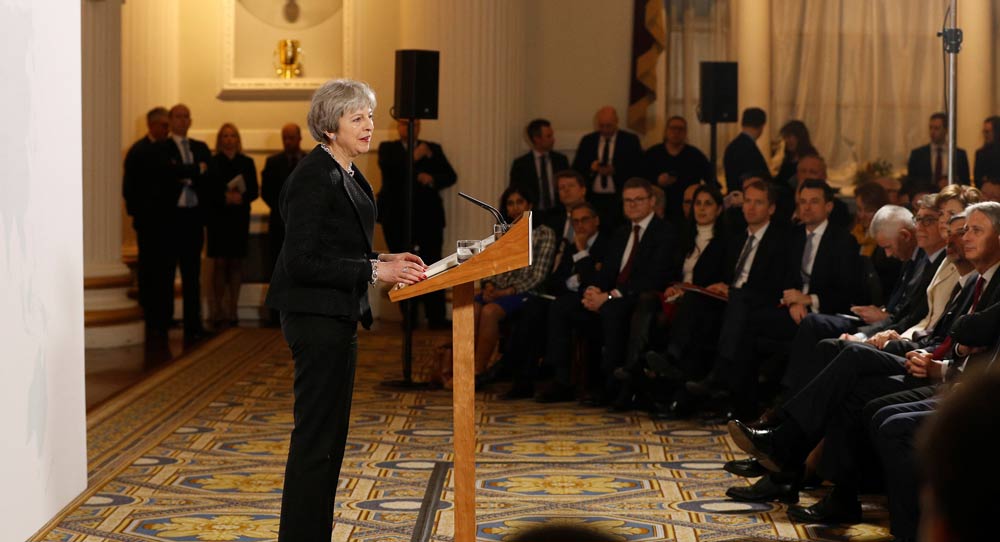
Something odd happened after Theresa May’s recent speech on the UK’s future relationship with the EU. The two wings of the Conservative Party—both the passionate pro-Europeans and the equally passionate Brexiteers—came together to welcome the prime minister’s plans. When she was questioned by MPs in the House of Commons three days later, there was none of the sniping from her own benches that have marked past such encounters.
Has Mrs. May finally unified her previously fractured party? Not really. The two sides are playing a waiting game; neither thought this was the occasion for criticizing her.One big reason for this is that May’s speech was carefully crafted to sound solid and detailed, while committing her to nothing specific. Consider that most fashionable of weasel words, “appropriate.” As philosophers have long argued, one basic requirement of an interesting proposition is that the opposite makes sense. I defy anyone to find a speech by a major—or, for that matter, minor—politician who advocates “inappropriate” action. Bearing that in mind, consider these sentences from the prime minister’s speech:
“Where appropriate, our [UK] courts will continue to look at the ECJ’s judgments.”
“We want to see an appropriate ongoing role for the UK’s Information Commissioner’s Office” (in setting up a new arrangement with the EU for data protection post-Brexit).
“We want to agree an appropriate labor mobility framework” (that enables workers to come and go between the UK and the EU).
For variety, Mrs. May also deployed that other elastic word, “possible,” as in:
“We also want as frictionless a border as possible between us and the EU.”
“We want the broadest and deepest possible partnership” for trade with the EU.
The system for processing goods crossing the border between Northern Ireland and the Irish Republic should be “as simple as possible.”
Such hopes sound ambitious, but mean little. Once again, this is made clear by the absurdity of the opposite: a pledge to do something that is “impossible.”
On one of the few occasions where Mrs. May set out to say something concrete, she was forced by pro-Brexit members of her cabinet to tone down her language. She had originally wanted to offer “a binding commitment” to keep UK regulatory standards “as high as the EU’s.” This was changed to “a strong commitment.” “Binding” implies a firm, legal guarantee; “strong” does not.
However, just as the prime minister said little that meant anything firm, she said little that anyone could attack—beyond the vagueness of her language. Both wings of her party understood this. Rather than lay themselves open to criticism by their colleagues for splitting the party, they chose to interpret Mrs. May’s words to suit themselves. To the pro-EU faction, her speech indicated a wish for a soft Brexit; at the same time, the anti-EU faction welcomed her apparent devotion to bringing lawmaking powers back home to Westminster.
Where do we go from here, assuming the UK-EU negotiations don’t blow up at the EU Council meeting later this month?
For pro-EU Tories, the test will be what will replace the customs union. If the UK government fails to secure an arrangement that looks very much like the current one, they will go ahead with their plan to vote with the opposition in parliament for just such a deal. The Irish border—the only land border between the UK and the rest of the EU—provides the key test, both because of the need to honor the Good Friday Agreement, signed twenty years ago, in which an open border was a key ingredient of the peace process, and because anything other than a deal that keeps the Irish border open would also imply unacceptable delays to trade passing through Britain’s seaports and airports.
The stance of the passionate pro-Brexiteers is more intriguing. They might have been expected to oppose Mrs. May’s willingness to accept some kind of regulatory alignment with the EU post-Brexit; and to consider “remaining part” of some EU agencies—such as those dealing with chemicals, medicines, and aviation—and pay for this; and to accept some (so far undefined) role for the ECJ. Yet there has been no squeak of protest.
Their judgment, though no one will say so clearly and publicly, is that all that matters is that the UK leaves the EU on time, in March 2019. Once parliament has reclaimed all its powers, it can do what it wants—including abrogating or renegotiating any deal done ahead of Brexit. A cardinal rule of Britain’s unwritten constitution is that no parliament can bind its successors. The most enthusiastic Brexiteers believe they can apply this principle and, in time, overturn any pre-Brexit decision they don’t like.
What they fear is that the negotiations get so bogged down that they run out of time, and the UK invokes Article 50 to seek an extension of EU membership beyond next March. If this happens, then maybe one extension could lead to another. What spooks the Brexiteers is that, in this scenario, the UK might end up never leaving the EU at all.
To avoid this, the Brexiteers want an agreement, almost any agreement, to be concluded by this autumn. If this requires major concessions, so be it. Their silence today flows from strategic calculation, not acquiescence.

Former Nonresident Scholar, Carnegie Europe
Kellner was a nonresident scholar at Carnegie Europe, where his research focused on Brexit, populism, and electoral democracy.
Recent Work
Peter Kellner
Peter Kellner
Carnegie does not take institutional positions on public policy issues; the views represented herein are those of the author(s) and do not necessarily reflect the views of Carnegie, its staff, or its trustees.

The EU can impose sanctions but struggles to enforce them without the United States. With Washington increasingly disinterested in backing European interests, the bloc must now fend for itself.


Nicu Popescu, Tiago Antunes

Russia is testing the waters of NATO’s mutual defense clause. What do strikes in Romanian territorial waters mean for the alliance’s posture toward Moscow?

Dimitar Bechev

With its public finances in shambles, the far right polling at 35 percent ahead of the 2027 presidential election, and a growing protest movement, is France’s crisis a threat to the EU’s geopolitical awakening?

Rym Momtaz, ed.

Ahead of a tough winter for Ukraine, Donald Trump’s swing back toward Russia bodes ill. But instead of panicking, Kyiv’s European allies are focusing on action.
Rym Momtaz

While the EU and European governments are embracing the much-lauded middle-power moment, this entails three difficult conundrums.

Richard Youngs