

Commentary
Are Germany’s economic, industrial, and political struggles becoming a liability for the EU’s ability to rise to the geopolitical moment?
Rym Momtaz, ed.
{
  "authors": [
    "Daniel Keohane"
  ],
  "type": "commentary",
  "blog": "Strategic Europe",
  "centerAffiliationAll": "",
  "centers": [
    "Carnegie Endowment for International Peace",
    "Carnegie Europe"
  ],
  "collections": [
    "Europe’s Eastern Neighborhood",
    "Transatlantic Cooperation",
    "Brexit and UK Politics"
  ],
  "englishNewsletterAll": "",
  "nonEnglishNewsletterAll": "",
  "primaryCenter": "Carnegie Europe",
  "programAffiliation": "",
  "programs": [],
  "projects": [],
  "regions": [
    "Russia",
    "Europe",
    "Western Europe",
    "United Kingdom",
    "North America"
  ],
  "topics": [
    "Security"
  ]
}
Source: Getty
After Brexit, there is no guarantee that the major powers in NATO and the EU will agree on how to respond to future crises.
At a summit in Brussels on March 22, EU heads of government will issue a statement of solidarity with the United Kingdom following the recent nerve agent attack on double-agent Sergei Skripal in Salisbury. This statement of support follows similar strong declarations by NATO and the EU’s Foreign Affairs Council.
It is still not certain what additional action may be taken by the alliance or the EU, as it is not yet clear how the UK government will further respond to the attack, beyond having already expelled 23 Russian diplomats.
However, as UK Foreign Secretary Boris Johnson put it, London greatly welcomes the “unqualified solidarity” from the EU and NATO and their requests that Russia provide a full and complete disclosure of its Novichok nerve agent program.
But how would NATO and the EU react to such an incident after Brexit?
The United Kingdom will leave the EU in just over a year, and its departure raises a host of tricky questions for the future strategic alignment of the union and NATO. This is partly because the UK, currently the largest European defense spender at NATO, will remain a major European military power, despite Brexit.
Although the EU and NATO are very different political bodies, their memberships largely overlap—21 countries will remain members of both after Brexit.
In addition, since the 2016 NATO Warsaw summit, the alliance and the EU have been trying to work much more closely together on a number of security issues. These include maritime policing, cyber defense, strategic communications, and military mobility across Europe. But these are miniscule developments compared to the full range of security challenges that Europeans face.
Formally, after Brexit, the UK could no longer invoke help at the EU decisionmaking table, such as imposing new sanctions—though it could probably still ask for assistance through other channels (for example, via post-Brexit EU-UK consultation meetings). Strictly speaking, the EU would have no obligation to help the UK.
This is similar to how NATO has no formal obligation to protect EU countries that are not members of the alliance, including Austria, Finland, Ireland, Malta, and Sweden. Sweden, for instance, is introducing a new “total defense” plan to defend against a military invasion, partly based on their assumption that a coalition of allies would not be able to help for up to three months. That coalition might consist mainly of NATO members, but it would not formally be an alliance action.
For both the EU and NATO, membership has to matter. But as prospective scenarios in the UK and Sweden show, both organizations would be strategically and politically wise to consider together how far non-membership lines should be informally blurred, and how they should jointly respond to future crises in countries where membership does not overlap. European countries may still act through other clusters, but this would be to the detriment of both the alliance and the EU.
Given this lack of clarity, Russian President Vladimir Putin would be tempted to test both institutions’ resolves, if an opportunity to create formal divergences between the organizations presented itself. In addition, Russian tactics, often called hybrid warfare, require a wide range of responses, covering both NATO’s military and the EU’s non-military competences.
However, there are other grounds on which NATO and the EU should work harder to align their security efforts. The EU should be as prepared to respond to a nerve agent attack in non-EU NATO members, such as Norway or the United States, as it has been in the UK. Not only because this would be a breach of international law. But also because attacks like the one in Salisbury exposes the vulnerability of all EU and NATO countries.
Likewise, NATO should be ready (at least) to informally coordinate a military coalition, if needed, to help a non-member like Sweden or Finland in the event of an invasion from an “unspecified foreign adversary,” as the Swedish Defense Commission describes that threat. This is not only for political purposes but also because such an action could geostrategically cut off NATO members, such as the Baltic States, from military assistance.
If NATO and the EU do not hang together after Brexit, there are potential dangers for both organizations. Following Brexit, 80 percent of NATO defense spending will come from non-EU members. For the EU, the danger is that serious strategic conversations will increasingly take place at NATO or in other formats, such as ad hoc initiatives or bilateral relationships.
For NATO, the danger is that an acrimonious Brexit could encourage an Anglosphere-versus-Eurosphere split, with the United States and the UK on one side, and France, Germany, Italy, and Spain on the other. Similar to the bitter splits over the 2003 invasion of Iraq, this could potentially force other European governments to choose sides.
Much will depend on the attitudes of the bigger powers in both organizations. The firm joint response of France, Germany, the UK, and the United States to the Salisbury attacks is encouraging because they will form the political and strategic center of the future EU-NATO relationship.
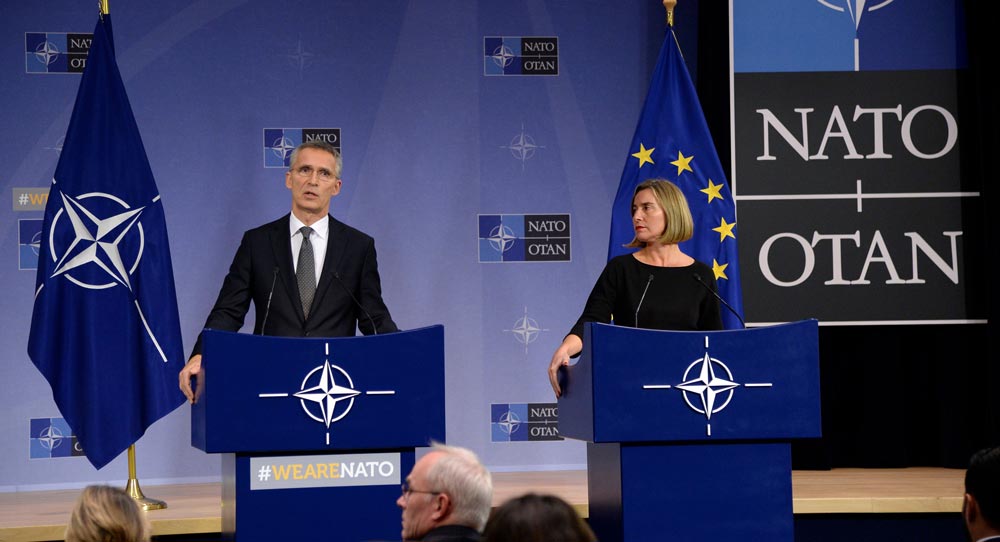
Nevertheless, NATO Secretary-General Jens Stoltenberg and EU High Representative Federica Mogherini should work harder to ensure future strategic alignment between both bodies. In the early 2000s, the then NATO and EU chiefs (George Robertson and Javier Solana, respectively) regularly made joint statements and visits to crisis zones. It is a shame that Stoltenberg and Mogherini did not make a joint statement after the Salisbury attack.
After Brexit, EU-NATO strategic alignment will likely become more difficult and evermore necessary. There is no guarantee that the major powers in both organizations will agree on how to respond to future crises. However, leaders in both institutions could at least encourage those governments to align by responding in concert.
Daniel Keohane is a senior researcher at the Center for Security Studies at ETH Zürich.
Daniel Keohane
Carnegie does not take institutional positions on public policy issues; the views represented herein are those of the author(s) and do not necessarily reflect the views of Carnegie, its staff, or its trustees.

Are Germany’s economic, industrial, and political struggles becoming a liability for the EU’s ability to rise to the geopolitical moment?

Rym Momtaz, ed.

European Commission President Ursula von der Leyen is about to give her annual address on the state of the EU. Here’s what she won’t—but should—say.
Rym Momtaz

The aftermath of the Ceuta crisis shows Europe has drawn the wrong lessons. Rather than doubling down on failed migration policies, the EU needs to address the underlying roots of such episodes.

Richard Youngs

An overwhelming victory by a far-right-wing party in a small state in eastern Germany will have major repercussions for Chancellor Friedrich Merz’s coalition.

Judy Dempsey

Canadian Prime Minister Mark Carney has twice inspired praise for standing up to U.S. President Donald Trump: at the 2026 World Economic Forum in Davos and on Canada-U.S. trade negotiations. Is Carney showing a third way better than the EU has in dealing with the Trump administration?
Rym Momtaz, ed.