

Article
Thomas de Waal
{
  "authors": [
    "Thomas de Waal"
  ],
  "type": "commentary",
  "blog": "Strategic Europe",
  "centerAffiliationAll": "",
  "centers": [
    "Carnegie Endowment for International Peace",
    "Carnegie Europe"
  ],
  "collections": [
    "Europe’s Eastern Neighborhood"
  ],
  "englishNewsletterAll": "",
  "nonEnglishNewsletterAll": "",
  "primaryCenter": "Carnegie Europe",
  "programAffiliation": "",
  "programs": [],
  "projects": [],
  "regions": [
    "Europe",
    "Eastern Europe",
    "Moldova"
  ],
  "topics": [
    "EU",
    "Security"
  ]
}
Source: Getty
A mood of realism around the Transdniestria conflict, supported by Russia, is leading to areas of de facto integration. The Moldovan government is cautious, but this is an opportunity for more international engagement.
The word “frozen” is applied misleadingly to the series of half-dozen unresolved conflicts in the post-Soviet space. None of them are properly frozen, especially in eastern Ukraine and Nagorny Karabakh, where people continue to be killed.
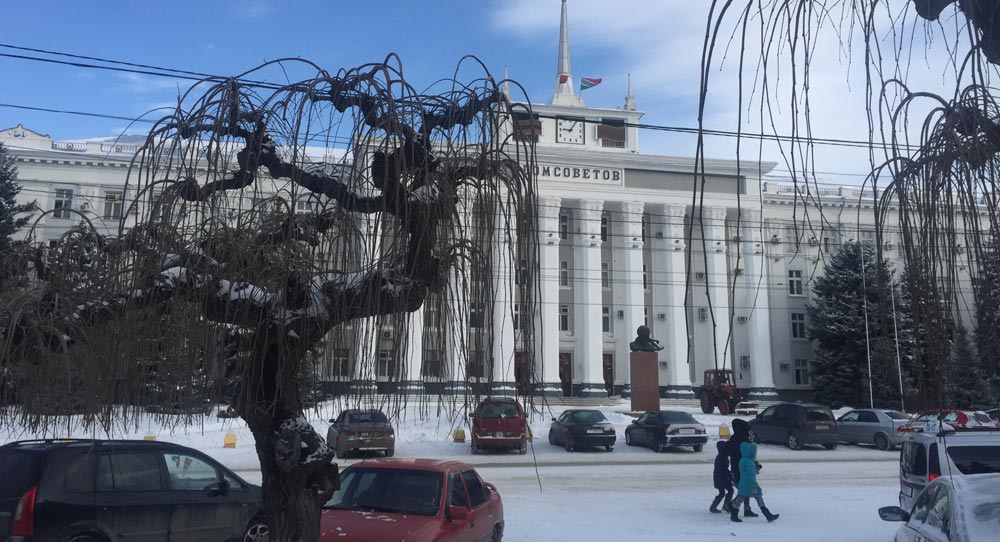
There was a literal deep freeze last week on both sides of the Dniester River, in both official government-controlled “right-bank Moldova” and Transdniestria, the slither of breakaway territory that is patronized by Moscow. Even the statue of Lenin outside the government building in the Transdniestrian capital Tiraspol seemed to shiver in icy subzero temperatures.
But in political terms the Transdniestrian conflict is also not frozen—and for a better reason. Things are moving under the surface, in a positive direction.
The Transdniestria conflict dates back to 1992, when the industrialized, generally Russian-speaking left-bank territory broke away from newly independent Moldova by force, with the support of Soviet troops. Since then, there has been a fierce ideological conflict between the two sides on many issues; but there has also been behind-the-scenes cooperation and almost no violence.
The “five-plus-two” negotiation process—which includes Moldova and Transdniestria, plus Russia, Ukraine, the United States, and the EU, and is run by the Organization for Security and Cooperation in Europe (OSCE)—stalled for many years. That process restarted properly last November with the reopening for traffic of the long-closed Gura Bicului Bridge between the two sides of the river. That broke the ice, allowing the two sides to resolve several other long-standing disputes from a list of eight technical questions identified several years ago as priorities. They include the functioning of eight schools teaching the Moldovan language in the Latin script in Transdniestria.
On February 28, the two sides closed one more deal, agreeing a mechanism under which students’ diplomas from the university in Tiraspol can receive an “apostille”—official certification—from the Ministry of Justice in Moldova. That will allow European universities to accept individual Transdniestrian students to study with them, even if they do not recognize the university itself as a valid institution.
Resolution of two other issues on the list remains deadlocked. They are how to register Transdniestrian number plates that will allow cars from the territory to travel in Europe, with the consent of the Moldovan authorities; and an agreement on a single telecommunications market between Transdniestria and right-bank Moldova.
Mediators say that resolution of those two issues would be a template for agreement on public administration documents and economic convergence between the two—but they underline that it is Chisinau, not Tiraspol, which is being more stubborn.
Why the progress?
Some commentators, in Ukraine and beyond, like to warn that Russian-backed Transdniestria may threaten Ukraine from the west or that the rebel regions in eastern Ukraine may end up becoming a “second Transdniestria.”
But the East-West geopolitical template that fits Ukraine does not apply fully here. In my conversations on both banks of the river last week, everyone was keen to stress how different Moldova and Ukraine are.
“We have a mission here to create a zone of stability, not conflict,” Transdniestria’s de facto foreign minister, Vitaly Ignatiev, told me. Transdniestria, he said, was very different from the two rebel territories in eastern Ukraine.
In Chisinau, Ion Stavila, the Moldovan Foreign Ministry’s ambassador-at-large with responsibility for the conflict, agreed that their situation was very different from Ukraine, suggesting that the Ukraine conflict had made the Transdniestrians more flexible. “They feel pressure because of the geopolitical situation in the region,” he said.
There are two interrelated reasons for the progress.
Since December 2016, the de facto president of Transdniestria has been Vadim Krasnoselsky, the candidate of the Sheriff group, a conglomerate with a de facto monopoly of most business in the territory.
Sheriff has a more pragmatic, business-oriented attitude toward the conflict than its predecessors. Political rhetoric has dropped as a host of economic problems—emigration, poverty, and a big social benefits budget—have threatened Transdniestria with what one local called a looming “catastrophe.”
So long as certain “red lines” are maintained—Transdniestria keeps its Russian ideological orientation, and the small number of Russian troops still in the territory are maintained—that means the new authorities in Tiraspol are prepared to build many elements of a de facto common state with Moldova. In particular, Transdniestria, always the industrial base of Soviet Moldova, has joined the European Union’s Deep and Comprehensive Free Trade Area (DCFTA) with Moldova. Its factories now export far more to the EU and right-bank Moldova than they do to Russia.
Indeed, one reason why many in Chisinau are nervous about closing the draft deal on an integrated telecoms market is that it would give the Sheriff-run Transdniestrian mobile phone company IDC roaming rights with Moldovan customers—thereby allowing a powerful economic player to begin to operate on the right bank of the river.
The other reason for progress is that—in sharp contrast to Ukraine— Russia has supported the five-plus-two talks. (As another sign that geopolitical dynamics work differently here, it should be noted in parenthesis that Michael Scanlan, the OSCE ambassador in Chisinau, who has been knocking heads together and effecting the diplomatic breakthrough, is, like his predecessors in that position, an American.)
Moscow has cut its direct funding to Tiraspol (maybe Ukraine is too expensive) and appears to have told Krasnoselsky that his government must work to achieve special status inside Moldova. The Russians are not altruists of course. They have another agenda, seeing political opportunities in Moldova as the governing PDM party, which has declared itself “pro-European,” and its de facto leader, Vlad Plahotniuc, have been tarnished by a string of corruption scandals.
Moscow seems to be focused on supporting the declaredly pro-Russian president of Moldova and leader of the Socialist Party, Igor Dodon, in the parliamentary elections at the end of 2018. Those elections are another reason why Chisinau is stalling on doing a deal. The Moldovan authorities see no benefit in being generous when the votes of the nationalist electorate are up for grabs.
More than anything, this reveals that the deepest issue in this conflict is: What kind of state does Moldova want to be, and where does Transdniestria fit into this state-building process? That is a long-term process. In the meantime, the mood of realism is a time of opportunity. It gives more space for international engagement with Transdniestria and more of a chance to integrate its economy and people into a world they have been isolated from for 25 years.
Photo Credit: Thomas de Waal
Carnegie Europe is grateful to the Government Offices of Sweden and the Robert Bosch Stiftung for their financial support of this publication.

Senior Fellow, Carnegie Europe
Thomas de Waal is a senior fellow at Carnegie Europe, specializing in Eastern Europe and the Caucasus.
Recent Work
Thomas de Waal
Thomas de Waal
Carnegie does not take institutional positions on public policy issues; the views represented herein are those of the author(s) and do not necessarily reflect the views of Carnegie, its staff, or its trustees.

The aftermath of the Ceuta crisis shows Europe has drawn the wrong lessons. Rather than doubling down on failed migration policies, the EU needs to address the underlying roots of such episodes.

Richard Youngs

An overwhelming victory by a far-right-wing party in a small state in eastern Germany will have major repercussions for Chancellor Friedrich Merz’s coalition.

Judy Dempsey

Canadian Prime Minister Mark Carney has twice inspired praise for standing up to U.S. President Donald Trump: at the 2026 World Economic Forum in Davos and on Canada-U.S. trade negotiations. Is Carney showing a third way better than the EU has in dealing with the Trump administration?

Rym Momtaz, ed.

The EU’s responses to two recent incidents expose the gulf between European perceptions and capabilities. Unless the union can bridge that gap, it will never become a real geostrategic power.
Rym Momtaz

In supporting Europe’s far-right, MAGA and Russia both want the same thing: a weaker EU. Europe must defend itself without abandoning the openness these forces exploit.

Armida van Rij