

Commentary
Judy Dempsey
{
  "authors": [
    "Judy Dempsey"
  ],
  "type": "commentary",
  "blog": "Strategic Europe",
  "centerAffiliationAll": "",
  "centers": [
    "Carnegie Endowment for International Peace",
    "Carnegie Europe"
  ],
  "collections": [
    "Transatlantic Cooperation"
  ],
  "englishNewsletterAll": "",
  "nonEnglishNewsletterAll": "",
  "primaryCenter": "Carnegie Europe",
  "programAffiliation": "",
  "programs": [],
  "projects": [],
  "regions": [
    "Asia",
    "North America",
    "United States",
    "East Asia",
    "North Korea"
  ],
  "topics": [
    "Security",
    "EU"
  ]
}
Source: Getty
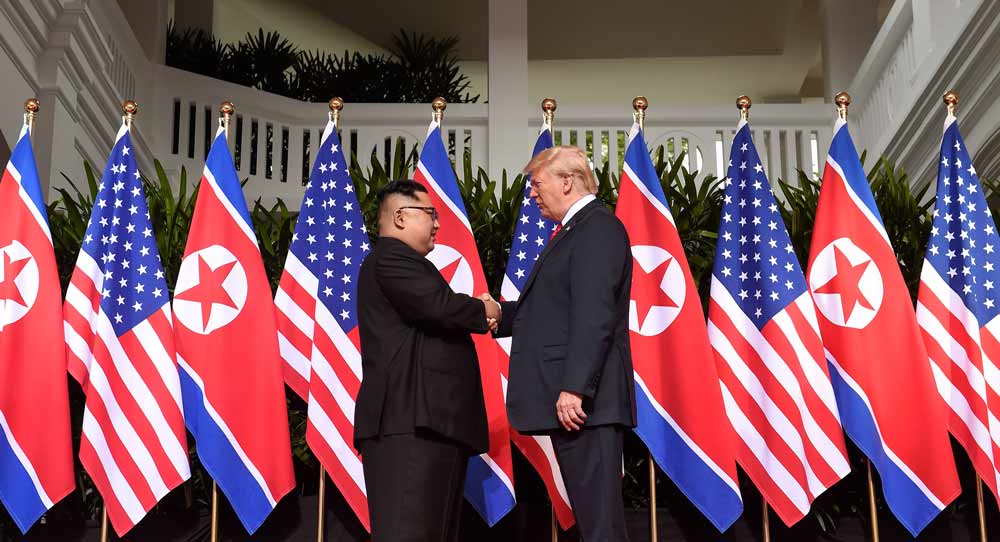
Donald Trump’s summit with Kim Jong-un may further convince the U.S. president that traditional allies are dispensable.
After attending the G7 summit in Canada, U.S. President Donald Trump left early to fly to Singapore. On the way, he reneged on the most timid of G7 communiques. He fired off tweets criticizing Canadian Prime Minister Justin Trudeau and German Chancellor Angela Merkel. He criticized NATO’s free-riding on the back of the U.S. security guarantee. And he was all set to impose hefty tariffs on European imports. Tempers were frayed. What a prelude to next month’s NATO summit in Brussels.
Apart from taking the United States to the World Trade Organization, America’s allies are at a loss about how to deal with Trump. He sure gave them the impression that multilateral deals and democracies are more of a hindrance than an asset for maintaining a rules-based system based on values, free trade, and trust.In Singapore, Trump was a completely different leader, even displaying the appearance of gravitas. And no wonder. He became the first sitting American president to meet a North Korean leader. Judging from the official accounts—and, of course, Trump’s tweets—of the summit with Kim Jong-un, it was a big success.
“We had a really fantastic meeting. A lot of progress. Really, very positive, I think better than anybody could have expected, top of the line, really good,” Trump said. As for reaching some kind of agreement in which North Korea would denuclearize its arsenal, Trump called the document “pretty comprehensive,” adding that North Korean denuclearization would begin “very quickly.” Kim put in his two cents’ worth: “The world will see a major change,” he said. The devil will be in the detail, as well as what happens over the coming weeks and months.
Trump’s praise for Kim and the deal he apparently pulled off juxtaposes uneasily with his treatment of America’s traditional allies. It amounts to a negative correlation.
Dealing with allies is often messy and difficult. It requires patience and compromise. Dealing with authoritarian leaders and dictators is another matter. In the case of Trump’s relations with Chinese President Xi Jinping, Russian President Vladimir Putin, Turkish President Recep Tayyip Erdoğan, and North Korean leader Kim Jong-un, values and rules don’t get a look in.
Unless it was raised tête-à-tête in his talks with Kim, not a word was raised about the shocking human rights abuse in North Korea.
Yet when the Europeans are still doing everything possible to save the nuclear deal with Iran, which Trump pulled out of, he spared no criticism of Iran’s human rights record. He also blamed former president Barack Obama—and implicitly the Europeans—for signing up to the accord. It’s as if Trump’s policies were aimed at dismantling Obama’s legacy, his criticism of Russia and Israel, the close relationship he forged with Merkel, and not to forget Obama’s trade deals.
If the Singapore summit ends up being really substantive, then hats off to Trump. At stake is the stability and security of Southeast Asia. The summit may also embolden the U.S. administration to further disregard its allies in favor of embarking on a special kind of unilateral foreign policy. If so, America’s allies have to ask themselves: Are we ready for this new world order?

Nonresident Senior Fellow, Carnegie Europe
Judy Dempsey is a nonresident senior fellow at Carnegie Europe
Recent Work
Judy Dempsey
Judy Dempsey
Carnegie does not take institutional positions on public policy issues; the views represented herein are those of the author(s) and do not necessarily reflect the views of Carnegie, its staff, or its trustees.

While the EU and European governments are embracing the much-lauded middle-power moment, this entails three difficult conundrums.

Richard Youngs

Much has been said of the changes Brussels is trying to make to the EU enlargement process. Here’s why gradual integration might—or might not—be the answer.

Dimitar Bechev

The European Commissioner for Trade is headed to China. But after President Xi’s bridge-building visit to Washington, can a more isolated EU overcome Beijing’s stranglehold on critical raw materials? Who will blink first?

Rym Momtaz, ed.

The domestic impacts of how long it is taking to end the war in Ukraine have pushed the French electorate to the political extremes and compromised the country’s diplomatic capacity.
Rym Momtaz

Before the next wave of EU enlargement takes place, the union needs to grapple with thorny questions of how power is distributed among its members.


Emil Sondaj Hansen, Ditte Brasso Sørensen