

Commentary
Judy Dempsey
{
  "authors": [
    "Judy Dempsey"
  ],
  "type": "commentary",
  "blog": "Strategic Europe",
  "centerAffiliationAll": "",
  "centers": [
    "Carnegie Endowment for International Peace",
    "Carnegie Europe"
  ],
  "collections": [],
  "englishNewsletterAll": "",
  "nonEnglishNewsletterAll": "",
  "primaryCenter": "Carnegie Europe",
  "programAffiliation": "",
  "programs": [],
  "projects": [],
  "regions": [
    "Europe",
    "Western Europe",
    "France",
    "Germany"
  ],
  "topics": [
    "EU"
  ]
}
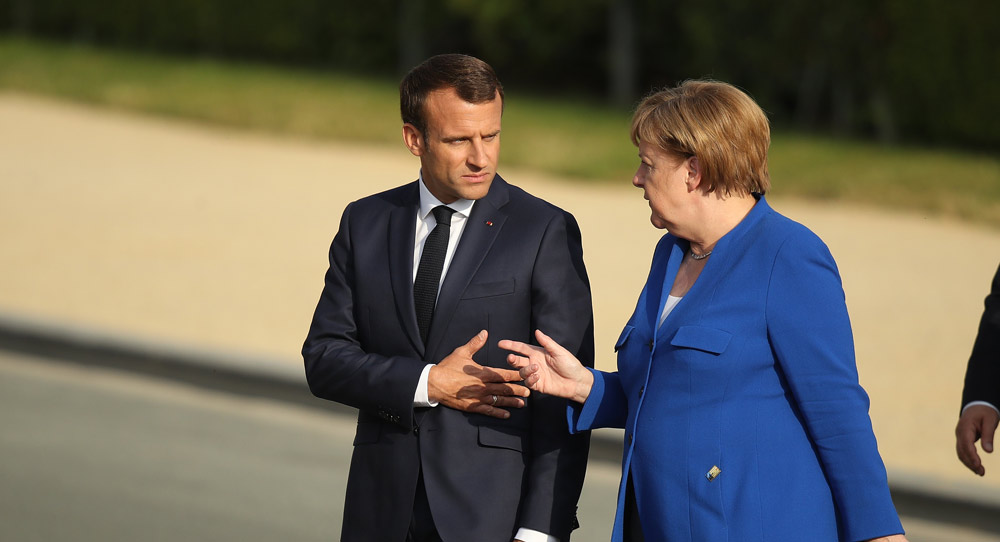
Source: Getty
Berlin and Paris are no longer providing the leadership Europe urgently needs to adapt to global, geostrategic shifts.
They tried to be upbeat.
For all the smiles and hugs, the reality is that the Treaty of Aachen that French President Emmanuel Macron and German Chancellor Angela Merkel sign on January 22 lacks strategic depth. It’s a shadow of the 1963 Élysée Treaty.
Back then, the Élysée Treaty was about these two countries embarking on a long, historic road toward reconciliation in what turned out to be remarkably successful venture.
That reconciliation was anchored on the European Union. The vows expressed in 1963 and repeated this week in Aachen—the burial place of Charlemagne, who united swathes of Europe during the Middle Ages—were about promoting and projecting peace. They were aimed at ending centuries of war that engulfed the continent.
Since the early 1960s, the EU has promoted itself as a bloc built on peace. This philosophy has been the guiding principle of the union’s foreign policy. That foreign policy, influenced by France and especially by Germany, today lacks strategic ambition as the new Aachen treaty shows.
The engine’s drivers, who had ambitions for a more integrated Europe in the past, have chosen to downplay or even ignore the geostrategic shifts taking place across the globe. The vows are timid and inward-looking, traits out of place for the challenges facing Europe in the twenty-first century.
Just two examples will suffice to show not only the lack of ambition but a provincialism out of sync with Europe’s needs. The Aachen treaty refers to “forward-looking solutions for integration in Europe.” In practice, this is what it amounts to: “To improve the life of citizens in border regions… local actors will be given the opportunity to establish cross-border projects such as nurseries, education facilities, emergency and health services, and industrial estates.”
As for the thorny issue of security and defense, German pacifists and those who believe only in soft power and development aid need not worry. “Military cooperation is also to be stepped up,” the treaty states. In practice, this will “include the development of joint strategic approaches, including the design of the European Defense Union, a close partnership with Africa… and even close consultation and coordination within the United Nations and other multilateral organizations.”
And by the way, forget about the EU ever winning support from Berlin or Paris for a permanent seat on the United Nations Security Council. Instead, “France supports Germany’s wish” to have such a seat. Forget also about further integration of the eurozone. In short, forget about Macron’s Sorbonne speech of September 2017, in which he unveiled what he hoped would be a blueprint for pushing the EU toward more integration on many levels.
So what’s gone wrong with the Franco-German engine? One explanation is that Merkel doesn’t like big designs and didn’t buy into Macron’s vision for the EU. The other is that perhaps she believes that Macron’s model would institutionalize a two-speed Europe—something that leading German politicians embraced back in the early 1990s.
Yet today’s EU is already a patchwork of opt-outs or opt-ins, whether they be related to defense, justice and home affairs, different policies towards migration, the Schengen system, or the euro. On reflection, it’s remarkable the EU functions as it does.
Without support from Merkel, who has had to contend with enough domestic problems since she was sworn in as chancellor for a fourth term last March, there was little chance of Macron winning broad acceptance from other member states.
The northern Europeans opposed his ideas, letting them do the running for Merkel. Not only that. European leaders didn’t offer their own views about Europe’s future. It’s as if they were afraid of challenging euroskeptics and populists, who were quick to capitalize on their silence. The Franco-German engine lacked the steam to move forward.
Maybe the expectations for France and Germany continuing to shape Europe have become too high. Maybe new groupings of countries, big and small, are needed to galvanize support for setting a strategic course for Europe.
Given the distractions over Brexit, the European Parliament elections, and Central Europe, the EU is woefully unprepared to deal with any bust-up between China and the United States. If Macron and Merkel don’t recognize that tension, no amount of renewing vows will compensate.

Nonresident Senior Fellow, Carnegie Europe
Judy Dempsey is a nonresident senior fellow at Carnegie Europe
Recent Work
Judy Dempsey
Judy Dempsey
Carnegie does not take institutional positions on public policy issues; the views represented herein are those of the author(s) and do not necessarily reflect the views of Carnegie, its staff, or its trustees.

While the EU and European governments are embracing the much-lauded middle-power moment, this entails three difficult conundrums.

Richard Youngs

Much has been said of the changes Brussels is trying to make to the EU enlargement process. Here’s why gradual integration might—or might not—be the answer.

Dimitar Bechev

The European Commissioner for Trade is headed to China. But after President Xi’s bridge-building visit to Washington, can a more isolated EU overcome Beijing’s stranglehold on critical raw materials? Who will blink first?

Rym Momtaz, ed.

The domestic impacts of how long it is taking to end the war in Ukraine have pushed the French electorate to the political extremes and compromised the country’s diplomatic capacity.
Rym Momtaz

Before the next wave of EU enlargement takes place, the union needs to grapple with thorny questions of how power is distributed among its members.


Emil Sondaj Hansen, Ditte Brasso Sørensen