

Commentary
Judy Dempsey
{
  "authors": [
    "Judy Dempsey"
  ],
  "type": "commentary",
  "blog": "Strategic Europe",
  "centerAffiliationAll": "",
  "centers": [
    "Carnegie Endowment for International Peace",
    "Carnegie Europe"
  ],
  "collections": [
    "Transatlantic Cooperation"
  ],
  "englishNewsletterAll": "",
  "nonEnglishNewsletterAll": "",
  "primaryCenter": "Carnegie Europe",
  "programAffiliation": "",
  "programs": [],
  "projects": [],
  "regions": [
    "Middle East",
    "Europe",
    "North America",
    "Western Europe",
    "Russia",
    "Southern, Eastern, and Western Africa"
  ],
  "topics": [
    "Security"
  ]
}
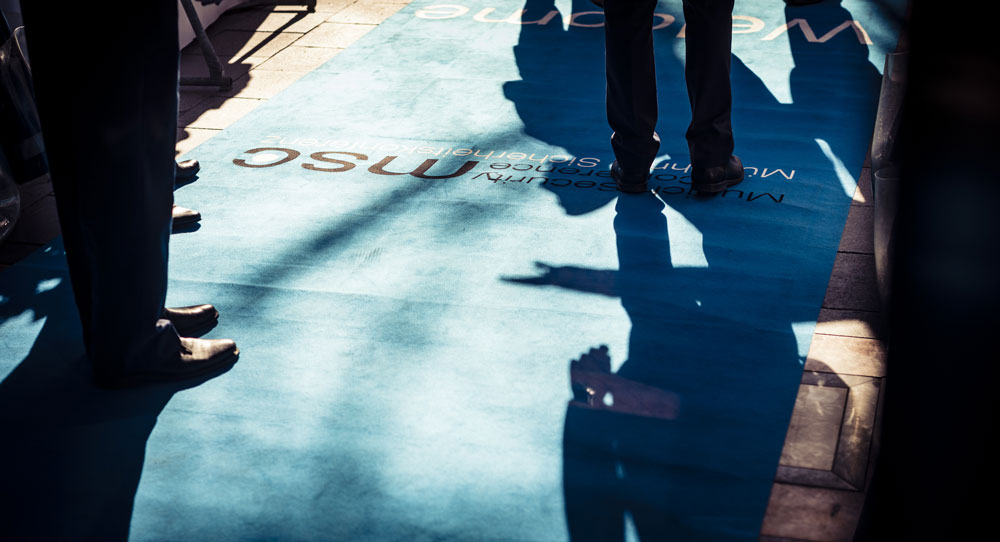
Source: Getty
This year’s Munich Security Conference ended as it begun: a bickering West reluctant to address the new geostrategic realities.
Carnegie Europe was on the ground at the 2019 Munich Security Conference, offering readers exclusive access to the debates as they unfold and providing insights on today’s immense threats to international peace and stability.
***
Diplomacy didn’t have much of a field day in Munich.
Nor did the West for that matter.
The absence of diplomatic tools and a sense of inquiry combined with sharp exchanges between the Europeans and some of the American delegation confirmed, more than ever, the weakness and disunity of the West.
This obsession with the “old” West during this year’s Munich Security Conference will delay any strategic realignment of its priorities as Russia and China, but also Japan and India, move on to define their interests. The West reacts as the rest of the world changes.Blaming the Trump administration, lambasting Vice President Mike Pence’s anti-European speech, and waxing lyrical over former U.S. vice-president Joe Biden’s elegant and passionate pro-transatlantic speech will not equip the West with the essential tools to defend its values and interests.
If anything, in Munich there was a nostalgia for the old West of the post-1945 era. Back then, there was a certain predictability about the conduct of diplomacy, about spheres of influence, and about ideological certainties.
The wars in the former Yugoslavia, Russia’s invasion in Georgia and later in Ukraine, and the continuing violence and misery of the wars in Syria and Yemen should have surely convinced the West that the old parameters and narrative are long over.
Listening to Henrietta Fore, executive director of the United Nations International Children’s Emergency Fund (UNICEF), speak in the main hall on Sunday about what was happening to women and children in Syria and other countries in the region was a world away from another discussion going on down the corridor.
The former debate confirmed the absence of strong, diplomatic tools to end the suffering. The latter was an elegant and worthy town hall meeting focused on a new publication: Defending Democracy and a Rules-Based Order. The gap in the language between both meetings was stark.
And that is what the MSC amounted to in the main hall: little listening. Too many polemics.
Russian Foreign Minister Sergey Lavrov railed against the United States but spared Europe. No wonder. The Kremlin must be savoring the weak dialogue in the transatlantic relationship. Pence didn’t hold back any punches about the hapless Europeans, and their continuing defense of the Iran deal. Russia was slapped hard, too.
And you should have heard Iranian Foreign Minister Mohammad Javad Zarif—his speech was one long tirade against the United States. At least the BBC’s ace journalist Lyse Doucet did her utmost not to let him drift, compared to last year when he got away scot-free without any trenchant questioning. But similar to last year, Zarif was a stand-alone. There was no engagement with other regional players.
Zarif’s speech exposed the deep divisions between the United States and the Europeans over the Iran nuclear deal. Despite Chancellor Angela Merkel’s attempts on Saturday to explain why it was necessary to preserve the deal, while at the same time acknowledging Iran’s disruptive role in Lebanon, Syria, Yemen, and Gaza, there was no meeting of minds between both sides of the Atlantic.
And since that is the case, how on earth are the Americans and Europeans going to work together—and with Russia—to save the Intermediate-Range Nuclear Forces (INF) Treaty? How are Western leaders going to take stock that the idea of the old West, one of Atlanticism, needs to break out of this geographical setting and mindset?
This would mean creating a wider security, political, and economic architecture that could include Japan and South Korea, Australia and New Zealand, and African and Latin American countries. It would be about widening and deepening democracy and its values. None of these issues were brought up in the main sessions.
And as for the West defending its values, it was really shameful how Egyptian President Abdel Fattah el-Sisi, who was given the podium on Saturday, was not at all confronted by either the chairman of the MSC nor the audience about the widespread abuse of human rights, the disappearances, the torture, and the crackdown on civil activists. Not forgetting the fact that the rubber-stamped Egyptian parliament approved measures that would allow him to extend his rule until…2034.
And yet, three interesting, optimistic trends that affect the traditional way of doing business by the West may have traction.
The first is the way in which Greek and Macedonian leaders managed to end years of dispute over the future name of Macedonia. Besides paving the way for Macedonia to join the EU and NATO, the accord was about political will and immense leadership and courage shown by Greek Prime Minister Alexis Tsipras and his Macedonian counterpart, Zoran Zaev. They were backed by skilled and patient diplomats from both sides who made the deal possible.
The second, again outside the confines of this almost anachronistic MSC, is the way other countries, such as the Netherlands and Norway, are quietly mediating in conflicts in the Middle East.
And the third is how a group of retired diplomats, but also those in office, realize that the West is no longer the old West. It’s about reaching out to democracies across the globe.
I’ve seen the likes of these “Declarations of Principles” before. But they were confined to the Euro-Atlantic organizations of the EU and NATO. (And now look what’s happening in Hungary and Poland).
This time it’s about the bigger horizon that should define the contours of the West. About using globalization and digitization to support values and democracy and humanitarian support for refugees. Just another initiative, cynics would respond. As it is, there’s already too much cynicism and too little dialogue. Maybe it’s time to really change the contours of the MSC itself.
Image source: MSC / Kuhlmann

Nonresident Senior Fellow, Carnegie Europe
Judy Dempsey is a nonresident senior fellow at Carnegie Europe
Recent Work
Judy Dempsey
Judy Dempsey
Carnegie does not take institutional positions on public policy issues; the views represented herein are those of the author(s) and do not necessarily reflect the views of Carnegie, its staff, or its trustees.
Preparing candidate countries for EU membership is no longer enough. As the enlargement process becomes a reality, the union must also prepare its own societies.

Iliriana Gjoni
Five countries staged the biggest political boycott in Eurovision history over Israel’s participation. With the FIFA World Cup and other sporting or cultural touchstones on the horizon, are boycotts effective?

Rym Momtaz, ed.
The full list of humiliations Europe has endured since Donald Trump returned to the White House makes for grim reading. But Washington’s adversarial approach to its allies undermines its own power base.
Rym Momtaz
The closure of the Strait of Hormuz has triggered a global energy crisis, but Europe is stuck in reaction mode. Without more strategic foresight, the EU will remain dependent on fossil fuels and will never be truly secure.


Milo McBride, Pauline Gerard
After spending much of 2025 trying to placate Donald Trump, some European leaders are starting to change posture. But is even a hostile Washington still so important to Europe that the U.S. president’s outbursts are worth putting up with?
Rym Momtaz, ed.