

Commentary
Gwendolyn Sasse
{
  "authors": [
    "Gwendolyn Sasse"
  ],
  "type": "commentary",
  "blog": "Strategic Europe",
  "centerAffiliationAll": "",
  "centers": [
    "Carnegie Endowment for International Peace",
    "Carnegie Europe"
  ],
  "collections": [
    "Europe’s Eastern Neighborhood"
  ],
  "englishNewsletterAll": "",
  "nonEnglishNewsletterAll": "",
  "primaryCenter": "Carnegie Europe",
  "programAffiliation": "",
  "programs": [],
  "projects": [],
  "regions": [
    "Europe",
    "Eastern Europe",
    "Ukraine"
  ],
  "topics": [
    "EU"
  ]
}
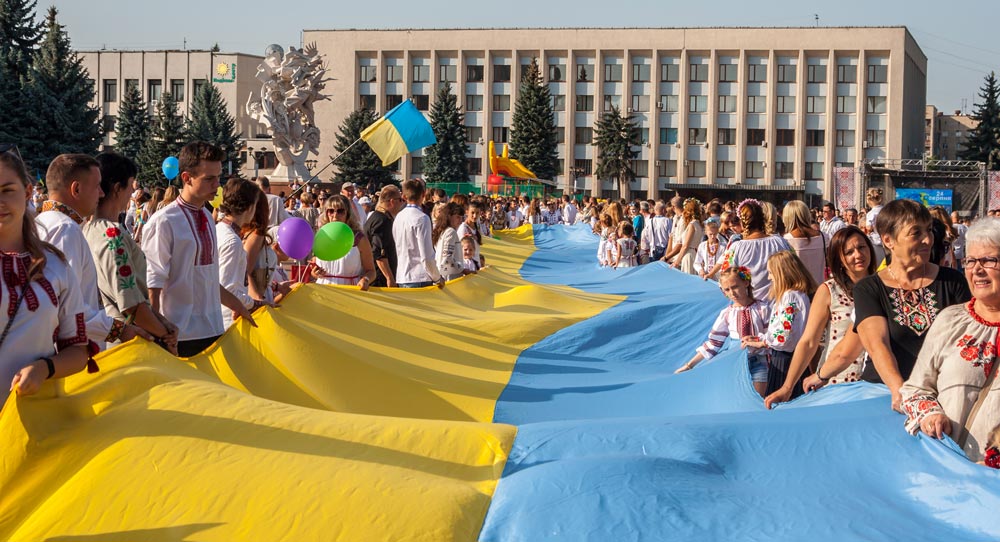
Source: Getty
The continuing war in Ukraine plays an important role in shaping politics and public perceptions in the run-up to this year’s elections. It turns out that identity issues are much more nuanced than the campaign rhetoric suggests.
With less than two months to go until Ukraine’s presidential elections on March 31, the official list of candidates is about to be confirmed, but uncertainty abounds. About 44 percent of the electorate says it will definitely participate but about 20 percent regularly state that they are still undecided about who they would vote for—a proportion that can have a critical effect on both turnout and the margins of success.
The support for two frontrunners, incumbent President Petro Poroshenko and Yuliya Tymoshenko, is below 20 percent, while their negative rankings are extremely high (about 60-70 percent). A victory of either of them in a second-round runoff in April would leave the electorate and political elites highly polarized and only partially anchored in society, as the country seamlessly moves toward a parliamentary election in October. The other key presidential contenders are the comedian Vladimir Zelensky, a newcomer in Ukrainian politics, and former defense minister Anatoliy Hrytsenko. While Zelensky has closed the gap to the frontrunners in some polls, Hrytsenko could still play the role of a compromise candidate, though his public approval is lower.
However, while speculation about the outcome of the presidential election commands all the attention, it is worth tracing the attitudes of Ukrainian society at large on a number of politically salient identity issues.
The election highlights the extent to which the ongoing war in eastern Ukraine is shaping the political culture. Under the slogan “army, language, faith,” Poroshenko’s campaign reflects the securitization of identity and culture in the official political discourse. It still remains unclear to what extent this strategy will help him win votes. Arguably, a president who now regularly poses in camouflage clothing and builds his image on that of the chief commander is at odds with how many Ukrainians think of their country.
A comparison of opinion poll data from 2017 and 2018, based on a set of questions inserted by ZOiS into the regular nationally representative survey conducted by KIIS in Ukraine (without the non-government controlled territories), highlights a couple of noteworthy trends:
1. Ukrainian citizenship—i.e. an identification with the state—has become the most important identity selected by respondents from a longer list of options including ethnic, linguistic, regional, and social identity categories. There has been a statistically significant increase from 38 percent of respondents choosing this option in 2017 to 49 percent in 2018. Conversely, in 2017 the category “ethnic Ukrainian” had still been predominant at 46 percent. In 2018, this option was chosen by 37 percent of the survey respondents, a statistically significant drop from one year to the next.

2. While a clear majority of respondents across both years name Ukrainian as their native language (68 percent in 2017 and 59 percent in 2018), the decrease is statistically significant, as is the increase in the identification with Russian as the respondents’ native language (13 percent in 2017 and 20 percent in 2018). Moreover, a steady third of respondents identifies with a dual native-language category (both Ukrainian and Russian), without any statistically significant change between the two years.

These survey results show that salient identities can shift even within the space of one year, particularly in a political context shaped by war and elections. A civic Ukrainian state identity linked to citizenship rather than ethnicity has become significantly stronger over the last two years. The data also show that individuals continue to exhibit much greater nuances in their self-identification than the official state rhetoric, election slogans, and recent legislation on the state language and education suggest. They also indicate a negative reaction among Russophones or residents in Russophone regions against a more exclusive notion of “Ukrainianness” projected by the official state discourse. Importantly, this does not call into question the strong identification with the Ukrainian state.
In sum, the ongoing war plays an important role in shaping both politics and public perceptions in the run-up to the elections. The trends in public opinion point to discrepancies between the campaign of the incumbent President Poroshenko and the self-identification of a significant part of the Ukrainian population. However, the other main contenders for the presidency have avoided formulating more nuanced perspectives on the diversity of Ukrainian society. Thus, the identity discourse is symptomatic of the distance between the political system and society in Ukraine that is likely to become more apparent in the aftermath of the presidential elections. In the long run, however, society’s more nuanced views on citizenship, ethnicity, and language offer scope for inclusive state-building.
Gwendolyn Sasse is a nonresident senior fellow at Carnegie Europe and director of the Centre for East European and International Studies (ZOiS) in Berlin.
Nonresident Senior Fellow, Carnegie Europe
Gwendolyn Sasse is a nonresident senior fellow at Carnegie Europe. Her research focuses on Eastern Europe, with a particular focus on Ukrainian politics and society, EU enlargement, and comparative democratization.
Recent Work
Gwendolyn Sasse
Gwendolyn Sasse
Carnegie does not take institutional positions on public policy issues; the views represented herein are those of the author(s) and do not necessarily reflect the views of Carnegie, its staff, or its trustees.

The EU can impose sanctions but struggles to enforce them without the United States. With Washington increasingly disinterested in backing European interests, the bloc must now fend for itself.


Nicu Popescu, Tiago Antunes

Russia is testing the waters of NATO’s mutual defense clause. What do strikes in Romanian territorial waters mean for the alliance’s posture toward Moscow?

Dimitar Bechev

With its public finances in shambles, the far right polling at 35 percent ahead of the 2027 presidential election, and a growing protest movement, is France’s crisis a threat to the EU’s geopolitical awakening?

Rym Momtaz, ed.

Ahead of a tough winter for Ukraine, Donald Trump’s swing back toward Russia bodes ill. But instead of panicking, Kyiv’s European allies are focusing on action.
Rym Momtaz

While the EU and European governments are embracing the much-lauded middle-power moment, this entails three difficult conundrums.

Richard Youngs