

Commentary
Peter Kellner
{
  "authors": [
    "Peter Kellner"
  ],
  "type": "commentary",
  "blog": "Strategic Europe",
  "centerAffiliationAll": "",
  "centers": [
    "Carnegie Endowment for International Peace",
    "Carnegie Europe"
  ],
  "collections": [
    "EU Integration and Enlargement",
    "Brexit and UK Politics"
  ],
  "englishNewsletterAll": "",
  "nonEnglishNewsletterAll": "",
  "primaryCenter": "Carnegie Europe",
  "programAffiliation": "",
  "programs": [],
  "projects": [],
  "regions": [
    "Europe",
    "Western Europe",
    "United Kingdom"
  ],
  "topics": [
    "EU"
  ]
}
Source: Getty
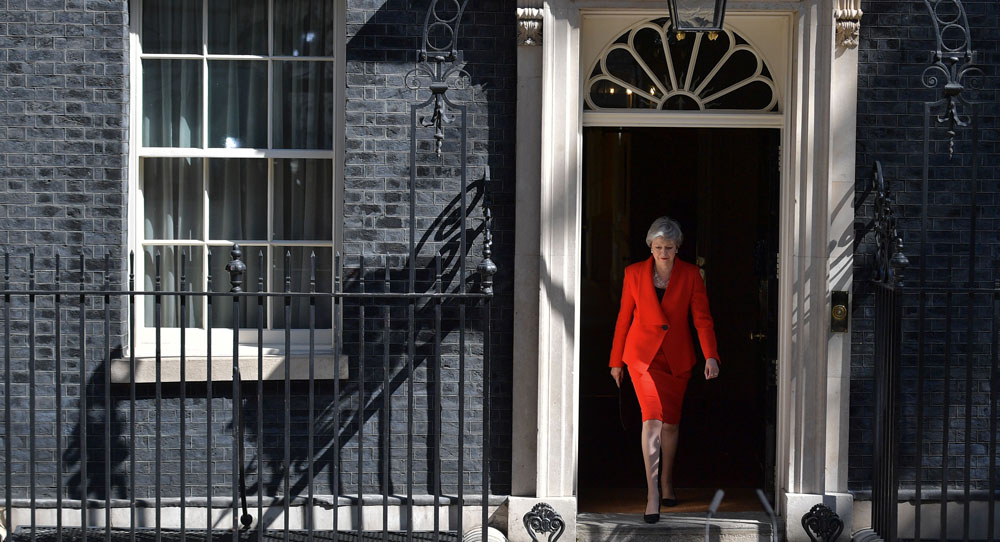
As the race to succeed Theresa May as UK prime minister heats up, Brits must make a number of pivotal decisions that will have major consequences for the country’s future.
The questions are clear; the answers anything but. Over the coming months, British members of Parliament (MPs), party activists, and possibly voters will face some stark choices. What they decide will determine the direction of British politics—and, especially, the UK’s relationship with the European Union—for years to come.
On May 24, Theresa May announced her resignation as Conservative Party leader and UK prime minister. The polls and the betting odds both make Boris Johnson, a former foreign secretary and mayor of London, the firm favorite to succeed her. He is by far the most popular choice among Conservative Party members, and they have the final say in electing the next party leader, who will also be the new prime minister.
However, Johnson’s victory is not certain. If there are more than two candidates, Conservative MPs decide which two names to put to party members. Many MPs dislike Johnson. They may try to prevent him from being one of those final two. Moreover, Johnson has frequently said or written things without thinking of their effect. His history of gaffes may harm his chances, especially if he adds to them in his coming campaign. I would put the odds of Johnson becoming prime minister at more than 50 percent, but not much more.Much will depend on how party members react to the mauling the Tories received in the May 23–26 European Parliament elections. The party slumped to fifth place and won just 9 percent of the vote—compared with the newly formed Brexit Party’s 32 percent share. The panic among Conservatives is palpable; but it is not yet clear whether this will help or harm Johnson’s prospects.
The list of other possible candidates is long and getting longer. If the party wants a leader who is strongly pro-Brexit and doesn’t mind the UK crashing out of the EU with no withdrawal agreement, then it could be Dominic Raab, who served briefly as Brexit secretary before resigning in protest against May’s strategy.
A more consensual choice might be Michael Gove, the environment secretary, or Matt Hancock, the health secretary. Hancock in particular has warned of the dangers of a no-deal Brexit.
After the decision of four Conservative MPs to leave the party, the UK government—with Northern Ireland’s Democratic Unionists—has a majority in the House of Commons of just five. It would take only a handful of pro-Remain Conservative MPs to withdraw their support, especially if the new prime minister is a hardline pro-Brexiteer, for the government to lose a vote of confidence. Until it is known who the new prime minister is, and the extent to which he or she tries to seek consensus across the Conservative Party, the result of a confidence vote is impossible to predict.
If the new prime minister loses this vote, Parliament would then have two weeks to see whether an alternative prime minister could win a fresh vote of confidence—possibly leading a multiparty coalition for a short time to sort out Brexit. But it is far more likely that such an administration could not be formed, in which case there would be an early general election sometime this fall.
There is, then, a tension in the process for electing the new prime minister. To become Tory leader, the successful candidate may well be the person who strikes the most aggressive pro-Brexit pose. But such a pose might make it impossible to survive a vote of confidence in Parliament.
Goodness knows. Under the UK’s first-past-the-post system for parliamentary elections, the Brexit Party may syphon, say, 2 or 3 million voters from the Conservatives, without winning any seats. That would help Labour win closely fought Labour-Conservative contests.
On the other side of the debate, the centrist, anti-Brexit Liberal Democrats’ strong performance in the European Parliament elections could give them momentum to do well in a general election. If, as last week, they capture pro-Remain voters who would otherwise support Labour, this too would affect the outcome in Labour-Conservative marginals.
My best guess: neither Labour nor the Conservatives would win an outright majority in an early general election. There will have to be some kind of minority or coalition government, which might find it no easier than the present parliament to reach a clear decision on Brexit.
The law says yes; the politics say probably not. The legal position is that the UK will leave the EU on October 31, unless Parliament passes a new law to change course. A strong Brexiteer prime minister might seek to prevent a new bill from coming before MPs. However, most MPs reject the thought of a no-deal Brexit. If that is where the country is heading, then Parliament is likely to find some way to stop it from happening.
The legal position could make the process complex, but in the end, politics will win out. That could require the UK to seek a further extension beyond October 31.
If there is no general election—and possibly even if there is—another referendum becomes increasingly likely. When the issue was tested in Parliament in April, a narrow majority opposed a referendum. But now that May’s compromise plan for an EU withdrawal agreement is dead, and if Parliament blocks a no-deal Brexit, then the pressure to hand the decision back to the people will grow.
Under British rules for holding referendums, a ballot would take around five months to set up, once the decision is made to go ahead; so if that decision comes in September or October, the referendum would be held in early 2020.
Until recently, the obvious choice, backed by most advocates of a new public vote, was between remaining in the EU and endorsing May’s withdrawal agreement. With that deal dead, the next obvious choice would be between remaining and leaving the EU without a deal.
However, most MPs think a no-deal Brexit would be so catastrophic that it would be irresponsible to make it one of the options. They would prefer some kind of compromise Brexit plan—which brings us back to either the existing withdrawal agreement, even if it means digging up its grave, or some alternative compromise. But it is unclear what that would be.
Polls suggest that Remain currently leads Leave by 54 to 46 percent, when Leave is left undefined. When Remain is pitched against specific versions of Leave, the Remain majority rises toward 60 percent.
The results of the European Parliament elections give modest encouragement to Remainers. If Labour votes are counted on the Remain side of the ledger (and the vast majority of Labour voters are anti-Brexit) and Conservative votes on the Leave side, then support for the Remain parties totals 54 percent and that for the Leave parties 44 percent—similar to recent polls. And, for as long as Britain is represented in the new European Parliament, it will have 37 pro-Remain and 33 pro-Leave members: a better result for the anti-Brexit cause than anyone expected before the votes were counted.

Former Nonresident Scholar, Carnegie Europe
Kellner was a nonresident scholar at Carnegie Europe, where his research focused on Brexit, populism, and electoral democracy.
Recent Work
Peter Kellner
Peter Kellner
Carnegie does not take institutional positions on public policy issues; the views represented herein are those of the author(s) and do not necessarily reflect the views of Carnegie, its staff, or its trustees.

With its public finances in shambles, the far right polling at 35 percent ahead of the 2027 presidential election, and a growing protest movement, is France’s crisis a threat to the EU’s geopolitical awakening?

Rym Momtaz, ed.

Ahead of a tough winter for Ukraine, Donald Trump’s swing back toward Russia bodes ill. But instead of panicking, Kyiv’s European allies are focusing on action.
Rym Momtaz

While the EU and European governments are embracing the much-lauded middle-power moment, this entails three difficult conundrums.

Richard Youngs

Much has been said of the changes Brussels is trying to make to the EU enlargement process. Here’s why gradual integration might—or might not—be the answer.

Dimitar Bechev

The European Commissioner for Trade is headed to China. But after President Xi’s bridge-building visit to Washington, can a more isolated EU overcome Beijing’s stranglehold on critical raw materials? Who will blink first?
Rym Momtaz, ed.