

Commentary
Judy Dempsey
{
  "authors": [
    "Judy Dempsey"
  ],
  "type": "commentary",
  "blog": "Strategic Europe",
  "centerAffiliationAll": "",
  "centers": [
    "Carnegie Endowment for International Peace",
    "Carnegie Europe"
  ],
  "collections": [],
  "englishNewsletterAll": "",
  "nonEnglishNewsletterAll": "",
  "primaryCenter": "Carnegie Europe",
  "programAffiliation": "",
  "programs": [],
  "projects": [],
  "regions": [
    "Europe",
    "Western Europe"
  ],
  "topics": [
    "EU"
  ]
}
Source: Getty
The new members of the European Parliament and leaders of the EU’s institutions need to think strategically if the continent is to defend its political, economic, and security interests.
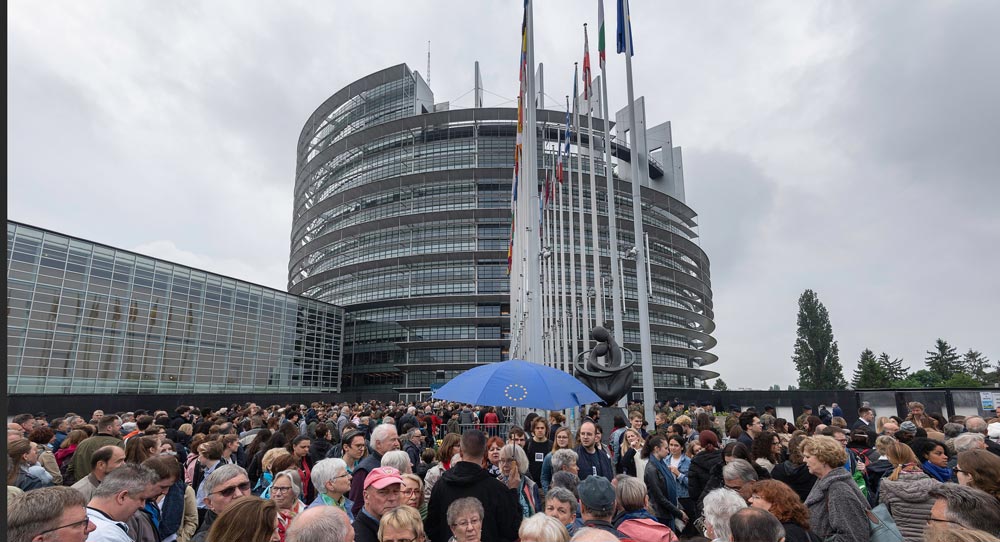
Europeans can be a cynical lot. They complain about the creeping bureaucracy of the EU’s institutions. They complain about the generous expenses of European Parliament legislators and their insane and costly shuttling between Brussels and Strasbourg to attend parliamentary sessions. When they look outside Europe, they complain about U.S. President Donald Trump, especially the way he is confronting China over its trade practices and Iran over its nuclear ambitions.
Now is the chance for adult citizens who make up part of the EU’s 513 million–strong population to do something about this whining. On May 23–26 voters in all 28 EU member states will elect new members of the European Parliament. The populist movements think they have the answers: less Brussels, more sovereignty, and closed borders—not to mention harsher rule of law.
One of those movements, the far-right Freedom Party of Austria (FPÖ), has punctured that confidence. A sting operation showed Heinz-Christian Strache, then Austrian vice-chancellor and FPÖ leader, promising back in 2017 to an alleged niece of a Russian oligarch the chance to buy a clutch of state holdings plus a share in the mass-circulation daily Kronen Zeitung. The aim was to boost the financial and political strength of the FPÖ, which is an ally of Russian President Vladimir Putin’s United Russia party.Chancellor Sebastian Kurz, who had hoped to prove his conservative Austrian People’s Party could govern with such a far-right party (with Nazi credentials), has now washed his hands of this undisguised pro-Russian coalition partner.
The affair has provided a distraction in the run-up to the European Parliament elections. Some pundits argue this is a blow to Russian interference and the ability of populist movements to band together and become a cohesive force in the newly elected parliament. Others add this is a fillip for the Liberals and Greens, who are expected to do well as they campaign on reining in climate change, an issue taken up by other parties.
Climate change is hugely important. But there is something just as urgent that leaders across Europe need to talk about. This is the necessity to think and act strategically if Europeans are to defend their political, economic, and trade interests. This means taking an unjaundiced look at the condition of the transatlantic relationship, the role of China, and the persistent menacing interference of Russia in the EU.
The transatlantic relationship must take precedence. What happens to NATO fundamentally affects Russia’s and China’s roles in Europe. For all the talk about the EU having its own army or the Europeans wanting strategic autonomy, a new report by the International Institute for Strategic Studies (IISS) debunks these half-baked notions. Instead, the authors provide a much-needed sober assessment about what the European allies need to do if the United States leaves NATO.
Until now, with few exceptions, the Europeans have been unaware, or have taken for granted, that the United States has protected global sea lines of communication (SLOCs). Either through NATO or outside the alliance, the United States has been indispensable for protecting Europe’s trade. Similarly, it is the U.S.-led NATO that continues to defend European NATO territory against a state-level military attack.
But what would happen to European security if the United States were to quit NATO as Washington focuses on China as its main strategic competitor?
IISS sets out the scenario. The costs wouldn’t come cheap. “European members would have to invest between US$288bn and US$357bn to fill the capability gaps generated by this scenario,” states the report. The Europeans, with the Canadians, would need to establish a NATO-Europe force level that could prevail in a limited regional war in Europe but not a full-scale continental war. In short, the debate needs to focus on capabilities to tackle the threats to European security, “rather than on institutional engineering”—a dig at simplistic discussions about an EU army.
And even if the European NATO members got their act together over capabilities, “the recapitalisation across the military domains would take up to 20 years” if the funding were available. As the IISS report explains, this is because the Europeans are hampered by limited production capacity in addition to challenges of recruitment, training, and operational capability.
So how does this report feed into the outcome of the European Parliament elections and the horse-trading that will ensue in the following months to pick the next leaders of the EU’s institutions? It’s about Europeans understanding that with or without the United States in NATO, they have to grasp that their way of life will be jeopardized if they do not take security and defense seriously. SLOCs can be easily disrupted—by Iran in the Strait of Hormuz or by China in the South China Sea.
But are European leaders planning strategically for how to react if global trade is disrupted? Are they militarily prepared to defend their Eastern flank if Russia takes advantage of a United States turning away from NATO? The answer to both is no. That is why Europe is vulnerable. But don’t expect the bloc’s leaders or those running for the European Parliament to tell voters that the peace project established after 1945 and underpinned by the United States needs to be defended.

Nonresident Senior Fellow, Carnegie Europe
Judy Dempsey is a nonresident senior fellow at Carnegie Europe
Recent Work
Judy Dempsey
Judy Dempsey
Carnegie does not take institutional positions on public policy issues; the views represented herein are those of the author(s) and do not necessarily reflect the views of Carnegie, its staff, or its trustees.

With its public finances in shambles, the far right polling at 35 percent ahead of the 2027 presidential election, and a growing protest movement, is France’s crisis a threat to the EU’s geopolitical awakening?

Rym Momtaz, ed.

Ahead of a tough winter for Ukraine, Donald Trump’s swing back toward Russia bodes ill. But instead of panicking, Kyiv’s European allies are focusing on action.
Rym Momtaz

While the EU and European governments are embracing the much-lauded middle-power moment, this entails three difficult conundrums.

Richard Youngs

Much has been said of the changes Brussels is trying to make to the EU enlargement process. Here’s why gradual integration might—or might not—be the answer.

Dimitar Bechev

The European Commissioner for Trade is headed to China. But after President Xi’s bridge-building visit to Washington, can a more isolated EU overcome Beijing’s stranglehold on critical raw materials? Who will blink first?
Rym Momtaz, ed.