

Commentary
Gwendolyn Sasse
{
  "authors": [
    "Gwendolyn Sasse"
  ],
  "type": "commentary",
  "blog": "Strategic Europe",
  "centerAffiliationAll": "",
  "centers": [
    "Carnegie Endowment for International Peace",
    "Carnegie Europe"
  ],
  "collections": [
    "Europe’s Eastern Neighborhood"
  ],
  "englishNewsletterAll": "",
  "nonEnglishNewsletterAll": "",
  "primaryCenter": "Carnegie Europe",
  "programAffiliation": "",
  "programs": [],
  "projects": [],
  "regions": [
    "Europe",
    "Eastern Europe",
    "Ukraine"
  ],
  "topics": [
    "Political Reform",
    "EU"
  ]
}
Source: Getty
After Ukraine’s president wins a majority in the country’s parliament, the potential for real change exists, but it comes with the risk that the government could lose sight of socioeconomic and political priorities.
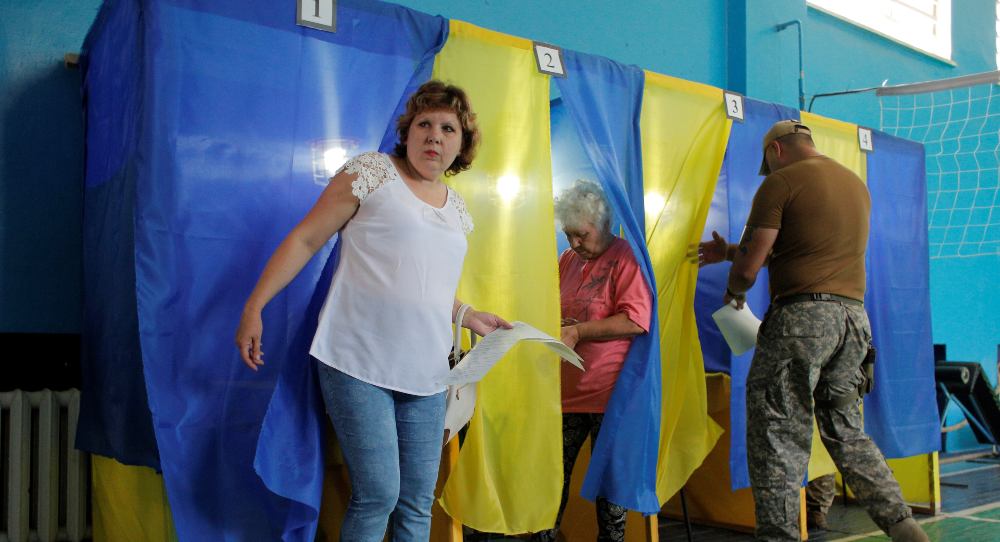
The Ukrainian parliamentary election on July 21 has achieved what few would have deemed possible: President Volodymyr Zelenskiy’s new party, Servant of the People, looks set to command a clear majority in the parliament, or Rada. In Ukraine’s mixed electoral system, the party secured a majority of the party-list votes and managed to win many of the single-member constituencies. The latter have long been a stronghold of entrenched oligarchic interests.
With about 80 percent of the votes counted by the evening of July 22, Zelenskiy’s party had won some 43 percent of the vote and roughly 250 out of 424 seats in the parliament (out of a total of 450 seats—those for Russian-annexed Crimea and the non-government-controlled areas in the Donbas region remain unfilled). A single-party majority is a first in Ukrainian politics since the country’s independence in 1991.Between 60 and 70 percent of the elected members of parliament (MPs) will be newcomers to the Rada and many to official Ukrainian politics in general. This marks an unprecedented elite turnover in Ukraine. It is remarkable even compared with the early transition changes in Central and Eastern Europe after the fall of communism.
The key question is whether such a radical turnover in one of Ukraine’s least-trusted political institutions will translate into effective legislative work to bolster the reform process and bring peace to Ukraine, as Zelenskiy has promised. It is an immense challenge that begs other questions. Will the lack of political experience in the new Rada hamper this process? And will vested interests and rivalries emerge and divert the reform process, as in previous political cycles?
After the 2013–2014 Euromaidan mass demonstrations, which ousted then Ukrainian president Viktor Yanukovych, there was also a significant turnover of parliamentarians. However, some pursued their own oligarchic interests, while others suffered from their close association with incoming president Petro Poroshenko.
Poroshenko delayed important reforms, in particular those tackling corruption. And his rhetoric, centered on a narrow definition of the Ukrainian nation at war, became detached from Ukrainian society. This proved a liability for his presidential campaign and for the political future of a new generation of reform-minded politicians. The post-Euromaidan period, characterized by high expectations and big disappointments on the part of the electorate, prepared the ground for the landslide victory of the political outsider Zelenskiy and his new party.
Zelenskiy’s strategy to bring forward the parliamentary election, which was originally slated for October this year, has paid off. As in April’s presidential election, Ukrainian voters have used the opportunity to express their discontent with the country’s political elites. Their frustration, seriously underestimated by those elites, had reached such levels that voters proved willing to back entirely unknown candidates. Uncertainty is now seen as a risk worth taking when judged against the status quo.
Four other parties are on course to have crossed the 5 percent threshold needed to gain seats in the parliament: Opposition Platform—For Life, a re-creation of Yanukovych’s party with direct links to the Kremlin (which won about 13 percent of the vote), the new, vaguely liberal party Voice of rock singer Svyatoslav Vakarchuk (about 6 percent), Poroshenko’s relatively unsuccessfully rebranded European Solidarity (about 8 percent), and former prime minister Yulia Tymoshenko’s party Fatherland (also about 8 per cent).
In particular the Russian media, but also some Western circles, tended to concentrate on the alleged strength of right-wing forces in Ukrainian politics. But this parliamentary election has shown clearly that their appeal among Ukrainian voters is extremely limited.
At just below 50 percent, turnout was slightly lower than in the 2014 election. However, given the timing of this election in the middle of the summer, this should not be overinterpreted. If anything, holding an early election in the summer was a risk on Zelenskiy’s part. While there was significant variation in turnout across the country, there is no straightforward underlying pattern, as turnout was lower in Kyiv as well as in western and eastern cities.
Zelenskiy’s party will not need to form a coalition, something that proved difficult even for reformist governments in the past. It allows the president and the government to work closely with the parliament and, in principle, creates the space to pass legislation, especially given that the other parties in the parliament do not form a united opposition.
Nevertheless, Zelenskiy has announced that he would be open to a coalition with the other new party, Voice. The two parties’ mobilization strategies are similar, although their policies appear to be somewhat different. A coalition could ensure that the two groups do not turn into political rivals in the near future.
Once the votes are fully counted, all eyes will be on the nomination of the new prime minister. According to the Ukrainian constitution, MPs will propose the new head of government to the president. The parliament also has to approve the government put forward by the prime minister; only the foreign and defense ministers are nominated by the president.
The institutional potential for real change exists, but it comes with the risk that the president and government could lose sight of Ukraine’s socioeconomic and political priorities. Banning anyone who has ever held office from politics, as Zelenskiy’s team announced, is one such example of an unnecessary policy, given the need for a balance between starting afresh and benefiting from existing experience.Ukraine’s European partners, in particular national parliaments, should concentrate on getting to know their new Ukrainian counterparts, offering their expertise, and testing the basis for deeper cooperation.
There is reason to be skeptical about the smooth running of Ukraine’s legislative process and executive-legislative relations in view of the lack of political experience. But it is definitely worth the effort to engage more at the parliamentary level. Doing so will send a signal to the new parliamentarians that they are taken seriously, that they can call on support, and that the expectations they face are high. Europe’s engagement and commitment are critical.
Gwendolyn Sasse is a nonresident senior fellow at Carnegie Europe and director of the Centre for East European and International Studies (ZOiS) in Berlin.
Nonresident Senior Fellow, Carnegie Europe
Gwendolyn Sasse is a nonresident senior fellow at Carnegie Europe. Her research focuses on Eastern Europe, with a particular focus on Ukrainian politics and society, EU enlargement, and comparative democratization.
Recent Work
Gwendolyn Sasse
Gwendolyn Sasse
Carnegie does not take institutional positions on public policy issues; the views represented herein are those of the author(s) and do not necessarily reflect the views of Carnegie, its staff, or its trustees.

With its public finances in shambles, the far right polling at 35 percent ahead of the 2027 presidential election, and a growing protest movement, is France’s crisis a threat to the EU’s geopolitical awakening?

Rym Momtaz, ed.

Ahead of a tough winter for Ukraine, Donald Trump’s swing back toward Russia bodes ill. But instead of panicking, Kyiv’s European allies are focusing on action.
Rym Momtaz

While the EU and European governments are embracing the much-lauded middle-power moment, this entails three difficult conundrums.

Richard Youngs

Much has been said of the changes Brussels is trying to make to the EU enlargement process. Here’s why gradual integration might—or might not—be the answer.

Dimitar Bechev

The European Commissioner for Trade is headed to China. But after President Xi’s bridge-building visit to Washington, can a more isolated EU overcome Beijing’s stranglehold on critical raw materials? Who will blink first?
Rym Momtaz, ed.