

Commentary
Judy Dempsey
{
  "authors": [
    "Judy Dempsey"
  ],
  "type": "commentary",
  "blog": "Strategic Europe",
  "centerAffiliationAll": "",
  "centers": [
    "Carnegie Endowment for International Peace",
    "Carnegie Europe"
  ],
  "collections": [],
  "englishNewsletterAll": "",
  "nonEnglishNewsletterAll": "",
  "primaryCenter": "Carnegie Europe",
  "programAffiliation": "",
  "programs": [],
  "projects": [],
  "regions": [
    "Europe",
    "Western Europe"
  ],
  "topics": [
    "EU",
    "Democracy",
    "Political Reform"
  ]
}
Source: Getty
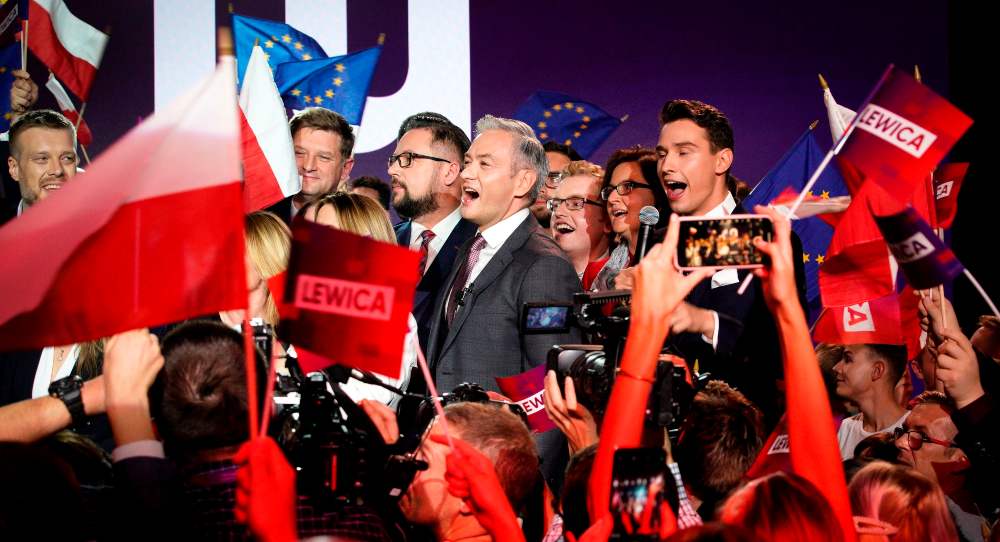
The results of parliamentary elections in Poland and local elections in Hungary should push the opposition to come up with policies aimed at protecting democracy and overcoming polarization.
Something is happening in Poland and Hungary: opposition parties are slowly finding their voice.
On October 13, Poland’s governing Law and Justice (PiS) party, in power since 2015, won an absolute majority in the country’s parliamentary election. Its share of votes increased from 37.6 percent in 2015 to 43.6 percent, which, translated into parliamentary seats, gives PiS 235 seats in the 460-strong Sejm.
So, more of the same in terms of PiS trying to establish a Poland anchored on nationalist, conservative, and patriotic lines? It’s not as clear-cut as that.The opposition has begun to find its voice. The Civic Coalition led by the center-right Civic Platform won 27.4 percent, while the Left, an alliance of center-left parties, won nearly 13 percent. A coalition of two other parties, the rural Polish People’s Party and the anti-establishment Kukiz’15, mustered 8.6 percent, and the nationalist, conservative Confederation managed to win 6.8 percent. All told, the opposition has 224 seats. PiS doesn’t have the power to change the constitution; it lacks the required two-thirds majority.
Moreover, PiS lost its majority in the one hundred-member Senate, the upper house: opposition and independent candidates now hold the majority with fifty-one seats. This is a significant victory. The senate has the power to initiate legislation and reject bills approved by the Sejm. Yes, PiS—with its absolute majority in the Sejm—can reject amendments made by the Senate. But it’s not going to be plain sailing for the governing party.
On the same day in Hungary, Prime Minister Viktor Orbán’s governing Fidesz party took a battering in local government elections.
Opposition parties put aside their differences to oust Fidesz majors in eight important cities, including Budapest, where opposition candidate Gergely Karácsony won a major victory to become chief mayor of the capital. He had assembled bands of young supporters, who managed to win fourteen of Budapest’s twenty-three districts. Of Hungary’s twenty-three cities with so-called county rights, which don’t include Budapest, ten cities elected an opposition-backed candidate as mayor.
“After nine years this is the first election which can be qualified as a defeat for the governing coalition, so no wonder that the opposition parties are in a state of euphoria right now,” wrote political scientists Viktor Z. Kazai and János Mécs.
But they issued a caution: “Make no mistake, outside of Budapest Fidesz remained the strongest political force. However, these results show that cooperation between the opposition parties has been a successful strategy . . . and they can start to build up local centers of resistance.”
More than that. In both Poland and Hungary, the opposition will now have to translate their gains into policies aimed at ending the deep divisions in their countries. It will be a long haul. But a pendulum that was almost static in Poland since 2015 and in Hungary since Fidesz gained power in 2010 is slowly beginning to move.
And the pendulum is beginning to swing not because of the European Union.
Over the years, as Fidesz chiseled away at the independent media and civil society organizations as well as at the independence of the constitutional court and of academic institutions, the EU was slow to respond. It was more outspoken about Poland, particularly when PiS changed the way judges are nominated and attempted to remove a significant amount of judges from both higher and lower courts.
Yet, ultimately, it wasn’t EU criticism that dented support for Fidesz or woke up the Polish opposition. It was the citizens. Regardless of their political hew they voted for new faces. A new language. But a coherent narrative has yet to take hold—and not just for Poland and Hungary.
The search for a new political narrative—a new way of making politics—is something Slovaks, Romanians, and Bulgarians have also been seeking.
Zuzana Čaputová, a political novice who campaigned on fighting corruption, was elected president of Slovakia in March 2019. The public had had enough of the links between politicians and organized crime, which the investigative journalist Ján Kuciak was probing, when he and his fiancée, Martina Kušnírová, were murdered in February 2018. Those murders led to a huge reaction by civil society movements and activists who wanted an end to Slovakia’s endemic corruption.
Elsewhere, in Bulgaria and Romania, anticorruption campaigners continue struggling against the widespread abuse of power and weak rule of law. They need far more support from the EU. It’s all very well for member states to issue new conclusions on democracy support in the EU’s external relations, with one of many goals to “support efforts to strengthen the rule of law, democratic integrity and accountability through reinforcing the separation of powers, . . . fighting impunity and combating corruption” across the world. But ask Bulgarian and Romanian activists what impact the EU is having when it comes to defending those very principles within the bloc itself.
Yet, over time, change comes from within. From the people. If the change is based on revenge, often the hallmark of PiS and Fidesz, it will do little to create a politics of inclusiveness or end the political polarization.
But the slow swing of the pendulum in Poland and Hungary just may be the beginning of a new narrative.

Nonresident Senior Fellow, Carnegie Europe
Judy Dempsey is a nonresident senior fellow at Carnegie Europe
Recent Work
Judy Dempsey
Judy Dempsey
Carnegie does not take institutional positions on public policy issues; the views represented herein are those of the author(s) and do not necessarily reflect the views of Carnegie, its staff, or its trustees.

While the EU and European governments are embracing the much-lauded middle-power moment, this entails three difficult conundrums.

Richard Youngs

Much has been said of the changes Brussels is trying to make to the EU enlargement process. Here’s why gradual integration might—or might not—be the answer.

Dimitar Bechev

The European Commissioner for Trade is headed to China. But after President Xi’s bridge-building visit to Washington, can a more isolated EU overcome Beijing’s stranglehold on critical raw materials? Who will blink first?

Rym Momtaz, ed.

The domestic impacts of how long it is taking to end the war in Ukraine have pushed the French electorate to the political extremes and compromised the country’s diplomatic capacity.
Rym Momtaz

Before the next wave of EU enlargement takes place, the union needs to grapple with thorny questions of how power is distributed among its members.


Emil Sondaj Hansen, Ditte Brasso Sørensen