

Commentary
Thomas de Waal
{
  "authors": [
    "Thomas de Waal"
  ],
  "type": "commentary",
  "blog": "Strategic Europe",
  "centerAffiliationAll": "",
  "centers": [
    "Carnegie Endowment for International Peace",
    "Carnegie Europe",
    "Carnegie Russia Eurasia Center"
  ],
  "collections": [
    "Europe’s Eastern Neighborhood",
    "Coronavirus"
  ],
  "englishNewsletterAll": "",
  "nonEnglishNewsletterAll": "",
  "primaryCenter": "Carnegie Europe",
  "programAffiliation": "",
  "programs": [],
  "projects": [],
  "regions": [
    "Russia",
    "Eastern Europe",
    "Caucasus",
    "Georgia"
  ],
  "topics": [
    "Security",
    "EU"
  ]
}
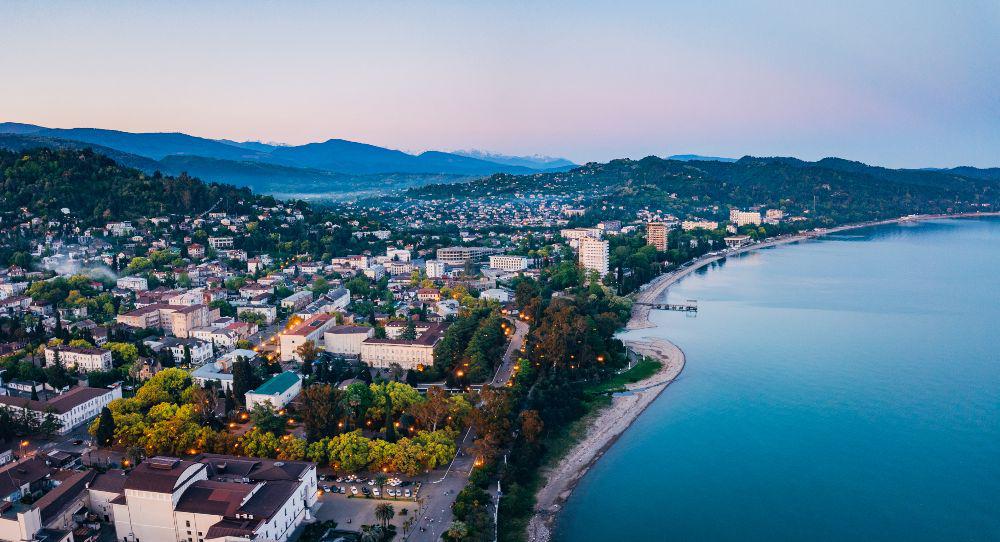
Source: Getty
The Georgian-Abkhaz ethnic conflict looks rather small and old-fashioned in light of the coronavirus pandemic. The two sides should seize the moment to start working more closely together.
A moment of global crisis is an occasion to look anew at some old problems. As it happens, Abkhazia, which is the center of an exhausting three-decades-old conflict, has elected a new leader. It is a moment to think about a reset.
Abkhazia is the small Black Sea territory that split away in conflict from rule by Georgia almost thirty years ago as the Soviet Union broke up, but is recognized as a state only by Russia and a handful of Russian allies.
For years now, both Abkhazia and Georgia have been practicing policies of mutual isolation. The Georgian authorities have restricted any substantial international interaction with Abkhazia that does not bear a Georgian imprint. Long before the rest of us, the Abkhaz have been practicing selective self-isolation, attaching strings to proposed international projects.This isolation now looks like a luxury neither side, bound together by geography if nothing else, can afford.
In the era of the new coronavirus, Abkhazia provided a bizarre spectacle when it went ahead with an election to choose a new de facto president on March 22, 2020. Big campaign rallies were held. When former security chief Aslan Bzhania was declared the winner, he was congratulated with hugs from supporters and a prolonged handshake from his main rival.
On March 25, the acting leader of the republic expressed anger that Abkhaz were still holding their traditional mass weddings, attended by as many as 1,500 people at a time.
Only on March 27 did the de facto authorities announce restrictions to limit the spread of the virus. They have now even closed the border with Russia.
The indifference was partly Caucasian bravado. But the Abkhaz were also desperate to press ahead with the vote to end a period of political turmoil. The previous president, Raul Khajimba, was almost literally thrown out of office in January 2020 by a crowd of protestors. For a long period, the republic has been almost ungovernable.
Officially, Abkhazia has registered only one case of the virus, but as there is almost no testing it is impossible to confirm what the real situation is. A serious outbreak would quickly overwhelm its health system.
It has received some medical aid from Russia. World Health Organization officials also arranged for two shipments of equipment via Georgia. Very unusually, this was funded by the U.S. Agency for International Development—a move that sets a good precedent for Western aid to be delivered to Abkhazia through UN channels.
However, Western governments missed a golden opportunity when they issued their routine statements on Abkhazia’s election.
The group of fifteen Western “Friends of Georgia” issued a statement saying they “do not recognize the legitimacy of the so-called ‘presidential elections’ held in Georgia’s Abkhazia region.” The EU statement was worded slightly differently, saying that “the European Union does not recognise the constitutional and legal framework in which [the elections] took place.”
Amazingly, neither of these cookie-cutter statements mentioned the coronavirus. The EU document referred to its 2009 “policy of non-recognition and engagement” but offered no assistance within that policy. What would it have cost to add a line saying that “the current pandemic is a global crisis which respects no boundaries. We stand ready to assist Abkhazia to combat the coronavirus and to stop the spread of the disease”?
The robust Western policy of non-recognition of Abkhazia and reassurance of Georgia is well-justified. The de facto state of Abkhazia is an ethnocracy, it lacks legitimacy because of the flight or expulsion of more than 200,000 Georgians during the war with the Georgian government in 1992–1993. It has several thousand Russian troops stationed on it, in violation of international law.
But a “non-recognition and engagement” policy can take many forms. Two new factors, the election of Bzhania and the global pandemic, are an argument for much more active engagement.
Bzhania has more legitimacy than any Abkhaz leader for many years. In interviews, he repeats the standard Abkhaz line that Tbilisi and Western countries need to recognize the “reality” of Abkhazia’s aspiration for independence, that his homeland will never return to Georgia after twenty-seven years apart. But he also speaks much more respectfully of Georgia (as a “neighbor”), with which he will need to work on a host of issues.
The sovereignty clash over Abkhazia is almost insoluble. But a reset could focus on three shorter-term elements.
The first is for both Tbilisi and Western countries to engage more openly with the de facto leadership in Abkhazia on issues such as the pandemic. The pretense that they do not care if the Abkhaz choose a leader—that they would not mind if Abkhazia was in a state of anarchy—is disingenuous. Besides, there has actually been constant contact over the years with Abkhaz leaders on issues ranging from security to electricity sharing.
An alternative model already exists with the leadership of the Turkish Republic of Northern Cyprus, a de facto state recognized internationally only by Turkey: Greek Cypriots and internationals meet with Mustafa Akıncı as the “leader of the Turkish community.” Former European Commission president Jean-Claude Juncker congratulated Akıncı on his election in 2015—as did the Greek Cypriots—and his successor will do so again.
The second is that Abkhazia needs an on-the-ground international development assistance program that tackles the chronic needs of its population—not just in health but also in education and the environment—and complements Georgian-Abkhaz confidence-building measures.
The third element should be the quid pro quo. If Western countries and Georgia engage more seriously in Abkhazia, then the Abkhaz de facto authorities need to seriously up their game too. First of all, they should afford the roughly 50,000 Georgians living in the Gali region of eastern Abkhazia proper rights and protection, including transit into western Georgia and the right to mother-tongue education.
These people are currently the biggest losers from the crisis as the boundary line on the Inguri River has been closed since March 14.
In light of the coronavirus pandemic, the Georgian-Abkhaz ethnic conflict suddenly looks rather small and old-fashioned. It is a moment to shed some illusions and get the two sides working more closely together.

Senior Fellow, Carnegie Europe
Thomas de Waal is a senior fellow at Carnegie Europe, specializing in Eastern Europe and the Caucasus.
Recent Work
Thomas de Waal
Thomas de Waal

While the EU and European governments are embracing the much-lauded middle-power moment, this entails three difficult conundrums.

Richard Youngs

Much has been said of the changes Brussels is trying to make to the EU enlargement process. Here’s why gradual integration might—or might not—be the answer.

Dimitar Bechev

The European Commissioner for Trade is headed to China. But after President Xi’s bridge-building visit to Washington, can a more isolated EU overcome Beijing’s stranglehold on critical raw materials? Who will blink first?

Rym Momtaz, ed.

The domestic impacts of how long it is taking to end the war in Ukraine have pushed the French electorate to the political extremes and compromised the country’s diplomatic capacity.
Rym Momtaz

Before the next wave of EU enlargement takes place, the union needs to grapple with thorny questions of how power is distributed among its members.


Emil Sondaj Hansen, Ditte Brasso Sørensen