

Commentary
Judy Dempsey
{
  "authors": [
    "Judy Dempsey"
  ],
  "type": "commentary",
  "blog": "Strategic Europe",
  "centerAffiliationAll": "",
  "centers": [
    "Carnegie Endowment for International Peace",
    "Carnegie Europe"
  ],
  "collections": [
    "Coronavirus"
  ],
  "englishNewsletterAll": "",
  "nonEnglishNewsletterAll": "",
  "primaryCenter": "Carnegie Europe",
  "programAffiliation": "",
  "programs": [],
  "projects": [],
  "regions": [
    "Europe",
    "Western Europe",
    "Russia",
    "Asia"
  ],
  "topics": [
    "Foreign Policy",
    "EU"
  ]
}
Source: Getty
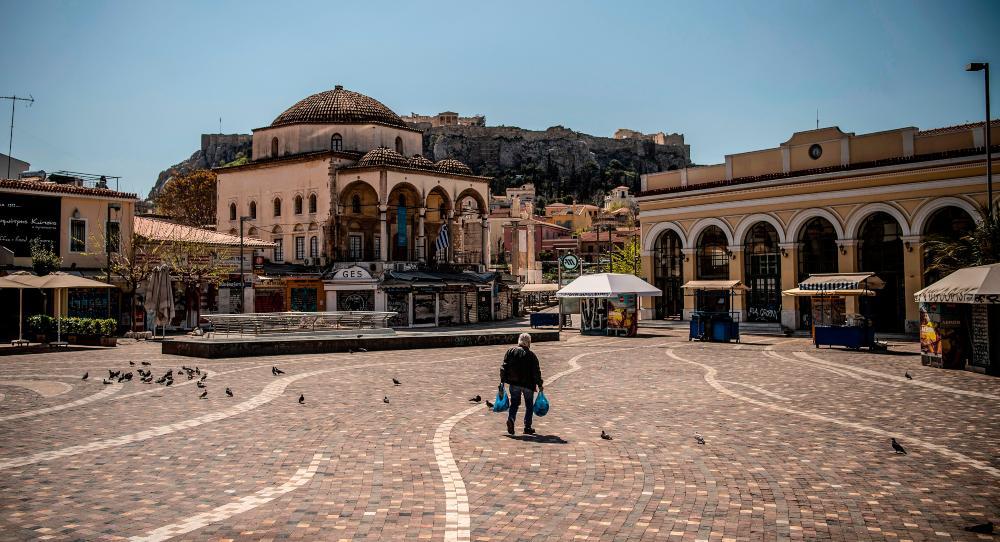
With the coronavirus pandemic challenging European democracies, not only with help from China and Russia but also from within, Europe must prepare an exit strategy.
The talk is about an exit strategy. Several European governments are mulling ways to ease a lockdown imposed to contain the highly contagious coronavirus.
The Spanish government announced it will allow certain businesses and factories to reopen. In Germany, a group of experts have recommended that schools be soon resumed. Austria is already loosening restrictions.
Other European countries are looking for an exit strategy as governments try and cushion the impact of a virus that has virtually shut down economies, closed borders, and temporarily ended a way of life that was so much taken for granted.In contrast, Ireland, Britain, and France are taking no risks. In a nationwide television address on April 13, 2020, President Emmanuel Macron announced that France’s lockdown will remain in place until May 11.
It’s too difficult to predict what Europe will look like once this pandemic has run its course. Debates have already begun about the merits of working from home, about how the pandemic has benefited the environment, about how health systems should be improved, and about how this virus has exposed a lack of resilience.
The latter is not just about the lack of preparedness or about anticipating crises. It is about the strength of democratic institutions—not just in Europe but also elsewhere—to withstand crises.
Yet those institutions, in most cases, have proved resilient. So far, public acceptance throughout Europe of the lockdown has been high. No thanks to attempts by China and Russia to sow distrust and divisions among democracies. That is the West’s other virus: the attempts to undermine democratic institutions from outside and from within.
From outside, China and Russia share the same narrative about the pandemic. They blame the West, in particular the United States for starting it. And in a bid to weaken the West and the fraying transatlantic relationship, their disinformation and propaganda campaigns have targeted Europe.
Europe is highly vulnerable to such propaganda. One reason is that most European governments are aghast about what is taking place in the United States under the leadership of President Donald Trump. The West has singularly failed to assume political leadership during this global pandemic.
The other reason for Europe’s vulnerability is that the EU as a bloc has had no coherent strategy toward China and Russia. The member states each have their own policy toward Beijing and Moscow, whether it be about integrating Chinese Huawei’s 5G into their mobile networks or German energy companies teaming up with Russian state-controlled Gazprom to send natural gas to Western Europe.
These controversies may seem remote as European governments fight to save lives and contain the fallout from the coronavirus. But China’s attempts to curry favor with EU countries by sending medical supplies are not altruistic or philanthropic. They are about showing the weaknesses of some European governments and their ability to cope.
Above all, China’s actions are about preparing its own European exit strategy for the day after, for the day when the pandemic is over. Such a strategy is about establishing a permanent foothold in Europe’s communications networks and in other strategic projects.
Indeed, Europe could become easy prey for China to buy stakes in companies hard hit by the pandemic. With this in mind, Margrethe Vestager, the EU’s competition commissioner, said in an interview with the Financial Times that European countries should buy stakes in certain companies so they don’t succumb to Chinese takeovers.
Meanwhile, no doubt Russia will continue its support of populist parties and movements in a bid to divide the EU and weaken its democratic institutions.
Europe is also vulnerable in ways that undermine its democracy from within. Hungarian Prime Minister Viktor Orbán has exploited the coronavirus pandemic to accrue even more powers by de facto suspending Hungary’s parliament. Orbán’s exit strategy for Hungary seems to be to ensure he comes out of the crisis more powerful than before.
In Poland, the governing Law and Justice party seems determined to go ahead and hold its presidential election in May 2020 via a postal ballot. Let’s not mention Poland’s lack of experience in holding this type of ballot and the fact that the country is currently in lockdown. That, by the way, has not stopped President Andrzej Duda from campaigning as he seeks reelection.
The other EU leaders have reacted in their usual way to these developments: lots of handwringing instead of sanctions. There are, after all, more pressing matters to deal with.
Yet during a crisis of this magnitude, democracy cannot be put on the backburner. If anything, there’s more than ever a need for democratic institutions and governments to become more inclusive and transparent. This will make them less vulnerable and more prepared for the day after.
And there’s much more of a need for European leaders to stop turning a blind eye and to defend their democracies from the external and internal threats.
That should be Europe’s other exit strategy.

Nonresident Senior Fellow, Carnegie Europe
Judy Dempsey is a nonresident senior fellow at Carnegie Europe
Recent Work
Judy Dempsey
Judy Dempsey
Carnegie does not take institutional positions on public policy issues; the views represented herein are those of the author(s) and do not necessarily reflect the views of Carnegie, its staff, or its trustees.

European Commission President Ursula von der Leyen is about to give her annual address on the state of the EU. Here’s what she won’t—but should—say.

Rym Momtaz

The aftermath of the Ceuta crisis shows Europe has drawn the wrong lessons. Rather than doubling down on failed migration policies, the EU needs to address the underlying roots of such episodes.

Richard Youngs

An overwhelming victory by a far-right-wing party in a small state in eastern Germany will have major repercussions for Chancellor Friedrich Merz’s coalition.
Judy Dempsey

Canadian Prime Minister Mark Carney has twice inspired praise for standing up to U.S. President Donald Trump: at the 2026 World Economic Forum in Davos and on Canada-U.S. trade negotiations. Is Carney showing a third way better than the EU has in dealing with the Trump administration?
Rym Momtaz, ed.

The EU’s responses to two recent incidents expose the gulf between European perceptions and capabilities. Unless the union can bridge that gap, it will never become a real geostrategic power.
Rym Momtaz