

Commentary
Peter Kellner
{
  "authors": [
    "Peter Kellner"
  ],
  "type": "commentary",
  "blog": "Strategic Europe",
  "centerAffiliationAll": "",
  "centers": [
    "Carnegie Endowment for International Peace",
    "Carnegie Europe"
  ],
  "collections": [
    "EU Integration and Enlargement",
    "Brexit and UK Politics"
  ],
  "englishNewsletterAll": "",
  "nonEnglishNewsletterAll": "",
  "primaryCenter": "Carnegie Europe",
  "programAffiliation": "",
  "programs": [],
  "projects": [],
  "regions": [
    "Europe",
    "Western Europe",
    "United Kingdom"
  ],
  "topics": [
    "EU",
    "Economy",
    "Trade"
  ]
}
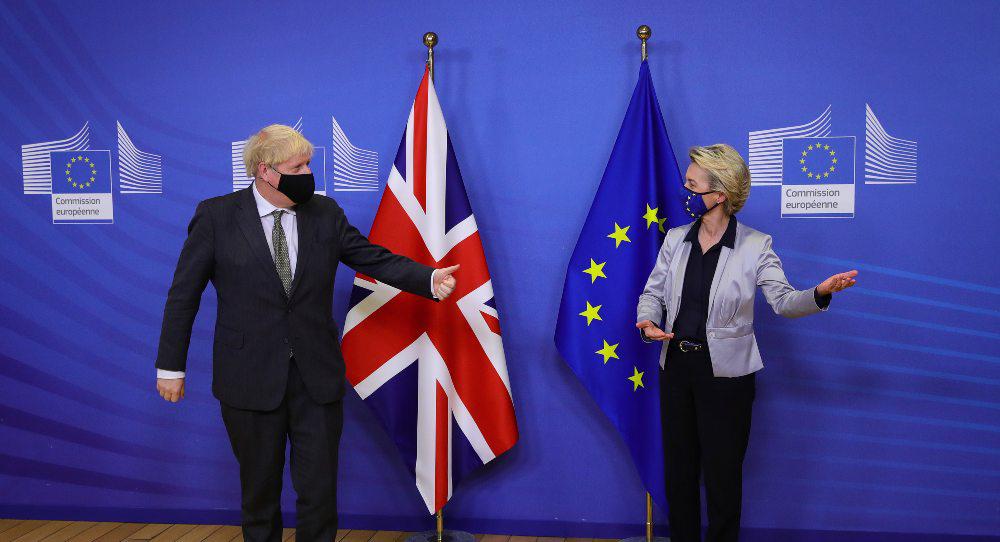
Source: Getty
Level playing field or no access to the EU’s single market? With Brexit talks in the final stages, one solution for a UK-EU trade deal seems within reach—but only if it allows for both sides to claim victory.
UK Prime Minister Boris Johnson thinks of himself as a latter-day Winston Churchill: a leader taking charge of a floundering nation and steering it toward the sunlit uplands of pride and prosperity. As time goes on, a more relevant model is turning out to be George III, the British king who diminished his country with his erratic conduct and ended up losing America.
As the Brexit saga goes on and on, Johnson never tires of referring to his “European friends.” But his actions betray a different sentiment.In September 2020, he presented Parliament with the internal market bill, which his own ministers admitted violated international law by threatening to breach the UK-EU withdrawal agreement in relation to Northern Ireland.
In December, his office briefed the media that the UK Royal Navy was preparing to keep EU fishing boats out of British waters if negotiations for a new UK-EU trade deal broke down.
These actions bear more than a passing resemblance to the character of George III in the musical Hamilton. The King threatened George Washington’s insurgents with “a fully armed battalion to remind you of my love.”
Just now, nobody knows what the outcome will be of the UK-EU talks. They should have been over weeks ago, but true to the EU’s traditions they have ignored deadline after deadline. As one comic writer observed years ago, “I love deadlines. I love the whooshing sound they make as they fly by.”
If we do not know what the outcome will be, we can at least say what needs to happen for a deal to be agreed. A successful outcome will appear to respect the blood-red lines of both sides.
For Johnson, a successful outcome will allow the UK to decide its own laws and regulations, including—especially—the rules governing employment laws, the environment, competition, and state aid for companies that the British government wants to support.
For the EU, a successful outcome will uphold the single market, which means that if the UK is to retain tariff-free access to the EU, it must not seek a competitive advantage by changing British rules in ways that undermine the level-playing-field obligations that the EU requires its members to uphold.
The question, then, is whether these apparently conflicting red lines can be reconciled. It looks impossible and, indeed, may prove to be so. If Britain accepts the principle of a level playing field, it will not be free to decide its own rules. If the UK insists on doing its own thing, the EU cannot allow Britain to keep its free access to the EU’s single market.
However, there may be a solution of sorts. It depends on a sleight of hand, in which the same words on a piece of paper are taken by both sides to mean different things.
In the latest talks, there appear to be discussions about ways in which the UK regains formal control of its own laws but accepts that significant divergence from the EU’s level playing field would result in tariffs on UK-EU trade.
Key to this will be the way each side sells the outcome to its own supporters. Johnson’s message to his fiercest pro-Brexit Conservative members of Parliament (MPs) will be:
We have our powers back. And don’t worry, we can vary them quite a lot without the EU imposing any tariffs. When push comes to shove, they will back off from taking action that would disrupt life for their car makers, farmers, drug companies, and other industries. The EU’s bark will be worse than its bite. Friends, we have prevailed.
In contrast, the message of the EU’s chief Brexit negotiator, Michel Barnier, and European Commission President Ursula von der Leyen to the EU member states will be:
The UK will have the formal power to decide its own rules, but this power won’t amount to much. The principles of the single market and the level-playing-field rules will be paramount. The UK knows that we shall not hesitate to invoke them. As the UK sends almost half its exports to the EU, it won’t dare to change its rules in ways that will damage British jobs and prosperity. Friends, we have prevailed.
One does not need a doctorate in philosophy to see the conflict between these two positions. On the other hand, experts in diplomacy can see how the circle might be squared. Both sides are speculating on what might happen some time in the future.
Johnson might boast about his right to diverge from level-playing-field rules—but not end up using that right. The EU might profess the sacred nature of the single market—but be wary of a provoking a bruising confrontation with the UK down the road.
So, will a form of words—and agreed procedures and system of governance—be negotiated that allow both sides to claim victory? If they are, then it seems likely that the fisheries dispute will also be settled, with compromises over percentages, timescales, and compensation.
But if not—and especially if enough pro-Brexit Conservative MPs think Johnson is giving too much away—then the talks will finally break down, and the UK will revert to World Trade Organization terms in its trade with the EU.
Which would be bad for the EU but far worse for Britain.

Former Nonresident Scholar, Carnegie Europe
Kellner was a nonresident scholar at Carnegie Europe, where his research focused on Brexit, populism, and electoral democracy.
Recent Work
Peter Kellner
Peter Kellner
Carnegie does not take institutional positions on public policy issues; the views represented herein are those of the author(s) and do not necessarily reflect the views of Carnegie, its staff, or its trustees.

The European Commissioner for Trade is headed to China. But after President Xi’s bridge-building visit to Washington, can a more isolated EU overcome Beijing’s stranglehold on critical raw materials? Who will blink first?

Rym Momtaz, ed.

The domestic impacts of how long it is taking to end the war in Ukraine have pushed the French electorate to the political extremes and compromised the country’s diplomatic capacity.
Rym Momtaz

Before the next wave of EU enlargement takes place, the union needs to grapple with thorny questions of how power is distributed among its members.


Emil Sondaj Hansen, Ditte Brasso Sørensen

A summer of escalation in the Black Sea has hurt Ukraine economically and is exacerbating world food security. A truce is needed—as is a broader reframing of Europe’s Ukraine strategy.

Thomas de Waal

Are Germany’s economic, industrial, and political struggles becoming a liability for the EU’s ability to rise to the geopolitical moment?
Rym Momtaz, ed.