

Commentary
While the EU and European governments are embracing the much-lauded middle-power moment, this entails three difficult conundrums.
Richard Youngs
{
  "authors": [
    "Luca Anceschi"
  ],
  "type": "commentary",
  "blog": "Strategic Europe",
  "centerAffiliationAll": "",
  "centers": [
    "Carnegie Endowment for International Peace",
    "Carnegie Europe"
  ],
  "collections": [],
  "englishNewsletterAll": "",
  "nonEnglishNewsletterAll": "",
  "primaryCenter": "Carnegie Europe",
  "programAffiliation": "",
  "programs": [],
  "projects": [],
  "regions": [
    "Asia",
    "Russia",
    "Central Asia",
    "Kazakhstan"
  ],
  "topics": [
    "Security",
    "Economy",
    "Political Reform",
    "EU"
  ]
}
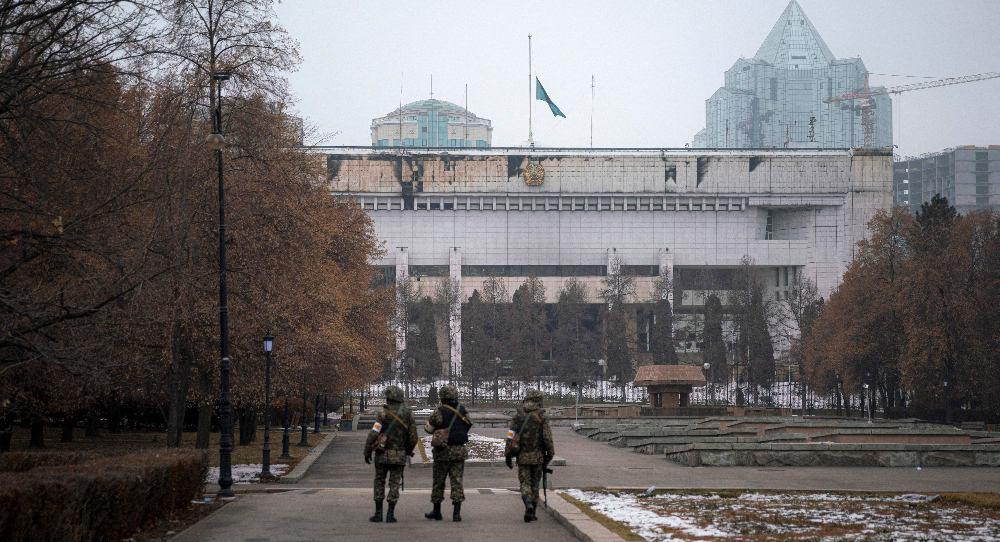
Source: Getty
A rift in Kazakhstan’s elite has violently played out in the streets of the country. Foreign troop support may have kept President Tokayev in power, but it has also linked his political future to Vladimir Putin.
Kazakhstan’s illusions of stability, carefully propagated by regime propaganda for over twenty years, imploded in the first week of 2022.
The peaceful protests that spread across the vast Kazakhstani territory from January 1 onward were soon highjacked by criminal gangs and violent individuals. It is precisely to address the state of lawlessness developed on January 4-7 that the Kazakhstani government requested the support of foreign troops, rapidly deployed by the Russia-led Collective Security Treaty Organization, of which Armenia, Belarus, Kazakhstan, Kyrgyzstan, and Tajikistan are members.
The unravelling of the problematic nexus between protests, violence, and foreign intervention offers a few interesting pointers to make sense of what has happened in Kazakhstan in the last week.
Let us focus first on the protesters.
After the process of leadership change staged by the regime in 2019, Kazakhstan’s democratic deficit remained significant. Its stagnating economy led to massive inequality across social classes, regions, and age groups. Kazakhstani society at large became exasperated by the regime’s ultimate failure to deliver on its political and economic promises.
On January 1, moved by widespread dissatisfaction, ordinary citizens and workers in West Kazakhstan began to demonstrate against a rapid spike in gas prices. Their socioeconomic grievances soon led to wider calls for political change, which became more intense as protests spread eastward across Kazakhstan.
By the morning of January 4, Kazakhstan’s disaggregated opposition had coalesced into large scale demonstrations, which peacefully demanded systemic change.
Violence in Almaty and elsewhere disrupted the organic evolution of anti-regime demonstrations, thwarting any possibility for the establishment of coordinated anti-regime action within and beyond the few structured opposition organizations operating across Kazakhstan’s political landscape.
It is only through speculations that one can delve into the second stage of Kazakhstan’s crisis.
There is no clarity on the identity and, most importantly, the political allegiances of the violent groups that brought chaos and devastation to Kazakhstan.
Sketchy reports from within the country—where the government imposed a total Internet blockage and continues to prevent the access of foreign reporters—confirmed that, throughout January 4–6, these subversive groups encountered no resistance from police forces and state services, a usually ubiquitous presence when it comes to contain public manifestations of dissent in Kazakhstan.
Judging based on my many years of research engagement with Kazakhstani politics, this latter chilling development suggests that the violence perpetrated by these actors represents the public manifestation of unprecedented regime instability.
The events of early 2022 are the culmination of a profound split in the post–2019 regime, revealing the existence of two belligerent groups: one coalesced around current president Kassym-Jomart Tokayev; the other—somewhat connected with the family of former president Nursultan Nazarbayev—had in Kazakhstan’s now disgraced National Security Committee (KNB) chairman, Karim Massimov, its political spearhead. The eminence grise of the Kazakhstani regime, Massimov represented an element of continuity between the elite of the Nazarbayev era and the power system developing under Tokayev.
One can only speculate that, hiding behind peaceful protesters, anti-Tokayev forces made use of foot-soldiers linked to Kazakhstan’s criminal underworld to destabilize the country and force a leadership change.
Further evidence of this regime split can be seen in the context of the CSTO intervention, the third crucial element in the characterization of the Kazakhstani crisis offered in this post.
As violence ripped through the streets of Kazakhstan, President Tokayev had so little trust left in the security sector that he could not even manage to deploy a relatively small, rapid intervention force made up entirely of Kazakhstani personnel.
The size of the CSTO mission—just over 2,000 troops at the time of writing—indicates that a limited contingent was indeed sufficient to restore order in Kazakhstan’s main cities, an objective that CSTO forces achieved with relative ease after their landing in Kazakhstan. A truly double-edged sword, CSTO support allowed Tokayev and his allies to hold on to power for the time being, yet it linked, perhaps inextricably, Kazakhstan’s political future to Russian President Vladimir Putin, who helped deliver the commencement of the Tokayev era.
In this new chapter of its political history, Kazakhstan’s relationship with the Russian Federation will undoubtedly be filtered through the lens of the authoritarian solidarity extended by Putin through CSTO intervention. Kazakhstani multivectorism—the foreign policy mantra of the Nazarbayev era—is now a thing of the past: as a consequence, we may reasonably expect the regime in Nur-Sultan to drop its typical reticence toward integration into the Eurasian Economic Union.
Domestically, the Kazakhstani crisis instigated harsher authoritarian dynamics. In one sign of things to come, official rhetoric is now conflating peaceful protesters with violent groups when assigning the blame for the riots of early January while no Kazakhstani official acknowledged the elite struggle that so profoundly influenced the unfolding of the crisis.
There is perhaps nothing more damaging to Kazakhstan’s image-making obsessed regime than having to admit to the instability we witnessed across the last week.
As order is partially restored, state information organs continued to maintain a cloud of silence over what has happened in Kazakhstan. Disinformation and dissimulation are Tokayev’s key tools to detract the world’s attention from the many abuses perpetrated throughout the crisis and those that will inevitably ensue, this time in the name of stability.
This new chapter in Kazakhstan’s history may well be one of its darkest.
Luca Anceschi is professor of Eurasian Studies at the University of Glasgow, where he is also the editor of the journal Europe-Asia Studies.
Luca Anceschi
University of Glasgow
Senior Lecturer in Central Asian Studies (Central & East European Studies), School of Social & Political Sciences, University of Glasgow
Carnegie does not take institutional positions on public policy issues; the views represented herein are those of the author(s) and do not necessarily reflect the views of Carnegie, its staff, or its trustees.

While the EU and European governments are embracing the much-lauded middle-power moment, this entails three difficult conundrums.

Richard Youngs

Much has been said of the changes Brussels is trying to make to the EU enlargement process. Here’s why gradual integration might—or might not—be the answer.

Dimitar Bechev

The European Commissioner for Trade is headed to China. But after President Xi’s bridge-building visit to Washington, can a more isolated EU overcome Beijing’s stranglehold on critical raw materials? Who will blink first?

Rym Momtaz, ed.

The domestic impacts of how long it is taking to end the war in Ukraine have pushed the French electorate to the political extremes and compromised the country’s diplomatic capacity.
Rym Momtaz

Before the next wave of EU enlargement takes place, the union needs to grapple with thorny questions of how power is distributed among its members.


Emil Sondaj Hansen, Ditte Brasso Sørensen