

Commentary
The European Commissioner for Trade is headed to China. But after President Xi’s bridge-building visit to Washington, can a more isolated EU overcome Beijing’s stranglehold on critical raw materials? Who will blink first?
Rym Momtaz, ed.
{
  "authors": [
    "Monika Sus"
  ],
  "type": "commentary",
  "blog": "Strategic Europe",
  "centerAffiliationAll": "",
  "centers": [
    "Carnegie Endowment for International Peace",
    "Carnegie Europe"
  ],
  "collections": [
    "EU Integration and Enlargement"
  ],
  "englishNewsletterAll": "",
  "nonEnglishNewsletterAll": "",
  "primaryCenter": "Carnegie Europe",
  "programAffiliation": "",
  "programs": [],
  "projects": [],
  "regions": [
    "Europe",
    "Eastern Europe",
    "Western Europe"
  ],
  "topics": [
    "EU",
    "Democracy",
    "Political Reform"
  ]
}
Source: Getty
Warsaw’s resistance to deepening European integration cannot be ignored by other EU capitals. To bridge conflicting perspectives on the union’s future, Brussels must engage in dialogue with Poland while insisting on respect for the rule of law.
This blog is part of ENGAGE, a project that examines challenges to global governance and EU external action. A consortium of thirteen academic institutions and think tanks seeks to assess the EU’s ability to harness all its foreign policy tools and identify ways to strengthen the EU as a global actor.
***
The Russian invasion of Ukraine in February 2022 brought a shift of powers in the EU, arguably moving the center of gravity toward Central Europe and the Baltics. Prior to the war, Poland, alongside other countries of the region, consistently warned about the Russian threat. Those warnings fell on deaf ears in Western European countries. Since February of last year, Poland has opened its doors to millions of Ukrainian refugees and migrants fleeing the war. It is also at the forefront of countries sending military and humanitarian aid to Ukraine. Poland has been “given an opportunity to matter in Europe” and is a core element of this power shift.
Or at least it should be. But it has been an EU-troublemaker since the conservative-nationalist government headed by Law and Justice (PiS) defeated the liberals lead by Civic Platform (PO) in 2015.
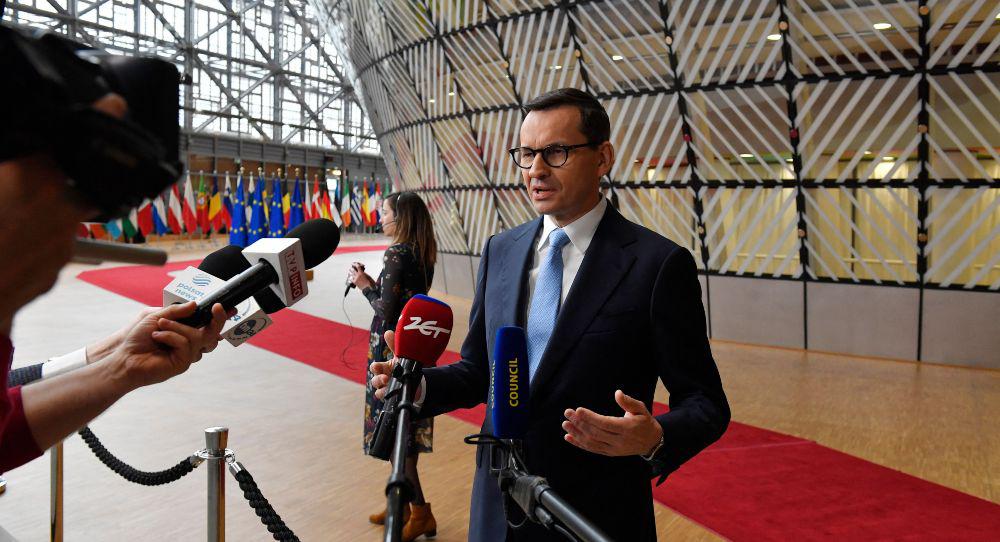
The ruling party has persistently undermined the rule of law and the independence of the judiciary. Nonetheless, Poland considers itself a regional leader and, as Polish Prime Minister Mateusz Morawiecki recently highlighted in his speech in the German city of Heidelberg, wants to be listened to when it comes to Europe´s future.
But is there anything to listen to?
Morawiecki began his speech by announcing that he would present his vision for Europe, which is worth unpacking.
The prime minister made three key points.
First, he emphasized that nation-states are Europe’s future. Everything else is “illusory or utopian” and lacks a democratic mandate. The EU, he claimed, has reached the limits of supranational governance. Instead, a Europe of strong nation-states is the only way forward.
As an example, he cited the COVID-19 pandemic. According to him, it demonstrated that efficient nation-states are the actors most capable of protecting their citizens—although Poland itself was not exemplary in coping with the pandemic.
Second, he discussed the EU’s future enlargement. Poland supports enlargement, including to Ukraine, Georgia, Moldova, and the Western Balkans. But it doesn’t believe that the EU has to reform itself first. For Morawiecki, this would amount to a camouflaged federalization proposal. For him, under the banner of “federalization” is a “top-down imposed concentration of decision-making.” If the EU elites insist on their vision of a centralized superstate, they will face the revolt of more European nations: “The more they persist, the fiercer this rebellion will be. I don’t want polarization, division, infighting, and chaos. I want a strong and competitive Europe,” Morawiecki said.
Third, the Polish prime minister called for the EU to partially reduce its competences to make an enlarged union efficient. Morawiecki argued that the EU should focus on areas where the Treaty of Rome has given it competences, and otherwise follow the principle of subsidiarity. He warned against “a pan-European cosmopolitan elite with immense power, but without an electoral mandate” who wants to create a “superstate” and govern it.
As for the rule of law, Morawiecki framed the conflict between Brussels and Warsaw as “discrimination (…) due to a complete lack of understanding of the reforms that a country emerging from post-communism needed to make.” These include the fight against oligarchization, the domination of closed professional corporations, poverty, and corruption. In his words, the rule-of-law dispute is one between the “sovereignty of states and the sovereignty of institutions. [It is] between the democratic power at a grassroots level and the top-down imposition of power by a narrow elite.”
Despite these criticisms of the EU, Morawiecki did not offer a vision that would contribute to a debate about Europe’s future. To propose that rolling back EU integration is the solution to current geopolitical, economic, and social challenges is naïve, in particular without specifying the areas in which EU integration should be rolled back and how.
What we learned from Morawiecki’s speech is, essentially, that the Polish government opposes deepening integration. This clashes with visions presented by his Western counterparts who believe that only stronger integration and more effective decision making are the way forward.
At the same time, Poland and its view of the EU cannot be ignored by the European elites. Morawiecki’s idea for Europe of strong nation-states without the “technocratic utopia” of supranational governance is quite representative of many other conservative, right-wing parties across Europe.
Poland is also on the way to becoming a European military superpower. Its growing potential as a key security provider and the most prominent U.S. ally in Europe has implications. Building a strong EU defense without Poland or pushing forward French President Emmanuel Macron’s idea for the EU’s strategic autonomy cannot happen without Warsaw on board.
This is why patronizing Warsaw is a dead-end. The best way to bridge the conflicting perspectives of Europe’s future seems to be engaging in a dialogue with Polish elites and society at every possible level.
The European elites should find a way to engage in the fight over the rule of law—where a strong stance of the European Commission is absolutely necessary—while still listening to Polish—and other conservative, right-wing European parties’—fears of federalist ideas. After all, Europe has always relied on the concept of compromise.
Monika Sus is a visiting professor at the Hertie School’s Centre for International Security and associate professor at the Polish Academy of Sciences. She is also a visiting fellow at the Robert Schuman Center for Advanced Studies at the European University Institute.


Monika Sus
Professor, Institute for Political Studies, Polish Academy of Sciences
Monika Sus is a professor at the Institute for Political Studies, Polish Academy of Sciences, Warsaw.
Carnegie does not take institutional positions on public policy issues; the views represented herein are those of the author(s) and do not necessarily reflect the views of Carnegie, its staff, or its trustees.

The European Commissioner for Trade is headed to China. But after President Xi’s bridge-building visit to Washington, can a more isolated EU overcome Beijing’s stranglehold on critical raw materials? Who will blink first?

Rym Momtaz, ed.

The domestic impacts of how long it is taking to end the war in Ukraine have pushed the French electorate to the political extremes and compromised the country’s diplomatic capacity.
Rym Momtaz

Before the next wave of EU enlargement takes place, the union needs to grapple with thorny questions of how power is distributed among its members.


Emil Sondaj Hansen, Ditte Brasso Sørensen

A summer of escalation in the Black Sea has hurt Ukraine economically and is exacerbating world food security. A truce is needed—as is a broader reframing of Europe’s Ukraine strategy.

Thomas de Waal

Are Germany’s economic, industrial, and political struggles becoming a liability for the EU’s ability to rise to the geopolitical moment?
Rym Momtaz, ed.