

Commentary
Judy Dempsey
{
  "authors": [
    "Judy Dempsey"
  ],
  "type": "commentary",
  "blog": "Strategic Europe",
  "centerAffiliationAll": "",
  "centers": [
    "Carnegie Endowment for International Peace",
    "Carnegie Europe"
  ],
  "collections": [
    "Europe’s Eastern Neighborhood"
  ],
  "englishNewsletterAll": "",
  "nonEnglishNewsletterAll": "",
  "primaryCenter": "Carnegie Europe",
  "programAffiliation": "",
  "programs": [],
  "projects": [],
  "regions": [
    "Europe",
    "Eastern Europe",
    "Ukraine"
  ],
  "topics": [
    "Security",
    "Migration",
    "EU"
  ]
}
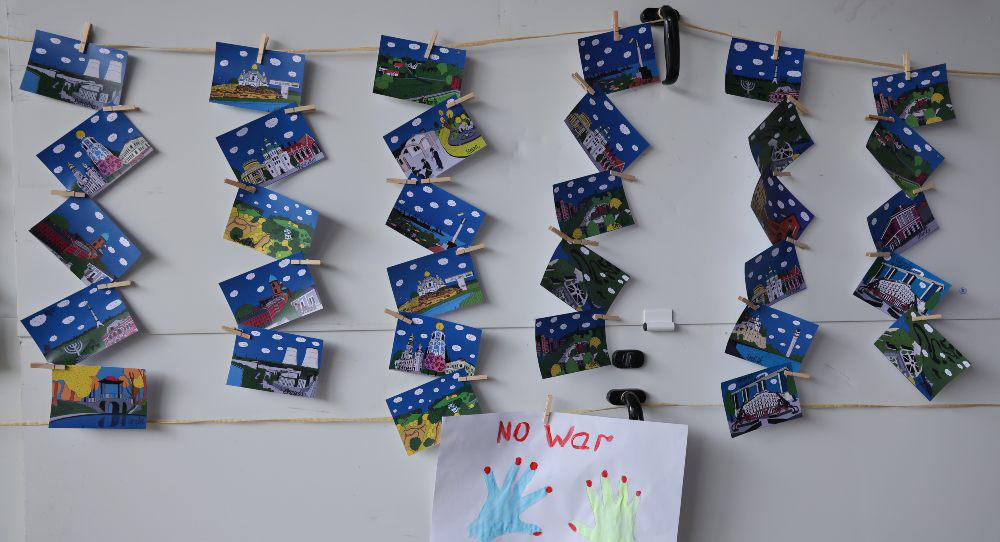
Source: Getty
President Zelensky’s appeal to G7 leaders for more military assistance is not only about defeating Russia. It is about making Ukraine safe for refugees to return and rebuild the country.
Over several days of non-stop meetings in Europe, the Middle East, and at the G7 summit in Hiroshima, Ukrainian President Volodymyr Zelensky’s messaging was clear.
Russia must not win in Ukraine, which it brutally attacked fifteen months ago. And leaders across the world should recognize that victory for Ukraine would be a victory for democracy and security for Kyiv and beyond.
Zelensky’s persistent appeals and the nature of Russia’s aggression have made Ukraine a global issue. It is no longer a war confined to Europe, even if the West and the so-called Global South perceive the war differently. It has affected food security, as Russia blocked Ukraine’s grain exports, creating a shortage and price hikes, especially in the Middle East. Russia has also threatened Ukraine with a nuclear strike.
As the war continues, it is increasingly clear that the outcome will have immense repercussions for the security of the continent of Europe, the West—and for Russia’s future, domestically and internationally.
It is also about the lives of the 8.2 million refugees—a fifth of Ukraine’s population—who have found safety in other European countries. And don’t forget the 5.9 million internally displaced people.
Germany is already hosting over one million Ukrainians, of which 80 percent of the adults are women. Over 72 percent of the adults have a university degree—a boon for the German economy if they choose to stay, a loss for Ukraine’s talent pool when the war ends.
Since February 2022, Berlin has provided housing, education, jobs, language lessons, and above all security. But the yearning for heimat (homeland) runs deep.
This sense of longing, of being able to regain the sense of familiarity, of being able to get back together again with families, relatives, and pets, was the theme of a very special bilingual play performed by a group of teenagers at Berlin’s Deutsches Theater on May 22, 2023. The cast of twelve, mostly from Ukraine but also including some Germans with immigrant backgrounds, was very special.
As Zelensky pleaded with leaders from across the world to defend his country’s territorial integrity, independence, and sovereignty, the play Linie 8 und Pudding für Alle! (Line 8 and Pudding for All!) was about the sense of loss, the sense of identity, the sense of homesickness.
The young cast, living in different parts of Berlin, was brought together by Junges DT, a cultural youth program run by the Deutsches Theater. The play’s setting and theme were simple. It was based on line 8 of the city’s subway system. Each of the members of the cast described their favorite stop.
There was a big screen at the back of the stage that showed the teenagers traveling together, chatting, laughing, imagining what’s going on in the heads of the other passengers. As the short play unfolds, it becomes clear the cast’s coming together spawned a special conversation about what home means.
One teenager reminisced about her home in the city of Kharkiv, bombed by Russia in the early stages of the war but now in Ukraine’s hands, where a degree of normality is returning. She missed her family, her dog, the way of life.
“Homeland is a feeling, a feeling of peace, of harmony,” said another. “I want to live again in Ukraine,” chimed in yet another. “When the war is over, I want to go home to Dnipro,” she added.
One teenager said she wasn’t sure when she would see all her family again. “I want to keep these feelings about home in my head,” she said. She talked about how she missed her father.
The longing for home was mixed with a certain affection and humor for Berlin. For the young cast, there were places with funny names, such as the district of Wedding. At one stage during the play, two of the actors, imitating an engagement proposal, said romantically, “Wedding is where you get married…” For seasoned Berliners, this invoked some laughter. Wedding is not the most salubrious of city districts.
Others praised the city’s wonderfully open spaces of the green and big Tiergarten (animal garden). Except, unless you went to the nearby zoo, there were no animals freely roaming around.
The play has had a great run. For me at least, it brought home the human anguish of separation caused by war and the longing to return that is often easy to forget.
It’s hard to know how many Ukrainians living in Germany will go home. A poll carried out by the Federal Office for Migration and Refugees found that 37 percent wanted to stay permanently or until the war is over. Such opinions can shift. But if and when peace returns, Kyiv is going to need as many people as possible to return and help rebuild their country.
The teenagers on the Deutsches Theater stage have no hesitation about where their future belongs.

Nonresident Senior Fellow, Carnegie Europe
Dempsey is a nonresident senior fellow at Carnegie Europe
Recent Work
Judy Dempsey
Judy Dempsey
Europe isn’t as weak in the new geopolitics of power as many would believe. But to leverage its assets and claim a sphere of influence, Brussels must stop undercutting itself.

Dimitar Bechev
Europe’s reaction to the war in Iran has been disunited and meek, a far cry from its previously leading role in diplomacy with Tehran. To avoid being condemned to the sidelines while escalation continues, Brussels needs to stand up for international law.

Pierre Vimont
France and Germany’s failure to agree on the Future Combat Air System (FCAS) raises questions about European defense. Amid industrial rivalries and competing strategic cultures, what does the future of European military industrial projects look like?

Rym Momtaz, ed.
France has stopped clinging to notions of being a great power and is embracing the middle power moment. But Emmanuel Macron has his work cut out if he is to secure his country’s global standing before his term in office ends.
Rym Momtaz
Integrating AI into the workplace will increase job insecurity, fundamentally reshaping labor markets. To anticipate and manage this transition, the EU must build public trust, provide training infrastructures, and establish social protections.
Amanda Coakley