

Commentary
Judy Dempsey
{
  "authors": [
    "Judy Dempsey"
  ],
  "type": "commentary",
  "blog": "Strategic Europe",
  "centerAffiliationAll": "",
  "centers": [
    "Carnegie Endowment for International Peace",
    "Carnegie Europe"
  ],
  "collections": [
    "Europe’s Southern Neighborhood"
  ],
  "englishNewsletterAll": "",
  "nonEnglishNewsletterAll": "",
  "primaryCenter": "Carnegie Europe",
  "programAffiliation": "",
  "programs": [],
  "projects": [],
  "regions": [
    "Middle East",
    "Europe",
    "North Africa",
    "Tunisia",
    "Southern, Eastern, and Western Africa"
  ],
  "topics": [
    "Foreign Policy",
    "Migration",
    "EU",
    "Security"
  ]
}
Source: Getty
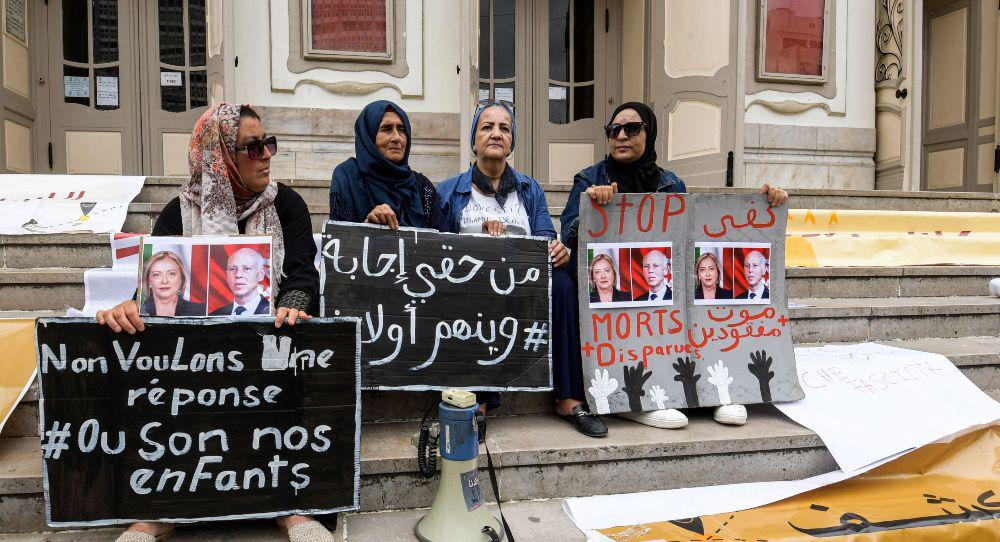
Pouring money into Kais Saied’s increasingly repressive regime will not solve Tunisia’s migration problem. Rather, it could lead to instability and a further exodus of people to Europe.
This blog is part of ENGAGE, a project that examines challenges to global governance and EU external action. A consortium of thirteen academic institutions and think tanks seeks to assess the EU’s ability to harness all its foreign policy tools and identify ways to strengthen the EU as a global actor.
***
They keep trying to leave. In small boats they make their way across the Mediterranean. Their first stop is either Malta or Italy, if they are lucky.
Many don’t make the crossing. Between April 19 and 24 alone, Tunisia’s coastguard found seventy dead bodies in the sea. The week before, twenty-five migrants were drowned.
It is not only migrants from other North African countries that are trying to make their way to Europe while the EU in response tries to strengthen the border controls in Libya.
Increasingly, the migrants are Tunisians. Back in 2016, they made up 4 percent of arrivals reaching Europe. By last year, their share had jumped to 18 percent. The main reasons are economic and political. Tunisia’s complicated and ambitious transition to democracy has been diverted if not hijacked by President Kais Saied. Young people, facing growing unemployment and diminishing civil rights, are leaving.
Italy’s prime minister, Giorgia Meloni, wants this migration flow to end. She has taken the lead in adopting a tougher EU policy against illegal migration and in pushing the EU into establishing a coherent strategy on migration, refugees, and asylum. These three issues have divided the bloc for decades.
Meanwhile, far-right, anti-immigration, and populist movements have been able to profit from the absence of any clear EU line. The union has only itself to blame for the inability to tackle issues that have domestic political repercussions and negative consequences for the Middle East and North Africa (MENA).
Curbing migration was Meloni’s big election promise. She has stuck to it. On June 11, European Commission President Ursula von der Leyen, flanked by Meloni, Dutch Prime Minister Mark Rutte, and President Saied put together an economic package aimed at stopping or at least curbing migration.
Von der Leyen’s statement reflects the technocratic and realpolitik view of most member states.
She spelt out how the EU would help Tunisia’s ailing economy. Investment and trade would be increased, especially in energy and renewables. The total package will amount to €1 billion ($1.1 billion). The EU will also reach out to the younger generation, providing €10 million ($10.8 million)—a miniscule amount—for student exchanges via the bloc’s Erasmus program. But the primary aim of the package is curbing migration. Money would be poured into border management to stop smugglers taking people across the Mediterranean.
“This year, the EU will provide €100 million to Tunisia for border management, but also search and rescue, anti-smuggling and return,” von der Leyen said during her visit to Tunis. “The objective is to support a holistic migration policy rooted in the respect of human rights,” she added.
Rooted in human rights? Really?
It is the erosion of human rights combined with the rapid deterioration of the economy that is driving Tunisians to leave the country. Since Saied became president two years ago through what has been described as a power grab, he has silenced the opposition, quashed the media freedom, undermined the rule of law, and almost destroyed the independent judiciary. His critics are either behind bars, in internal exile, or have left the country. And all this is happening at a time when the economy is rapidly declining. What a change from the heady days of 2011.
Once considered the great hope of the 2011 Arab Spring uprisings as new parties and leaders tried to build democratic institutions, Tunisia under Saied is reverting to the kind of authoritarian system that prevailed under the dictatorship of Zine El Abidine Ben Ali.
Ben Ali was toppled following massive protests spearheaded by young people. Then, the deteriorating economy, the lack of human rights and any perspective drove the population onto the streets.
Over the past several years, Tunisia embarked on a difficult path toward transformation. Politically and economically, the EU invested heavily in the country—though it could have done more to strengthen trade ties. Saied’s rise to power showed the vulnerability of the institutions and the fragility of the transition from autocracy to democracy.
The EU should have been far more outspoken from day one, when Saied’s intentions became clear. Words about “deep concern” are no longer enough. What Europe as a whole is doing in MENA is reminiscent of the policies it pursued before the Arab Spring. Then, the EU supported the authoritarian status quo. Stability was preferable to openly supporting independent human rights movements and independent non-governmental organizations.
Yet that kind of stability breeds its own instability. That was one of the main features of the Arab Spring. There was a spontaneous outbreak of pro-democracy movements. The protestors wanted fundamental change.
That change tried to take root in just one or two countries. But today, MENA states are either plagued by conflict and instability, such as Libya, or have reverted to authoritarian rule, such as Egypt.
Despite Egypt’s appalling human rights record, the sad erosion of Tunisia’s democracy, not to mention the political and economic destruction of war-torn Syria, the EU’s role remains reactive. It carries little standing and influence in a region whose current and future conditions fundamentally affect what happens in the Mediterranean and in Europe.


Nonresident Senior Fellow, Carnegie Europe
Judy Dempsey is a nonresident senior fellow at Carnegie Europe
Recent Work
Judy Dempsey
Judy Dempsey
Carnegie does not take institutional positions on public policy issues; the views represented herein are those of the author(s) and do not necessarily reflect the views of Carnegie, its staff, or its trustees.

Trump is distracted and Ukraine wants Europe to step up. The continent’s leaders must find their voice and assert it in talks with Russia.

Alissa de Carbonnel

Mounting economic strain and battlefield losses will not necessarily make the Kremlin less dangerous. They could instead push Moscow toward a more aggressive hybrid campaign designed to test NATO’s Eastern flank, exploit allied hesitation, and fracture European resolve.

Maksym Beznosiuk

Over the past ten years, NATO has held almost as many summits as it did during the entirety of the Cold War. Are they still useful, or is it time to stop holding annual meetings?

Rym Momtaz, ed.
Nearly a year and a half after Europeans leaned into sucking up to Trump, the strategy has produced some benefits when it comes to Ukraine.
Rym Momtaz
Far-right leader Marine Le Pen can—and will—run in France’s next presidential election. What does the outcome of her appeal against a 2025 embezzlement conviction mean for the country’s political future?
Catherine Fieschi