The Slovak Election and Its Ramifications for European Foreign Policy
A new government in Bratislava risks undermining EU unity over Ukraine. Regardless of the results, the Slovak public’s growing skepticism of the West and openness toward Russia will be difficult to reverse.
Link Copied
By Alena Kudzko
Published on Sep 14, 2023
This blog is part of ENGAGE, a project that examines challenges to global governance and EU external action. A consortium of thirteen academic institutions and think tanks seeks to assess the EU’s ability to harness all its foreign policy tools and identify ways to strengthen the EU as a global actor.
***
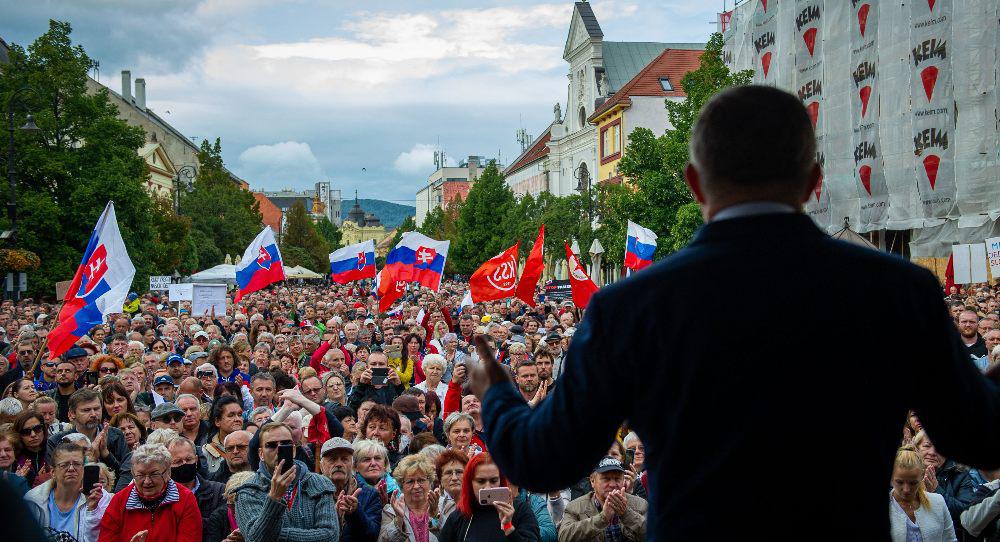
Slovakia is set to commence a long and contentious election season that will test the staying power of the European liberal democratic project and will have significant implications for the outcome of the war in Ukraine.
Polls indicate that following its September 30 election, Slovakia will more likely than not be led by former prime minister Robert Fico, who during his past tenures wanted his country to both be at the “core” of Europe and work toward good relations with Russia. If he is intent on delivering on his campaign promises, it may prove more difficult for the EU and NATO to forge unified foreign policy positions on Ukraine and Russia.
Slovak electoral mathematics are complex: No winner can rule alone without a coalition. And the choice and number of potential coalition partners will, in turn, depend on the mixture of parties that surpass the 5 percent threshold required to gain seats in the parliament. Another scenario, in fact, could still see the liberal Progressive Slovakia party led by the young Member of European Parliament Michal Šimečka claim the right to form a government.
Although Ukraine and migration have both garnered the spotlight during candidate debates and been used as hot-button issues to galvanize anti-establishment sentiment, the Slovak election will ultimately be decided by the population’s concerns about numerous kitchen-table issues. These range from energy prices, inflation, mortgage rates, and jobs to the ever-vexing problems regarding the country’s healthcare and education systems.
Throughout the election campaign, foreign policy has been implicated either as a cause of domestic problems or as a solution to these challenges. On one side stands Slovakia’s current caretaker government, Progressive Slovakia, and a spectrum of smaller parties. These groups perceive Russia’s aggression against Ukraine as a dangerous breach of international law. They worry that if Ukraine were to fall, Slovakia would find itself in a much more dangerous, unstable, and insecure world that would also threaten its economic prospects.
Meanwhile, on the other side, nationalist groups but also members of Fico’s Smer party perpetuate the narrative that Ukraine’s cause is not our war. They claim that if only the conflict were to end right now, lives would be saved, economies bolstered, and inflation reduced. They further add that Western countries are to blame for the situation by disregarding Russia’s security interests and constantly provoking Moscow.
The latter camp appears to be gaining wind in their sails. According to GLOBSEC Trends 2023, conducted in the spring, only 40 percent of Slovaks primarily hold Russia responsible for the war in Ukraine, while 34 percent assign blame to the West for purportedly provoking Russia, and another 17 percent fault Ukraine for allegedly oppressing the Russian speaking population. Only 54 percent, meanwhile, see Russia as a security threat. According to Eurobarometer polls conducted in June 2023, only 54 percent of Slovaks approve of providing financial aid to Ukraine—compared to an EU average of 75 percent—and only 45 percent support granting candidate status to Ukraine, compared to the 64 percent EU average. Across all these metrics, Slovakia is further away from the EU average than all other Central and Eastern European countries, apart from Bulgaria.
It should be acknowledged, however, that during his previous three terms in office, Fico ultimately walked back some of his campaign statements. Chances are, he will pursue a pragmatic course if he runs the country again.
As Ukraine policy and relations with Russia are not at the top of his priority list nor the source of his appeal at home, he could yet choose to align with the European mainstream on foreign policy, provided his domestic interests are protected. Indeed, Fico has not displayed the same level of ambition as Hungarian Prime Minister Viktor Orbán in seeking to remake Europe and global politics in his own image.
Smer’s outreach to respected diplomats and former government officials to potentially assume the foreign policy portfolio if the party wins the election suggests that a constructive way forward on foreign policy may not be far-fetched. The flipside is that the Slovak government could become a troublemaker willing to veto policies, protract discussions, and impede foreign policy decisionmaking frequently and profoundly, especially if the coalition has to rely on votes of nationalist groups.
In this case, foreign policy could also serve as a bargaining chip to secure more leeway for reforming judicial, media, and civil society institutions in the country in a way that would otherwise put Slovakia on a collision course with Brussels.
All of this means that Orbán might not be such an outlier. There will be louder calls from Central Europe to slash support for Ukraine, negotiate a settlement to the war, and potentially look for ways to reengage with Russia. An inward-looking focus will also entail less enthusiasm for financing the reconstruction of Ukraine.
Regardless of the ultimate election results, the new government will have to face a public that has been swayed by the months-long campaign and become even more entrenched in its skepticism toward Western institutions and its openness toward Russia.
Since the spring of 2022, the share of Slovaks blaming Russia—rather than Ukraine or the West—dropped from 51 to 40 percent. Support for NATO, meanwhile, shrank from 72 to 58 percent over the same period. And support for EU membership declined from 77 to 64 percent. These trends will be further accelerated by considerable disillusionment among those Slovaks whose parties fall short in the elections.
It took a substantial time investment over the past year to nudge public opinion more solidly into the Western-skeptics camp, with Russian influence operations in the country contributing significantly to these efforts. It will now take considerably more time and effort to reverse the trend.
Alena Kudzko is Vice President for Policy and Programming at GLOBSEC.
About the Author
Alena Kudzko
GLOBSEC
Alena Kudzko is a policy analyst who focuses on Central and Eastern Europe and European foreign policy.
Carnegie does not take institutional positions on public policy issues; the views represented herein are those of the author(s) and do not necessarily reflect the views of Carnegie, its staff, or its trustees.
The battle over free speech has taken center stage since U.S. Vice President JD Vance accused Europe of censorship. From travel bans to social media regulation, especially around the Israel-Palestine conflict, are liberal democratic governments weaponizing free speech?
Europe seems to have accepted its sidelining in the Middle East. The EU must reassert its support for the international rules-based order and step up engagement.
Amid uncertainty caused by the Iran war, the global drive for nonproliferation has stalled. With Europe diplomatically marginalized and countries reassessing their nuclear options, efforts to curb the spread of nuclear weapons risk becoming irrelevant.
Preparing candidate countries for EU membership is no longer enough. As the enlargement process becomes a reality, the union must also prepare its own societies.
Five countries staged the biggest political boycott in Eurovision history over Israel’s participation. With the FIFA World Cup and other sporting or cultural touchstones on the horizon, are boycotts effective?