

Commentary
Rym Momtaz, ed.
{
  "authors": [
    "Rym Momtaz"
  ],
  "type": "commentary",
  "blog": "Strategic Europe",
  "centerAffiliationAll": "",
  "centers": [
    "Carnegie Endowment for International Peace",
    "Carnegie Europe"
  ],
  "collections": [
    "EU Integration and Enlargement"
  ],
  "englishNewsletterAll": "",
  "nonEnglishNewsletterAll": "",
  "primaryCenter": "Carnegie Europe",
  "programAffiliation": "",
  "programs": [],
  "projects": [],
  "regions": [
    "Europe",
    "Ukraine",
    "United States"
  ],
  "topics": [
    "EU",
    "Security",
    "Foreign Policy"
  ]
}
Source: Getty
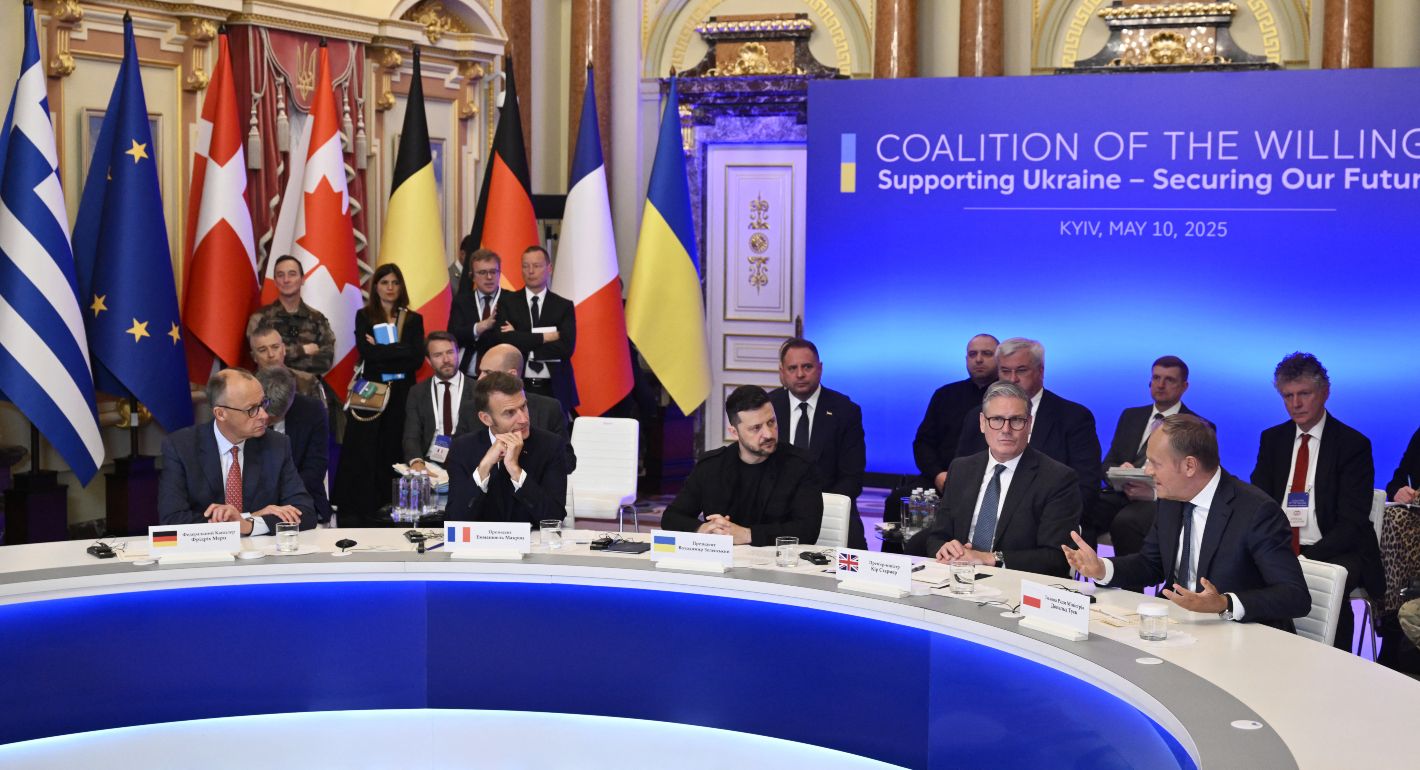
The meeting of EU leaders in Ukraine underscored their reliance on the United States for game-changing actions to end Russia’s war. But Europeans can influence military efforts on the ground, including interdicting Russian attacks over Kyiv and Western Ukraine.
We’re apparently at a “historic turning point” in Ukraine, where “a decisive step toward peace” was taken over the weekend. European leaders held a summit in Kyiv with the Ukrainian President Volodymyr Zelensky, and called U.S. President Donald Trump to coordinate further peace talks.
According to statements from the British, French, German, Polish, and Ukrainian leaders, either a thirty-day ceasefire starts immediately followed by direct negotiations between Ukraine and Russia, or Russia will face “massive” sanctions, coordinated with the United States, against its “banking and energy sectors, targeting fossil fuels, oil and the shadow fleet.”
To underline the transatlantic unity on this, these European leaders made a big show of their coordination with the United States by posting videos and pictures of themselves on calls with Trump.
Except, Trump promptly undermined the European ultimatum on Sunday. He once again put the onus on Ukraine to take an extra step and meet with the Russian side in Turkey, after Russian President Vladimir Putin suggested that in lieu of an immediate thirty-day ceasefire. By Monday evening, Trump was publicly toying around with crashing the Turkish meeting—even though Putin hadn’t yet committed to attending—and U.S. officials were scuttling imposing sanctions until after the event.
It was yet another instance of the Europeans shining a bright light on how dependent they remain on the United States for game-changing action, rather than taking it themselves. Instead of hollow ultimatums they cannot enforce, it is now time they create military facts on the ground that impose a ceasefire in at least parts of Ukraine.
Their calls for ramped up sanctions against Russia only raise legitimate questions. The first is why they haven’t been used over the past three years. Another one is why the EU has funded the Russian war effort as the fourth largest buyer of its oil and gas since the introduction of the G7’s price cap on Russian oil, while European taxpayers have shouldered the burden of this war.
Despite that, Europeans could actually shape the military realities on the ground in Ukraine much more than they have allowed themselves to. And they have practiced some impressive diplomacy since Trump’s inauguration in January.
Through deft diplomacy and leveraging personal relationships like the one between French President Emmanuel Macron and Trump, Europeans have managed to preserve open lines of communication with the United States and avoided a transatlantic clash that had been widely expected.
They have also guided Ukrainian officials with daily advice behind the scenes on everything, from communications to diplomacy, to help them repair their severely damaged relationship with the U.S administration after the blow-up between Trump, U.S. Vice President JD Vance, and Zelensky in the Oval office at the end of February.
And, with the arrival of the new German Chancellor Friedrich Merz to power, they have managed to build a strong core group with Poland and the Baltic and Nordic states in support of Ukraine, while also associating Turkey more closely into the European effort.
None of these accomplishments were a given in January, and by end of February they all seemed severely threatened. So, it is no small feat to be here in mid-May.
A mainstay of this diplomatic strategy has been to have turned Kyiv into the yes party: Anything Trump asks for, the Ukrainians are agreeing to, swallowing bitter pill after bitter pill.
This weekend, Ukraine announced for the third time that it accepts an unconditional thirty-day ceasefire. The first time was in March, after Ukrainian officials met with their U.S. counterparts in Saudi Arabia. The second was on the margin of the funeral of Pope Francis, in late April.
Zelensky went a step further announcing he was ready to meet with his Russian counterpart in Turkey on Thursday for negotiations, after Trump pressed him to. This is the second time in as many months that Ukraine has announced it is ready for direct negotiations with Russia.
The kink in that plan is that it relies on Trump, and his main aides and advisers, not only admitting that the party refusing to end the war is Russia—as it has always been since it launched its invasion in February 2022—but also exacting a prohibitive cost on Moscow as a result.
So far, at every setback, Trump has mostly blamed or increased pressure on Ukraine. And while U.S. Republican Senator Lindsey Graham has prepared a congressional bill with “bone-crushing” sanctions against Russia, there is scant indication that Trump is willing to go ahead just yet.
It was wishful thinking this weekend for European leaders to expect Trump to impose sanctions on Russia’s energy sector—which would threaten the price of oil and gas—while on a week-long high stakes tour of the Arab Gulf, in the first big foreign trip of his second mandate. Instead, by suggesting talks in Turkey, Putin may have—intentionally or not—provided Trump with the opportunity for a summit to end this war that he has been craving. That has trumped European calls for new sanctions, at least for now.
There is another play Putin may be going for: that the U.S. President simply walks away. Trump has increasingly shown signs that he is fed up with the headache of this mediation. Instead, he could choose to focus his political capital on negotiations with the Houthis, Iran, and trade talks with various countries that have so far provided him with quick splashy public relations wins.
If—or when— that happens, Europeans will have to deliver on all the expectations they have consistently raised over recent months with their talks of security guarantees and a “coalition of the willing.” And there is no reason they couldn’t. A good place to start, which would get both the attention and respect of the United States and push Russia to think twice about violating the ceasefire, would be to enforce a partial ceasefire by interdicting Russian attacks over Kyiv and Western Ukraine. This would not turn participant countries into belligerents; Instead, they would be acting within the legal authority of Article 51 of the UN Charter on the right of self-defense.

Editor in Chief, Strategic Europe
Rym Momtaz is the editor in chief of Carnegie Europe’s blog Strategic Europe. A multiple Emmy award-winning journalist-turned-analyst, she specializes in Europe and the Middle East and the interplay between those two spaces.
Recent Work
Rym Momtaz, ed.
Rym Momtaz
Carnegie does not take institutional positions on public policy issues; the views represented herein are those of the author(s) and do not necessarily reflect the views of Carnegie, its staff, or its trustees.

An overwhelming victory by a far-right-wing party in a small state in eastern Germany will have major repercussions for Chancellor Friedrich Merz’s coalition.

Judy Dempsey

Canadian Prime Minister Mark Carney has twice inspired praise for standing up to U.S. President Donald Trump: at the 2026 World Economic Forum in Davos and on Canada-U.S. trade negotiations. Is Carney showing a third way better than the EU has in dealing with the Trump administration?
Rym Momtaz, ed.

The EU’s responses to two recent incidents expose the gulf between European perceptions and capabilities. Unless the union can bridge that gap, it will never become a real geostrategic power.
Rym Momtaz

In supporting Europe’s far-right, MAGA and Russia both want the same thing: a weaker EU. Europe must defend itself without abandoning the openness these forces exploit.

Armida van Rij

As we close out another season of Strategic Europe, it is worth taking stock of the deep shifts underway.
Rym Momtaz