

Commentary
Thomas de Waal
{
  "authors": [
    "Thomas de Waal"
  ],
  "type": "commentary",
  "blog": "Strategic Europe",
  "centerAffiliationAll": "",
  "centers": [
    "Carnegie Endowment for International Peace",
    "Carnegie Europe"
  ],
  "collections": [
    "EU Integration and Enlargement",
    "Aso Tavitian Initiative"
  ],
  "englishNewsletterAll": "",
  "nonEnglishNewsletterAll": "",
  "primaryCenter": "Carnegie Europe",
  "programAffiliation": "",
  "programs": [],
  "projects": [],
  "regions": [
    "Georgia",
    "Caucasus",
    "Eastern Europe",
    "Europe"
  ],
  "topics": [
    "EU",
    "Democracy",
    "EU Enlargement"
  ]
}
Source: Getty
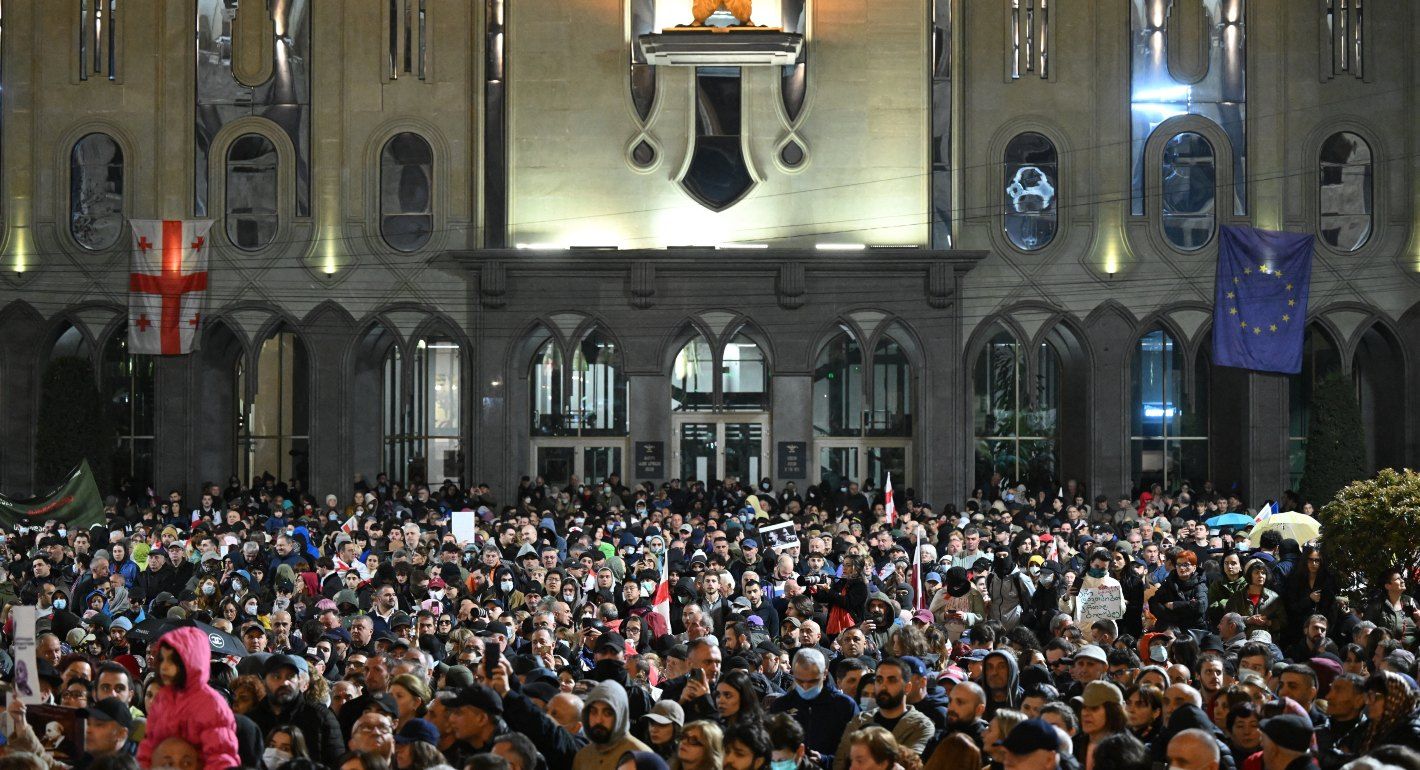
Since last year’s election, Georgia’s ruling party has rolled back democracy and sabotaged the country’s EU accession process. To avoid penalizing pro-European citizens, the union and its member states should focus punitive measures on a small group in the elite.
Away from the daily headlines, Georgia’s rapid retreat from democracy continues apace. This fall could be crucial in determining whether and how Europe can push back and impose costs on those who are taking the country backward.
Simply put, in what used to be a flawed but lively democracy, the ruling Georgian Dream party is entering full authoritarian mode and deliberately sabotaging the EU accession track Georgia embarked on a decade ago.
Georgian Dream is getting away with it, in part because it is dismantling Georgian democracy, steadily but carefully.
To deter pro-European antigovernment protests, the authorities have refined a new tactic that eschews a public display of force. Using Chinese facial-recognition technology, police identify demonstrators and hand out crippling fines of up to 5,000 laris, around €1,600 or $1,800, which is more than twice the average monthly salary in Georgia.
Around sixty people, including opposition politicians, street demonstrators, and the editor of an independent newspaper, are now in jail. They are essentially political prisoners. The country’s foreign-influence law is starting to curtail the activities of Georgia’s once-thriving nongovernmental sector. The ruling party is slowly beginning to put Georgian NGOs, think tanks, and independent media—which used to rely on foreign funding—out of business. Almost every week the government passes further legislation, which is virtually impossible to comply with.
In this dark picture, effective, politically savvy moves by the EU are essential to preserve the spirit of the European Commission’s 2023 offer to Georgia of candidate country status. Back then, in the words of Commission President Ursula von der Leyen, the EU moved to honor “the genuine aspirations of the overwhelming majority of its citizens to join the European Union”—not the actions of the government.
Brussels is a crucial external actor but has not yet come up with a big response. The problem is structural, not strategic. Those who work with Georgia directly, such as EU ambassadors, can see the daily deterioration before their eyes. But punitive steps have been foiled by vetoes from Georgia’s main European partner, Prime Minister Viktor Orbán’s Hungary.
Now the EU is threatening to suspend visa liberalization—visa-free travel to the EU—which half a million Georgians have enjoyed since 2017.
In July, Brussels sent Tbilisi a letter setting out benchmarks that need to be met for the policy to stay. This could be a big mistake—applying an outdated policy tool kit designed for a different kind of government in different times. Sure enough, Georgian Prime Minister Irakli Kobakhidze responded to the threat with open mockery.
The problem is that canceling visa-free travel would make the EU look principled, but at the cost of cutting off tens of thousands of Europeanized Georgians, whose European aspirations the bloc acknowledges. As the old medical joke goes, this could be a case where the operation was a success, but the patient died.
The EU still has a strong hand to play, as Georgian Dream is isolating itself. Its strategy is not the multivector hedging foreign policy of the authoritarian regime next door in Azerbaijan; domestic paranoia trumps geopolitics. Even if informal ties with Moscow have increased dramatically, the ruling party is burning bridges with Europe while not getting any obvious benefits from Russia in return. China, which the government claims is a trusted partner, has not delivered much either. There are big question marks over whether a purported deal for a Chinese state-owned company to develop a deepwater port at Anaklia on the Black Sea will materialize. Outreach to U.S. President Donald Trump’s administration, with claims about “full alignment in values,” has not yielded a positive U.S response either.
Moreover, Georgian Dream’s relative success rests on several factors, none of which is immutable. The government’s authoritarian project stands on flimsy foundations.
The party won a fourth term in office last year after manipulating the parliamentary election but also thanks to a divided and demoralized opposition, which is still failing to unite and mobilize. Now, half the opposition parties have decided to boycott next month’s local elections, which only undermines the chances of the other half, which decided to fight. That will probably cost them in Tbilisi’s mayoral race, where a unified candidate from the opposition would have had a good chance of success.
Georgian Dream also benefited from an economic spike caused by Russia’s war against Ukraine. Growth rates have soared thanks to an influx of Russian cash and a real-estate boom as well as the weakening U.S. dollar. But the downsides of this—a brain drain from both the public and the private sector, increased dependence on Moscow for gas and imports, a real-estate bubble that could burst—will only grow over time.
Polls show that Georgian voters overwhelmingly aspire to join the EU and care above all about unemployment and poverty. That means that they will surely tire of hearing increasingly extreme messages about culture wars and the awfulness of Europe. On July 18, Georgian Dream released its most bizarre statement yet, in which it accused a “Global War Party” of militarizing Europe and seeking violent regime change in Georgia.
Georgia’s new reality is the project of a very small group of people around the country’s de facto leader: Bidzina Ivanishvili, the billionaire businessman who founded Georgian Dream. Almost everyone else is a bystander. Threatening this group with specific punitive measures is the key to effecting change. One thing no government can change is that two generations of postindependence Georgians have been socialized into the idea that their destiny is in Europe and that their country should be a democracy.
If Brussels cannot take a lead, then EU member states need to step up. It is indicative that the country that has taken the toughest measures is the United Kingdom—one not bound by a consensus principle. France and Germany, where a lot of Georgian Dream officials hold assets, need to set the tone. Other European actions risk being attempts to solve the wrong problem.

Senior Fellow, Carnegie Europe
Thomas de Waal is a senior fellow at Carnegie Europe, specializing in Eastern Europe and the Caucasus.
Recent Work
Thomas de Waal
Thomas de Waal
Carnegie does not take institutional positions on public policy issues; the views represented herein are those of the author(s) and do not necessarily reflect the views of Carnegie, its staff, or its trustees.

With its public finances in shambles, the far right polling at 35 percent ahead of the 2027 presidential election, and a growing protest movement, is France’s crisis a threat to the EU’s geopolitical awakening?

Rym Momtaz, ed.

Ahead of a tough winter for Ukraine, Donald Trump’s swing back toward Russia bodes ill. But instead of panicking, Kyiv’s European allies are focusing on action.
Rym Momtaz

While the EU and European governments are embracing the much-lauded middle-power moment, this entails three difficult conundrums.

Richard Youngs

Much has been said of the changes Brussels is trying to make to the EU enlargement process. Here’s why gradual integration might—or might not—be the answer.

Dimitar Bechev

The European Commissioner for Trade is headed to China. But after President Xi’s bridge-building visit to Washington, can a more isolated EU overcome Beijing’s stranglehold on critical raw materials? Who will blink first?
Rym Momtaz, ed.