

Commentary
While the EU and European governments are embracing the much-lauded middle-power moment, this entails three difficult conundrums.
Richard Youngs
{
  "authors": [
    "Ceren Ergenc",
    "Chaofan Yu"
  ],
  "type": "commentary",
  "blog": "Strategic Europe",
  "centerAffiliationAll": "",
  "centers": [
    "Carnegie Endowment for International Peace",
    "Carnegie Europe"
  ],
  "englishNewsletterAll": "",
  "nonEnglishNewsletterAll": "",
  "primaryCenter": "Carnegie Europe",
  "programAffiliation": "",
  "programs": [],
  "projects": [],
  "regions": [
    "Europe",
    "China",
    "Southern, Eastern, and Western Africa",
    "South America",
    "Southeast Asia"
  ],
  "topics": [
    "EU",
    "Foreign Policy",
    "Trade"
  ]
}
Source: Getty
In competition with China’s Belt and Road Initiative, the Global Gateway strategy needs to find an edge. To better promote its interests through investment, the EU’s offer must become more coherent, transparent, and accountable.
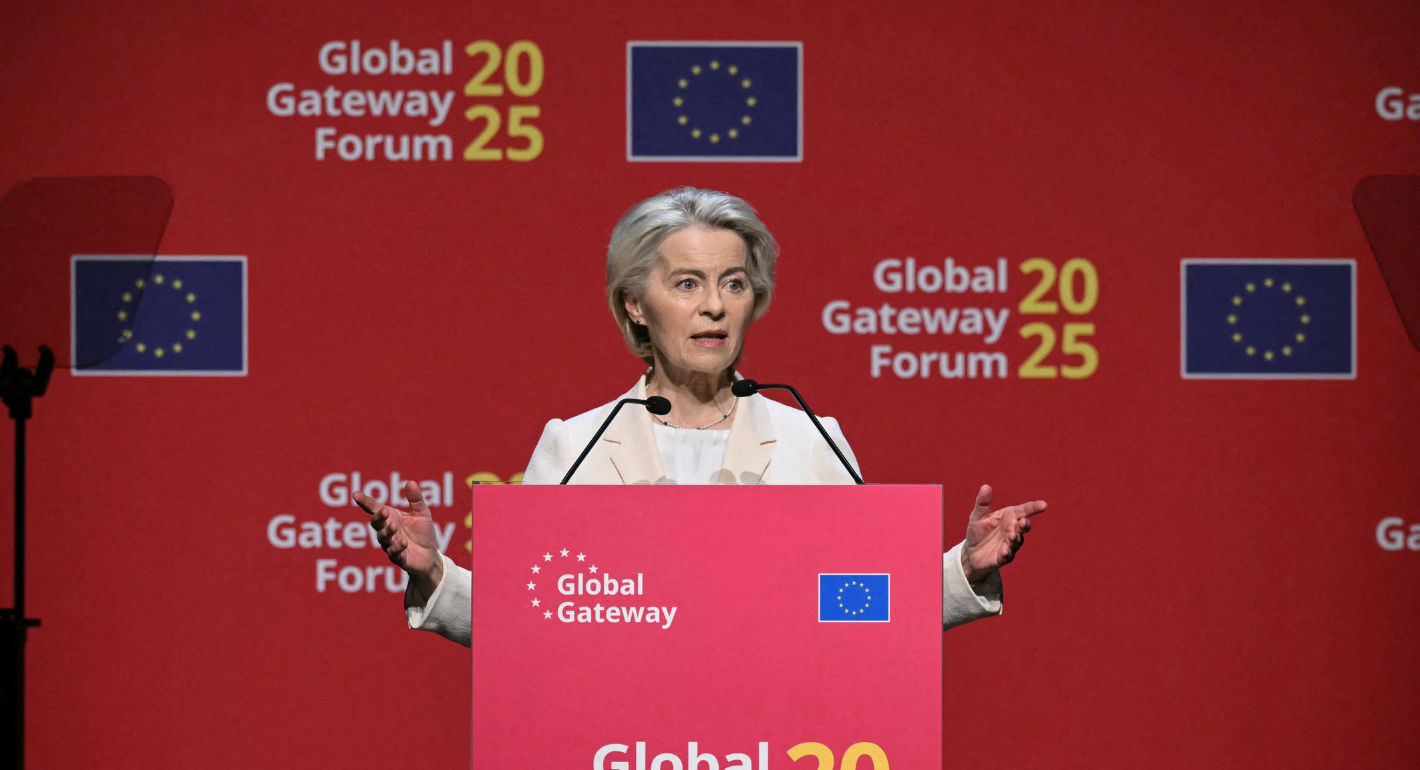
At the second Global Gateway Forum that took place on October 9–10, four years after the strategy’s launch, there was an effort to clarify the roadmap for stakeholders amid supply chain disruptions induced by the Covid-19 pandemic. While European participants left the event more satisfied, international partners were less convinced, because the EU’s offer is getting closer to the Chinese one at every turn. While that puts Brussels and Beijing in direct competition, so far Europe’s offer hasn’t been distinctive enough.
The EU initially identified five pillars for the Global Gateway: digital, energy, transport, health, and education. However, its limited impact in the early stages revealed that it had taken on too much, simultaneously remaining active in international development, the sustainability agenda, digital innovation, and the safeguarding of trade routes. This overextension left the initiative without a clear focus or message in an era of competing connectivity strategies, making its use and impact elusive to many, both within Europe and abroad.
Lately, the strategy has been at the center of debates over whether Europe should scale back its development role and prioritize competitiveness. The selection of flagship projects at this year’s forum focused mostly on two sectors: supporting emerging electrostate transitions and strengthening cybersecurity within the EU and among its partners. This was reflected throughout chosen digital and energy initiatives such as submarine cable networks, power grids, hydroelectricity projects, green shipping corridors, and electrification programs across the greater European neighborhood, as well as in Sub-Saharan Africa, Latin America and the Caribbean, and Southeast Asia.
The Global Gateway’s evolution toward a development through infrastructure model is the right direction, but so far it has not been fast enough to catch up with China’s Belt and Road Initiative (BRI). The EU faces a structural disadvantage by comparison, as Beijing’s policy feedback loop is much faster. However, the game is not lost before it begins: The Chinese projects are not monolithic, and there remains room for Europe to demonstrate its advantages.
Brussels is currently reforming the strategy’s governance structure not only to improve internal efficiency but also to better set it apart from the BRI. Flexible and blended finance tools introduced at the forum, along with the Global Gateway’s investment hub as a one-stop shop for potential investors, aim to produce innovation-heavy, sustainable, and financially sound projects. This aims to contrast Europe’s initiatives with large Chinese infrastructure investments that often lack technology transfer or skills training for local partners.
That is indeed how some still perceive the BRI, but in reality, Beijing has already moved on from this model, and Brussels needs to consider that to find its edge. The Made in China 2025 industrial upgrading strategy, launched in 2015, has since mobilized the BRI toward high-tech investments in the digital and green sectors. Its earlier cohort of digital and green projects followed in the footsteps of the large-scale infrastructure investments but proved too big to survive, mainly because new technologies were too costly to be sustainable, as illustrated by Egypt’s Benban Solar Park.
By the time the Global Gateway was launched in 2021, China was already rethinking its approach by introducing the “small and beautiful” strategy. This aimed to promote financially and managerially viable small-scale high-tech projects—such as the network currently developing under the umbrella of the Africa Solar Belt.
The BRI has been further amended through increased investment in environmental, social, and governance compliance monitoring expertise. This allows Chinese companies operating in the Global South to avoid outsourcing such services to European firms. As a result, BRI projects are now designed to meet all key criteria: innovativeness, financial stability, and sustainability.
As a result, the Chinese and European strategies are both becoming increasingly convergent in their industrial focus and implementation. China has proven capable of adjusting the BRI to improve its offerings as both initiatives respond to growing pressure from partner countries to promote genuine local growth and development.
While the Global Gateway refrains from explicitly referring to the BRI, such as comparison is inevitable since Beijing is present in virtually every sector and region where Brussels aims to expand.
Case in point, for nearly every flagship European project on African connectivity and energy transition, there is already a comparable Chinese initiative: China’s Benguela Railway competes with the EU’s Lobito Corridor; China’s Memve’ele and the EU’s Nachtigal hydroelectric power plants coexist in Cameroon; and China’s PEACE submarine cable and the EU’s Black Sea fiber-optic network are comparable.
But by bolstering its multiactor approach, which provides greater space for local communities in agenda-setting as well as in project design and implementation, the Global Gateway can find an edge and somewhat make up for its smaller funding and slower decision-making when compared with the BRI.
The EU’s next priority should be to establish a clear, single point of contact for the Global Gateway in each partner country. Rather than relying on union officials juggling multiple portfolios or dispersing responsibilities across separate offices for businesses, civil society, and other stakeholders, a dedicated coordination hub is needed. These offices would serve as the central node for matchmaking, dialogue, and participatory decisionmaking, ensuring coherence, transparency, and accountability in implementation.
Inclusivity will be the defining factor that sets Europe apart in the growing battle of offers for partnership in the Global South.
Ceren Ergenc is a research fellow at the Centre for European Policy Studies, where she works on China's domestic and overseas industrial policymaking, EU-Asia relations, and global connectivity initiatives.
Chaofan Yu is a PhD candidate at the University of Liverpool. She works on China's overseas investments and knowledge and technology transfer, with a particular focus on Africa.

Ceren Ergenc
Research Fellow, Centre for European Policy Studies
Ceren Ergenc is a research fellow at the Centre for European Policy Studies. She holds a PhD in Chinese politics from Boston University and works on China's domestic and overseas industrial policymaking, EU-Asia relations, and global connectivity initiatives.

Chaofan Yu
PhD Candidate, University of Liverpool
Chaofan Yu is a PhD candidate at the University of Liverpool. She works on China's overseas investments and knowledge and technology transfer, with a particular focus on Africa.
Carnegie does not take institutional positions on public policy issues; the views represented herein are those of the author(s) and do not necessarily reflect the views of Carnegie, its staff, or its trustees.

While the EU and European governments are embracing the much-lauded middle-power moment, this entails three difficult conundrums.

Richard Youngs

Much has been said of the changes Brussels is trying to make to the EU enlargement process. Here’s why gradual integration might—or might not—be the answer.

Dimitar Bechev

The European Commissioner for Trade is headed to China. But after President Xi’s bridge-building visit to Washington, can a more isolated EU overcome Beijing’s stranglehold on critical raw materials? Who will blink first?

Rym Momtaz, ed.

The domestic impacts of how long it is taking to end the war in Ukraine have pushed the French electorate to the political extremes and compromised the country’s diplomatic capacity.
Rym Momtaz

Before the next wave of EU enlargement takes place, the union needs to grapple with thorny questions of how power is distributed among its members.


Emil Sondaj Hansen, Ditte Brasso Sørensen