

Commentary
The EU can impose sanctions but struggles to enforce them without the United States. With Washington increasingly disinterested in backing European interests, the bloc must now fend for itself.
Nicu Popescu, Tiago Antunes
{
  "authors": [
    "Maksym Beznosiuk"
  ],
  "type": "commentary",
  "blog": "Strategic Europe",
  "centerAffiliationAll": "",
  "centers": [
    "Carnegie Endowment for International Peace",
    "Carnegie Europe"
  ],
  "englishNewsletterAll": "",
  "nonEnglishNewsletterAll": "",
  "primaryCenter": "Carnegie Europe",
  "programAffiliation": "",
  "programs": [],
  "projects": [],
  "regions": [
    "Europe",
    "China",
    "Russia",
    "Ukraine"
  ],
  "topics": [
    "Security",
    "EU",
    "Foreign Policy"
  ]
}
Source: Getty
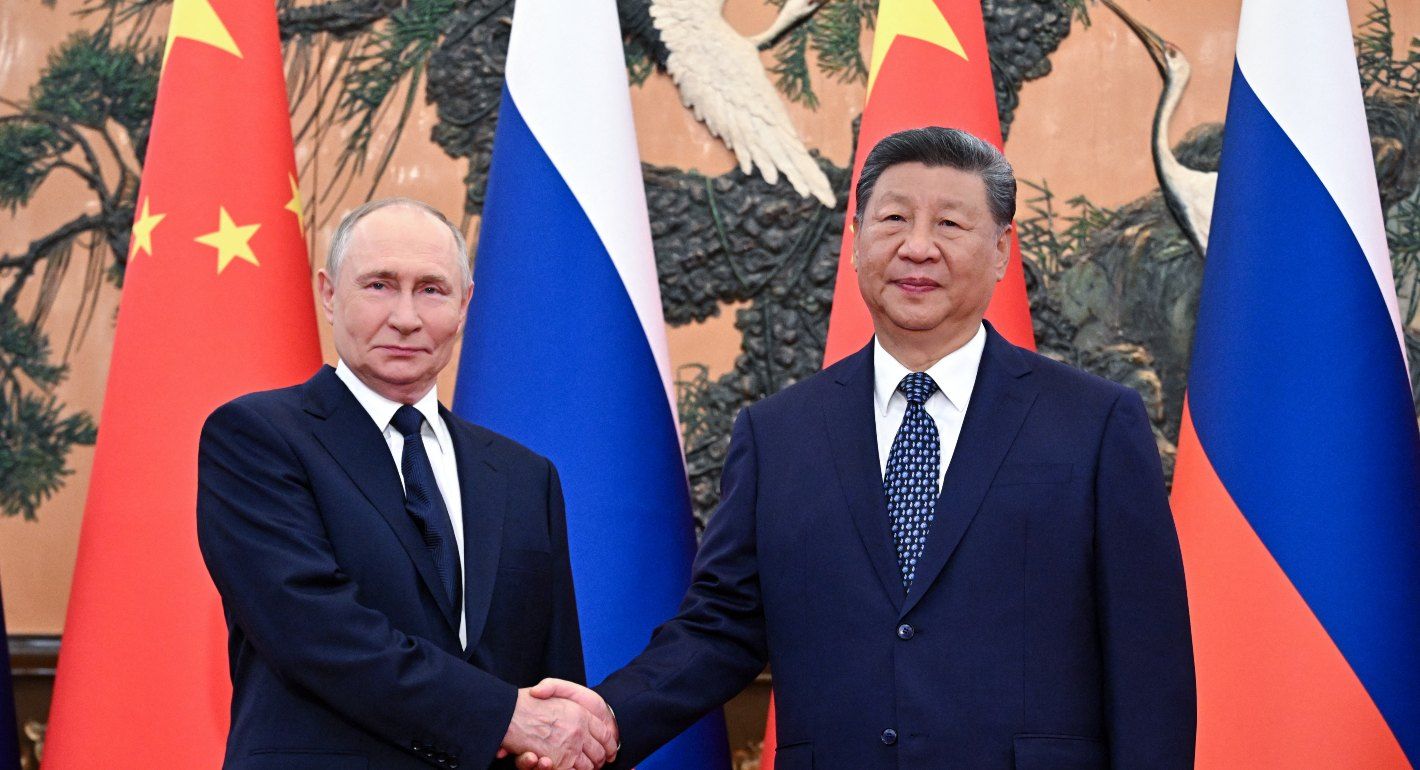
China plays an increasingly active role in the Kremlin’s hybrid war against Europe. The EU must confront this growing China-Russia cooperation, as it poses grave threats to both European security and economic resilience.
Both Europe and the United States are getting impatient with China over Ukraine. It is now clearer than ever that Beijing emboldens Russia to continue its war of aggression by providing Moscow with both military and economic assistance. And yet, Europe's active punitive measures against China still lag far behind its critical words.
On October 27, European Council President António Costa met Chinese Premier Li Qiang. He voiced Europe’s dissatisfaction with China's tightening export controls on critical raw materials and related goods and technologies, urging Beijing to contribute to ending Russia’s war in Ukraine. As Costa stated, “I expressed the EU’s expectation that China helps to put an end to the war.”
On October 30, Chinese President Xi Jinping and U.S. President Donald Trump met to discuss trade and other matters, including Ukraine. Afterward, Trump told reporters that “Ukraine came up very strongly,” adding they agreed to “work together to see if [they] can get something done.” He also remarked that “they are fighting and sometimes, you have to let them fight,” underscoring that the meeting yielded no concrete progress.
Both these meetings reveal a widening gap between Western hopes for closer cooperation with China and the grim reality of its deepening strategic alignment with the Kremlin.
European leaders need to recognize the true and extended nature of a partnership between Beijing and Moscow that fuses military, economic, technological, and informational tools to exhaust Ukraine militarily. In essence, Beijing evidently views the war in Ukraine as a way to tie down U.S. and European resources while keeping a China-friendly, anti-Western regime in the Kremlin in place.
Since 2022, China’s trade and financial support has been the backbone of Russia’s wartime resilience. Despite a minor slowdown this year, bilateral trade is projected to reach $230 to $235 billion by the end of the year, after a record $245 billion in 2024. Currently, nearly one-third of Russia’s external trade is settled in yuan, up from only 2 percent before the Russian invasion of Ukraine. This shift has transformed the Chinese currency into an instrument of sanctions evasion. According to Germany’s Foreign Ministry, up to 80 percent of Russia’s sanctions circumvention now involves Chinese entities. By allowing the Kremlin to finance aggression, China gains an economic advantage by tying Russia’s economy to its own.
China also supports the Kremlin’s covert hybrid activities aimed at undermining European economic resilience and cohesion. Since 2024, Chinese ships have been involved in incidents of targeting subsea infrastructure, particularly cutting subsea cables in the Baltic Sea.
The country increasingly deploys ambitious espionage and cyber attacks against government networks and critical infrastructure across Europe. These attacks seem to overlap with—or even be actively coordinated with—Russia’s espionage and influence operations across Europe.
Beijing also provides Moscow with high-tech military aid. Since mid-2025, Chinese components have been detected in Russian drones and missiles, often shipped via front companies disguised as suppliers of industrial cooling equipment. Last month, U.S. Treasury Secretary Scott Bessent voiced concerns over these components and said that Washington would soon release photo evidence stipulating China’s growing involvement in the war in Ukraine. Also, new evidence emerged showing that Chinese satellite intelligence was aiding Russian missile targeting.
Chinese machinery, including precision optics, lasers, and dual-use machine tools, now dominates Russia’s defense-related manufacturing. In August 2025 alone, China exported a record 328,000 miles of fiber-optic cable and nearly $50 million worth of lithium-ion batteries to Russia, reinforcing its role as the Kremlin’s primary wartime supplier of dual-use materials. Chinese engineers working at Russian drone facilities are adapting civilian quadcopters, such as the Autel Max 4T, for combat use.
Increasingly, Russia and China also cooperate in disinformation operations: Chinese campaigns such as “Spamouflage” are amplified by Russian media outlets and diplomatic channels. Both countries employ what look to be synchronized narratives accusing the West of being responsible for the war in Ukraine. Most worryingly, both Moscow and Beijing have begun to deploy generative AI and fake news portals to manipulate the information environment and reinforce each other’s messages, often without formal coordination.
If EU and U.S. leaders do not react decisively to these threats, Beijing’s economic and technological support will continue to undermine the Western sanctions regime on Russia and allow it to prolong its war in Ukraine.
Western leaders must coordinate more closely on sanctions policy to prevent new loopholes and ensure unified enforcement. The EU should demonstrate its intent by imposing secondary sanctions on Chinese computer numerical control machines, semiconductors, drone engines, optics, and missile components, and by regularly updating its methods to address new forms of sanction evasion.
As nearly half of Russia’s external trade is denominated in yuan, financial measures will help demonstrate to Beijing that the EU is serious. Brussels has already taken initial steps, blacklisting Chinese firms involved in dual-use exports and targeting banks that facilitate yuan-denominated payments. On September 1, China’s Heihe Rural Commercial Bank halted Russian transactions after it fell under EU sanctions, which proved the effectiveness of this kind of action against Chinese involvement in fueling the Kremlin’s war efforts. Europe can go further by monitoring yuan clearinghouses and sanctioning Chinese banks that facilitate Russian payments.
The hybrid campaign stretches from Europe into Asia. Europe should formalize deeper security cooperation with Japan, South Korea, Australia, Taiwan, and other democracies to police dual-use supply chains, share cyberthreat intelligence, and improve maritime domain awareness for undersea cables.
China’s partnership with Russia has become a central pillar of Moscow’s aggression against Ukraine and a direct threat to Europe’s security and economy. European and U.S. leaders must act decisively because, as long as Beijing offsets the effects of Western pressure, the Kremlin will continue waging war at reduced cost.
Maksym Beznosiuk is a strategic policy and security analyst and writer.

Maksym Beznosiuk
Analyst, Strategic Policy and Security
Maksym Beznosiuk is an analyst focusing on Ukraine, Russia, and international security and an associate fellow at GLOBSEC.

The EU can impose sanctions but struggles to enforce them without the United States. With Washington increasingly disinterested in backing European interests, the bloc must now fend for itself.


Nicu Popescu, Tiago Antunes

Russia is testing the waters of NATO’s mutual defense clause. What do strikes in Romanian territorial waters mean for the alliance’s posture toward Moscow?

Dimitar Bechev

With its public finances in shambles, the far right polling at 35 percent ahead of the 2027 presidential election, and a growing protest movement, is France’s crisis a threat to the EU’s geopolitical awakening?

Rym Momtaz, ed.

Ahead of a tough winter for Ukraine, Donald Trump’s swing back toward Russia bodes ill. But instead of panicking, Kyiv’s European allies are focusing on action.
Rym Momtaz

While the EU and European governments are embracing the much-lauded middle-power moment, this entails three difficult conundrums.

Richard Youngs