

Report
- +9
Richard Youngs, Erik Jones, Dan Baer, …
{
  "authors": [
    "Rosa Balfour"
  ],
  "type": "commentary",
  "blog": "Strategic Europe",
  "centerAffiliationAll": "",
  "centers": [
    "Carnegie Endowment for International Peace",
    "Carnegie Europe"
  ],
  "englishNewsletterAll": "",
  "nonEnglishNewsletterAll": "",
  "primaryCenter": "Carnegie Europe",
  "programAffiliation": "",
  "programs": [],
  "projects": [],
  "regions": [
    "United States",
    "Europe",
    "Venezuela"
  ],
  "topics": [
    "Foreign Policy",
    "Global Governance",
    "EU"
  ]
}
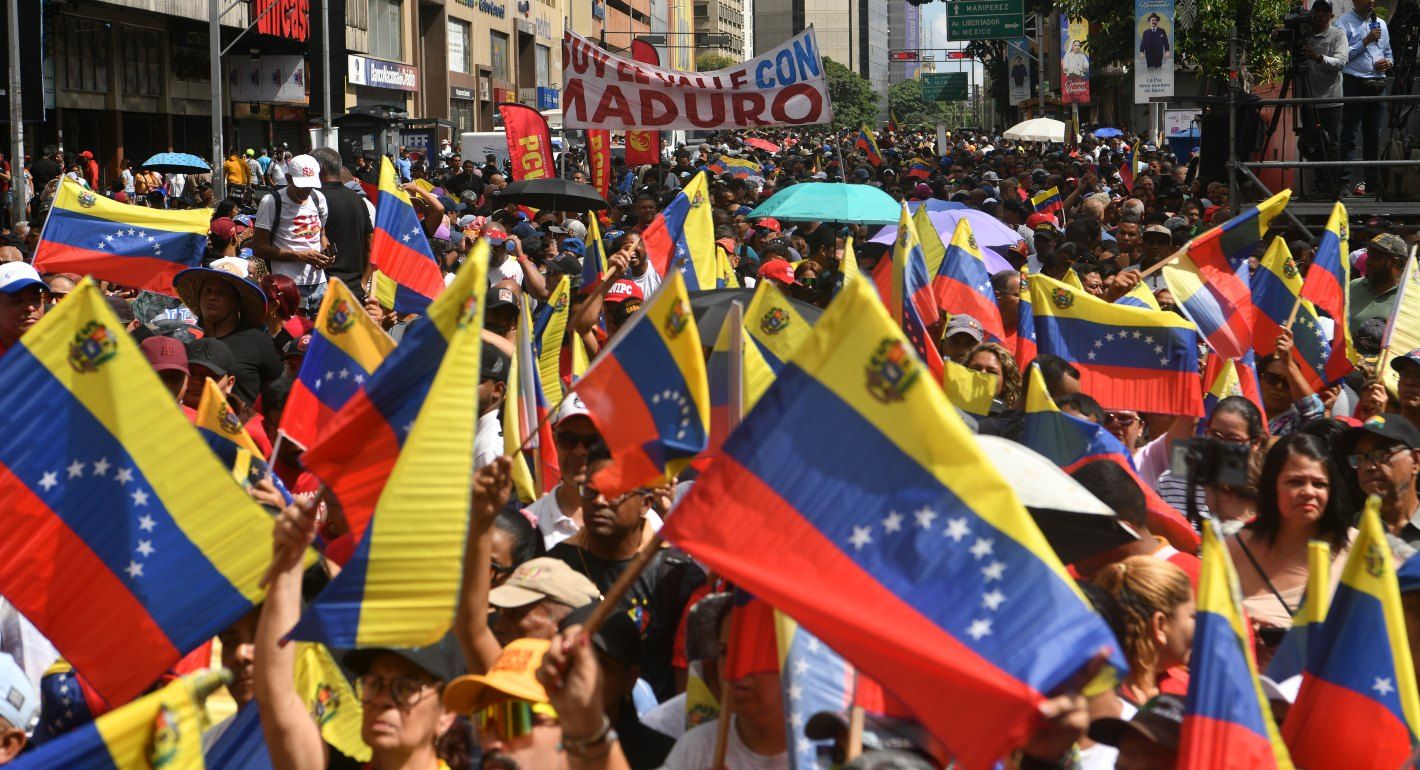
Source: Getty
International rules are only as strong as the democratic states supporting them. In the wake of the U.S. military operation in Venezuela, Europeans have a vested interest in making a compelling case for international law but shy away from doing so.
The United States violated both international and domestic law with the abduction of Venezuela’s authoritarian leader Nicolás Maduro. The operation, following months of bombardments against small vessels in the Caribbean Sea, starkly shows that the erosion of democracy at home and the rules-based order are two sides of the same coin.
International law has always been fragile, selectively applied, and reflective of power and interests, not just norms and ideals. Even an imperfect application of these principles requires the support of democratic states and international institutions. Yet most European responses to U.S. action have failed to offer that necessary defense.
Aside from more explicit statements from France, Norway, and Spain, most European governments have glossed over U.S. President Donald Trump’s breach of international law, accepting the situation as a fait accompli, and merely expressing a hope that international norms and the democratic aspirations of the people of Venezuela will now be considered. The end result is a now-familiar compromise between trying to avoid the U.S. president’s ire and repeating the usual checklist of principles. It is the story in a nutshell of European handling of the Trump’s second administration in 2025.
The muted European responses reflect the overbearing shadow of Washington’s influence on the continent, triggered by fears that Greenland will be the next stop for Trump’s adventurism or of the dire consequences of U.S. abandonment of Ukraine.
Some argue that supporting the rules-based order is a sign of weakness and naivety. The geopolitical times have changed, the argument goes: Align with the powerful and junk the principles of the old international order.
Others will argue that Trump’s action in Venezuela is just another episode in a long record of the flouting of international law, from the invasion of Iraq to the recent strikes in Iran, not to speak of the two-hundred-year history of U.S. military interventionism in Latin America. According to this view, U.S. action is morally no different from Russia in Ukraine or Israel in Gaza, the international order never really existed, and clinging to its dusty principles is a denial of reality.
But there are plenty of strategic and pragmatic reasons for Europe to stand up more robustly for international norms in the world Washington is rapidly ushering in. The military operation in Venezuela is an application of the recent U.S. National Security Strategy, with its “Trump corollary” to the Monroe Doctrine to “restore American preeminence in the Western sphere.”
U.S. Secretary of State Marco Rubio, who has retro-justified the operation in Venezuela as one against drug trafficking, sees the Western hemisphere as a space for legitimate U.S. action regardless of international law. This reflects a spheres of influence view of geopolitics, in which great powers assert control over and permit territorial revisionism in their respective neighborhoods: Russia in Eastern Europe, China over the South China Sea, and the United States in the Western hemisphere.
The European Union exercises some kind of sphere of influence on the European continent thanks, among other things, to its ability to attract new members. But it needs to be able to govern this space according to its democratically and collectively decided rules and constitutions, rather than be shaped by U.S. civilizational ideology or Big Tech. It needs to uphold the UN Charter to protect Greenland and Denmark, to ensure Ukraine’s fate is rooted in international law and justice, to manage relations with partners such as the UK, and to carry forward the ambitions of its future enlargement to the Balkans, Ukraine, and Moldova.
Territorial revisionism in Europe without international principles and a rules-based playing field for negotiation could unleash potentially disastrous consequences not just in fragile divided regions such as the Balkans and South Caucasus, but also for existing EU members whose constitutional status is still contested, such as Cyprus, or even the UK and Spain.
A second strategic reason why Europeans should steadfastly support international principles is to build better relations with countries of the so-called Global South. European rhetorical messaging toward them is steeped in UN Charter-derived language but the practical application of those principles leaves much to be desired, to put it kindly. Europe’s credibility in the world has been long eroded and that has endangered its search for partners in supporting Ukraine, and its quest for new trading partners as the United States remodels the global economy around its protectionist interests.
The EU has always been torn between a regional and global focus. It has recently tilted toward the former, but the geopolitical and economic reality is that this is a false choice. If the United States is embracing spheres of influence and Russia and China multipolarity, Europeans need to forge deeper ties with like-minded countries across the world, which promote new approaches to climate change, international justice, and economic development. Above all, Europeans need to be far more open to reforming the international system to make it more inclusive.
A further reason to uphold the principles of the rules-based order is to reclaim the language of rights and democracy from those who now misuse it. Ex post facto justifications of Maduro’s ousting ranged from his lack of democratic legitimacy to his role in narcotrafficking, for which the first Trump administration had already indicted him.
U.S. Vice-President JD Vance’s Munich speech in February 2025 and the U.S. National Security Strategy are littered with references to freedom of speech and political liberty emptied of their original meaning. President Trump’s language of deals has turned diplomacy and mediation into a business transaction. Pro-Russian politicians in Europe use the word “peace” as a synonym for Ukraine’s capitulation.
The creeping capture of the language of international principles and human rights risks both emptying these norms of their foundational value and depriving those actors committed to upholding those principles of arguments to pursue their cause. The consequences of the erosion of democratic norms at home and abroad will outlast the present European fear of—or attraction to—sphere-of-influence geopolitics.

Director, Carnegie Europe
Rosa Balfour is the director of Carnegie Europe. Her fields of expertise include European politics, institutions, and foreign and security policy.
Recent Work


Richard Youngs, Erik Jones, Dan Baer, …

Rosa Balfour, Stefan Lehne, Elena Ventura
Carnegie does not take institutional positions on public policy issues; the views represented herein are those of the author(s) and do not necessarily reflect the views of Carnegie, its staff, or its trustees.

While the EU and European governments are embracing the much-lauded middle-power moment, this entails three difficult conundrums.
Richard Youngs

Much has been said of the changes Brussels is trying to make to the EU enlargement process. Here’s why gradual integration might—or might not—be the answer.

Dimitar Bechev

The European Commissioner for Trade is headed to China. But after President Xi’s bridge-building visit to Washington, can a more isolated EU overcome Beijing’s stranglehold on critical raw materials? Who will blink first?

Rym Momtaz, ed.

The domestic impacts of how long it is taking to end the war in Ukraine have pushed the French electorate to the political extremes and compromised the country’s diplomatic capacity.
Rym Momtaz

Before the next wave of EU enlargement takes place, the union needs to grapple with thorny questions of how power is distributed among its members.


Emil Sondaj Hansen, Ditte Brasso Sørensen