

{
  "authors": [
    "Thomas Carothers",
    "Ivo Daalder",
    "Morton Halperin",
    "Tod Lindberg"
  ],
  "type": "event",
  "centerAffiliationAll": "",
  "centers": [
    "Carnegie Endowment for International Peace"
  ],
  "collections": [],
  "englishNewsletterAll": "",
  "nonEnglishNewsletterAll": "",
  "primaryCenter": "Carnegie Endowment for International Peace",
  "programAffiliation": "",
  "programs": [],
  "projects": [],
  "regions": [
    "North America",
    "United States"
  ],
  "topics": [
    "Political Reform",
    "Democracy",
    "Foreign Policy"
  ]
}
Is the League of Democracies a good idea?
Thu, May 29th, 2008
Washington, D.C.
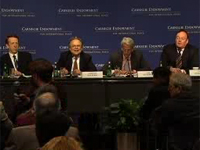
Is the League of Democracies a good idea? Thomas Carothers from the Carnegie Endowment argues that it is not given the lack of appetite in the world right now for the idea. The greatest challenges the United States faces—including nuclear proliferation, energy, Iraq, Middle East peace, and climate change—all require close U.S. cooperation with autocratic regimes, who would be antagonized and alienated by the creation of such a League. Furthermore, democracies, particularly non-Western democracies, maintain deep legitimate differences with the United States and other democracies on foreign policy. The weak record of the Community of Democracies should serve as a cautionary warning about the prospects of such an institution.
Two proponents for a League of Democracies, Ivo Daalder from the Brookings Institution and Tod Lindberg from the Hoover Institution, defended the idea. Daalder asserts that in a globalized world, international cooperation is necessary, but international institutions are falling short. As a result, a needed institution is one based on the broad idea that democracies share much in common and are the natural partners of the United States. As with the processes of socialization that occurred within NATO and the European Union, such an institution would also over time help democracies align more closely.
Lindberg added that there is a substantial relationship between regime type and foreign policy behavior, as demonstrated by evidence for the democratic peace thesis. Moreover, there is a will amongst democracies to increase cooperation that is inadequately served by current international institutions. Empowering the Community of Democracies, such as through a formal treaty process, would be a step in the right direction.
Morton Halperin from the Open Society Institute moderated the discussion.
Carnegie does not take institutional positions on public policy issues; the views represented herein are those of the author(s) and do not necessarily reflect the views of Carnegie, its staff, or its trustees.
Event Speakers
Harvey V. Fineberg Chair for Democracy Studies; Director, Democracy, Conflict, and Governance Program

Thomas Carothers, director of the Carnegie Endowment for International Peace’s Democracy, Conflict, and Governance Program, is a leading expert on comparative democratization and international support for democracy.
Ivo Daalder
Ivo Daalder is president of the Chicago Council on Global Affairs.
Morton Halperin
Tod Lindberg