

Commentary
Thomas de Waal
{
  "authors": [
    "Thomas de Waal"
  ],
  "type": "commentary",
  "centerAffiliationAll": "",
  "centers": [
    "Carnegie Endowment for International Peace",
    "Carnegie Europe",
    "Carnegie Russia Eurasia Center"
  ],
  "collections": [],
  "englishNewsletterAll": "",
  "nonEnglishNewsletterAll": "",
  "primaryCenter": "Carnegie Europe",
  "programAffiliation": "",
  "programs": [],
  "projects": [],
  "regions": [],
  "topics": []
}
Source: Getty
Turkey is not alone in having mutually incompatible elements of its history on display side by side, such as graves honoring Armenians and a man who had them murdered. But it is a sign of unresolved contradictions.
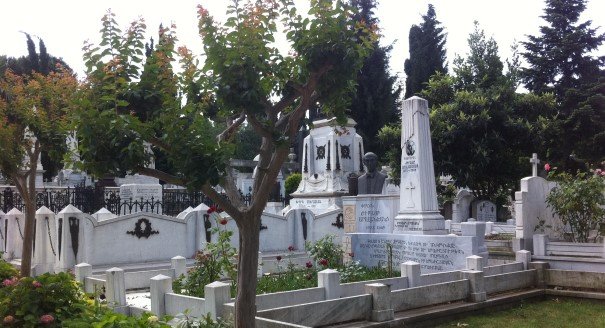
Tombstones have a story to tell. Last week in Istanbul, after attending an Armenian-Turkish conference, I went to the district of Şişli to visit some graves.
First, the big Armenian cemetery in Şişli. It is a lovely island of quiet in Europe’s biggest city, overlooked by the Trump Tower and the Hilton, but full of beautifully kept white marble tombs, roses and pine-trees and white catalpa trees.
The cemetery is a reminder that not all Armenians were murdered or deported from the Ottoman empire in 1915. A small minority remained in Istanbul and lived to die of old age in the 20th century. Some of them served the Turkish state, though half-suppressing their Armenian identity as they did so.
Only half a mile away is a more abandoned spot, hidden by a metal fence and pounded by the roar of an eight-lane highway. At the top of a small mound is the Monument of Liberty (or by its Ottoman name, Abide-i Hürriyet), the marble sculpture of a cannon. It is all that is left to commemorate the unlamented revolution of 1908 which brought the Young Turks to power in Istanbul.
The two most infamous Young Turks are buried here: Enver Pasha who led Ottoman armies to disastrous defeat in World War I and Interior Minister Talaat Pasha who will go down in history as the man who ordered the destruction of the Ottoman Armenians in 1915.
Turkey is not alone in having mutually incompatible elements of its history on display side by side, such as graves honoring Armenians and a man who had them murdered (and there are many Talaat Pasha streets in Istanbul as well). Russia has the same schizophrenic attitude to its history.
But it is a sign of unresolved contradictions. The governing AK Party has opened up Turkish history as never before, particularly when it comes to the Kurdish question. And it has given Istanbul’s 50,000 Armenians more rights than they ever had before under the Turkish Republic.
However, the current Islamist governing party still has a long way to go in recognizing the historical sufferings of Christians and Alevi Shiites, as well as the fears of Turkish secularists (see Taksim Square today). Its version of Turkish identity is more inclusive than that of its predecessors, but it still honors some Turkish citizens more than others.

Senior Fellow, Carnegie Europe
Thomas de Waal is a senior fellow at Carnegie Europe, specializing in Eastern Europe and the Caucasus.
Recent Work
Thomas de Waal
Thomas de Waal
Carnegie does not take institutional positions on public policy issues; the views represented herein are those of the author(s) and do not necessarily reflect the views of Carnegie, its staff, or its trustees.