

In The Media
Lilia Shevtsova
{
  "authors": [
    "Lilia Shevtsova"
  ],
  "type": "commentary",
  "centerAffiliationAll": "",
  "centers": [
    "Carnegie Endowment for International Peace",
    "Carnegie Russia Eurasia Center"
  ],
  "collections": [],
  "englishNewsletterAll": "",
  "nonEnglishNewsletterAll": "",
  "primaryCenter": "Carnegie Russia Eurasia Center",
  "programAffiliation": "",
  "programs": [],
  "projects": [],
  "regions": [],
  "topics": []
}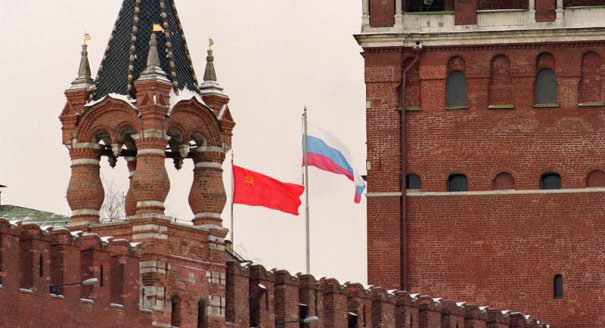
Source: Getty
Russia’s declaration of independence and the dissolution of the Soviet Union in reality helped the system of personalized power to survive in a new incarnation.
Imagine that the UK chose its Independence day the day it lost the United States as its colony or that Turkey decided to celebrate its independence from the Ottoman Empire, or that France would celebrate its liberation from Algeria! Bizarre?! Schizophrenic?! Meanwhile, Russia on June 12 celebrates acquiring its sovereignty trying not to raise the uncomfortable question—sovereignty from whom? From the Soviet Union? But the Soviet Union was exactly Russia, only under a different name. From its former colonies—the Baltics, Central Asia, and Ukraine?
One would say: “C’mon! There are hundreds of historical paradoxes, inconsistencies, and myths that have to compensate for the lack of a solution.” Correct! However, the problem with the Russian Independence Day is that it became the beginning of a chain of mystifications that have buried Russia in their quagmire and make today’s Russia one big Conundrum! Let me mention only several of them. Russia’s declaration of independence and the dissolution of the Soviet Union in reality helped the system of personalized power to survive in a new incarnation, with Yeltsin as its embodiment. Usually the collapse of the old state helps the transformation of the regime and the system of rule—in the Russian case it went the other way. With respect to the sovereignty declaration, it was mainly meant by the Russian political elite to get rid of Gorbachev and to take over control of the Soviet resources and instruments of power.
Another mystification. The Russian independence helped to freeze the leftovers of the Soviet empire in the form of the Russian Federation. Current Russian state is not a nation state, nor a true empire but something vague and amorphous—the swamp with old habits stuck in the interstitial civilizational space. The construct can survive only by returning back to the past, which it is being done now by Putin who is turning to repressive regime trying to prolong the Russian Matrix.
Beginning that disguised continuity as the revolution gave birth to a treacherous trajectory of a “new” Russia—with its liberals serving the personalized ruler, its reforms helping to monopolize power and property, its “democracy” camouflaging the authoritarianism, its cooperation with the West that has been followed by an anti-Western consolidation of the society.
In order to start thinking on how to transform the Russian “swamp,” we have for starters to realize what the beginning of the story was.
Former Senior Associate, Russian Domestic Politics and Political Institutions Program, Moscow Center
Shevtsova chaired the Russian Domestic Politics and Political Institutions Program at the Carnegie Moscow Center, dividing her time between Carnegie’s offices in Washington, DC, and Moscow. She had been with Carnegie since 1995.
Recent Work
Lilia Shevtsova
Lilia Shevtsova
Carnegie does not take institutional positions on public policy issues; the views represented herein are those of the author(s) and do not necessarily reflect the views of Carnegie, its staff, or its trustees.