

In The Media
Lilia Shevtsova
{
  "authors": [
    "Lilia Shevtsova"
  ],
  "type": "commentary",
  "centerAffiliationAll": "",
  "centers": [
    "Carnegie Endowment for International Peace",
    "Carnegie Russia Eurasia Center"
  ],
  "collections": [],
  "englishNewsletterAll": "",
  "nonEnglishNewsletterAll": "",
  "primaryCenter": "Carnegie Russia Eurasia Center",
  "programAffiliation": "",
  "programs": [],
  "projects": [],
  "regions": [],
  "topics": []
}
Source: Getty
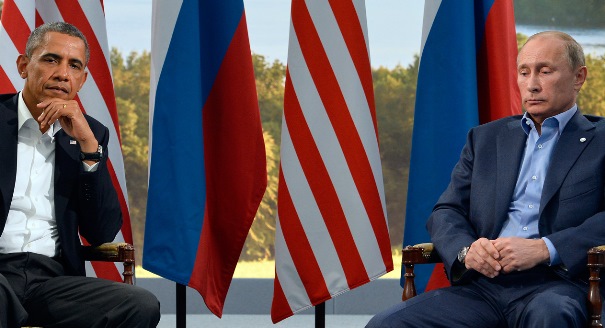
Both America and Russia have turned from the Yalta legacy of the “areas of influence” and interference in domestic affairs of other states to noninterference even in the case of mass slaughter.
Walter Russell Mead, a sensitive observer, one of the best too because of his ability to see the civilizational component of geopolitics, wrote in his last column in the American Interest, “The Russia-U.S. deal that the WH [White House] wants to spin as a win contains no mention of Assad leaving power, much less facing international justice for a massacre involving chemical weapons. The precedent is now set that, if it has Russia’s support at the UN, a rogue regime can gas its own people and emerge in a stronger diplomatic position. Unless something changes this new status quo, the use of chemical weapons in a civil war is no longer a grave crime against humanity. It is more of a violation, like a speeding ticket.”
I will push the ball further and would argue that the new status quo does not limit itself to the Middle East situation. This is not a temporary solution either. We have a new foreign policy paradigm. This paradigm provides face saving for the key international actors when they confront a challenge that they cannot respond to.
In the previous, “ideological,” era both America and Russia pursued their agenda using the Yalta legacy of the “areas of influence” and interference in domestic affairs of other states. Today in an “era of pragmatism,” as Syria shows, they have turned to noninterference even in the case of mass slaughter. This annihilates the OSCE principle according to which the issues of human rights, basic freedoms, democracy, and rule of law cannot be viewed as only internal issues of the state. But who cares! We are pragmatists now. Forget about “Responsibility to Protect,” too!
This does not mean that Yalta will be forgotten. The “areas of influence” approach still is the best technique to expand the influence of the two remaining empires—one liberal and the other autocratic. Whereas, the “noninterference” mechanism works better if the predatory regime has to be saved. There is no doubt as to who the beneficiary of the second approach could be.
Indeed, one would say it is Vladimir Putin, who is the author of the new “noninterference Doctrine.” However, this Doctrine could be traced to the “de-linkage” principle which justified delinking foreign policy from domestic developments and was the foundation of Obama’s “reset.” True, the end of “reset” hardly could be viewed as a convincing success.
But in any case, we need to give due to both Founding Fathers of the concept that could be called the “Obama-Putin Doctrine.” We do not have to wait long to see its results.
Former Senior Associate, Russian Domestic Politics and Political Institutions Program, Moscow Center
Shevtsova chaired the Russian Domestic Politics and Political Institutions Program at the Carnegie Moscow Center, dividing her time between Carnegie’s offices in Washington, DC, and Moscow. She had been with Carnegie since 1995.
Recent Work
Lilia Shevtsova
Lilia Shevtsova
Carnegie does not take institutional positions on public policy issues; the views represented herein are those of the author(s) and do not necessarily reflect the views of Carnegie, its staff, or its trustees.